Table of Contents
QUICK ANSWER
Retail video analytics is the use of AI-powered computer vision on existing CCTV cameras to count footfall, measure dwell time, monitor staff and SOP compliance, and trigger real-time alerts that drive same-day store decisions. In 2026, leading Indian retailers are moving beyond passive dashboards toward autonomous retail video analytics that closes the loop between detection, decision, and floor action — without adding cameras or headcount.
Every retailer in India already has data. What most still do not have is a way to act on that data inside the same shift. Retail video analytics is the single technology layer closing that gap in 2026 — turning the 50–500 IP cameras already running inside a typical Indian retail store into an autonomous decision engine that nudges floor staff, opens checkout counters, flags shrinkage patterns, and protects margin in real time.
This guide breaks down what retail video analytics actually is in 2026, why traditional CCTV is no longer sufficient for Indian retail, and the eight autonomous use cases that India’s most data-driven retail chains are deploying right now to lift conversion, cut shrinkage, and protect every rupee of customer acquisition cost they have already spent. For a technology overview, see our complete guide to retail video analytics.
Real numbers from active retail video analytics deployments across Indian retail chains, supermarkets, and apparel networks.


What Is Retail Video Analytics?
Retail video analytics is a software layer that sits on top of a retailer’s existing IP camera or CCTV infrastructure and uses computer vision plus deep learning models to extract operational and customer intelligence from live video feeds in real time. Instead of treating cameras as passive recording devices, modern retail video analytics treats every camera as a 24/7 sensor that detects, classifies, and routes events to the right person — store associate, floor manager, regional ops head, or loss prevention team — within seconds.
A modern AI-powered video analytics platform built for retail can simultaneously run footfall counting, demographic estimation, dwell time analysis, queue measurement, heatmap generation, staff-to-customer ratio tracking, shrinkage pattern detection, SOP compliance scoring, and zone-level alerting — all from the same RTSP camera streams the retailer is already paying to record.
Retail video analytics in 2026 is no longer a single capability. It is an operating layer for the physical store, just as web analytics became the operating layer for the e-commerce store fifteen years ago. The retailers winning in India today treat their CCTV grid the way Amazon treats clickstream — as the raw signal feeding every staffing, layout, merchandising, and loss prevention decision.
Why Indian Retail Cannot Win on Footfall Alone in 2026
India’s organised retail sector is on track to cross the USD 230 billion mark by 2030 according to the India Brand Equity Foundation, with footfall in malls, high-streets, and tier-2 cities recovering well past pre-pandemic levels. The problem is not that customers are not walking in. The problem is what is happening — and what is not happening — once they do.
A typical mid-market apparel store in India sees a 22–30% conversion rate on walk-ins. A typical electronics store sees 12–18%. A typical luxury or premium store often dips below 10%. Every percentage point of conversion that does not happen is pure margin already paid for through rent, marketing spend, and customer acquisition cost. And almost every store in India already has cameras pointed at the exact moments those conversions are being lost.
The reason most Indian retailers cannot move conversion is not lack of effort — it is lack of in-shift visibility. Manual store walk-throughs catch problems hours after they cost a sale. Daily reports surface issues a day late. End-of-week dashboards summarise damage that has already been done. Retail video analytics closes this gap by making every camera feed an active, in-shift signal — and by routing the right alert to the right person while there is still time to recover the customer, the queue, or the shelf.
This is the operational shift forward-thinking retail COOs across India are making in 2026: from passive measurement to autonomous retail video analytics that connects insight to action inside the same shift.
8 Autonomous Retail Video Analytics Use Cases for India 2026
The following eight use cases are the highest-impact deployments live across Indian retail chains, supermarkets, apparel brands, and electronics formats today. Each one follows the same pattern: an AI agent monitors a specific camera zone, detects a defined event class, and routes an alert to the role most likely to act on it — store associate, floor manager, supervisor, or central ops — usually via WhatsApp, SMS, push notification, or dashboard.
1. Real-Time Customer Dwell Alert — Rescue High-Intent Buyers Before They Walk
A customer who has stood in a premium aisle for more than three minutes without engagement is the single highest-intent signal a physical store generates — and the single most expensive signal to miss. Retail video analytics identifies these customers in real time, pinpoints the zone, and pings the nearest available floor associate on WhatsApp with the exact location and dwell duration.
The outcome is direct: a customer who would have walked out empty-handed gets a conversation. Stores running this use case typically see a 12–18% lift in conversion in their highest-margin zones within 60 days. Best for: apparel, jewellery, electronics, and any high-consideration category where staff engagement closes the sale.
2. Queue Overflow Alert — Open the Right Counter Before the Walkout Happens
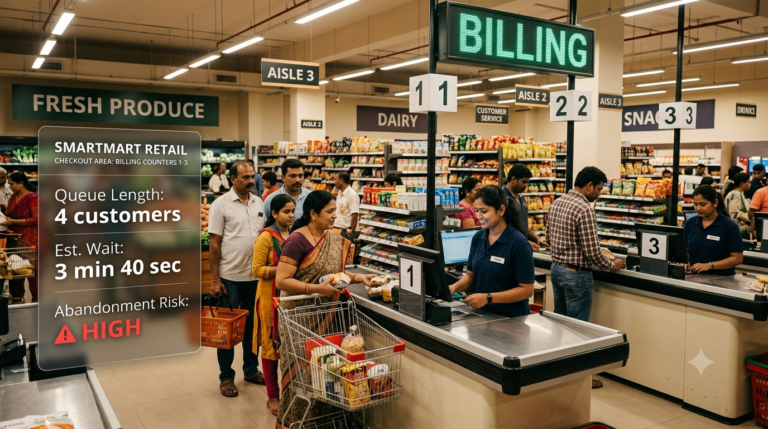
Queue abandonment costs Indian retailers an estimated 6–9% of monthly revenue in peak hours. Retail video analytics measures queue length per checkout in real time, predicts queue growth, and routes an alert to the floor supervisor the moment a queue crosses a defined threshold — usually 4–5 customers — so that a second counter can be opened before any customer sets the basket down and walks.
Combined with retail footfall analytics and POS integration, this use case directly attacks the single largest conversion leak in Indian supermarkets and QSRs. For a dedicated guide on deploying this at scale, see retail queue management for Indian retailers. Best for: supermarkets, hypermarkets, QSRs, and any retail format with multi-counter checkout.
3. Unattended Customer Alert: Staff Routing Before the Walkout
A customer spending 3 minutes or more in a product zone with no staff nearby is far less likely to buy. In high-consideration formats like jewellery showrooms, electronics stores, and premium apparel, assisted browsing converts at 2–3x the rate of unassisted browsing across organised retail.
Retail video analytics monitors customer presence and staff location simultaneously. When a customer remains in a zone beyond a configurable time threshold with no associate nearby, the system routes an alert to the nearest available floor staff member while the customer is still in the store. No manual monitoring required. The alert goes out in under 60 seconds from detection.
Best for: jewellery showrooms, consumer electronics, premium apparel, and any high-consideration retail format where floor assistance directly drives conversion.
4. Visitor-to-Trial Funnel: Know Which Conversion Stage Is Losing You Sales
Most Indian retailers track two numbers: total footfall and daily revenue. Retail video analytics tracks four. The visitor-to-trial funnel measures everyone who enters the store, customers who show interest in a product zone, customers who pick up or engage with a product, and customers who take it to trial or demo. Each stage becomes a measurable metric with its own benchmark.
The value is in the gaps between stages. A store converting 65% of visitors to product interest but only 12% of those to trial has a fitting room problem, not a traffic problem. For apparel retailers where trial room conversion determines whether a visit ends in a purchase, tracking all four funnel stages shows exactly where margin is leaking and which operational fix closes the gap.
Best for: apparel, footwear, beauty, and any retail format with a trial or demo stage in the purchase journey.
5. Counter Unmanned During Peak — Supervisor Alert in Under 60 Seconds
A cash counter or service desk that sits unmanned during peak hours is one of the most reliable predictors of customer walkouts and complaint-driven NPS damage. Retail video analytics detects counter absence patterns, identifies when the unmanned period crosses a threshold, and routes an alert to the floor supervisor with zone, time, and counter ID.
Across deployments, retailers using this use case have moved staff-at-counter compliance from a 58% baseline to 91% in 90 days — without adding a single new headcount. The gain came entirely from closing the visibility loop. Best for: banking-format retail, telecom stores, electronics, and any retail format where service desks are the conversion choke point.
6. Heatmap Dead-Zone Detection — Layout and Merchandising Alerts
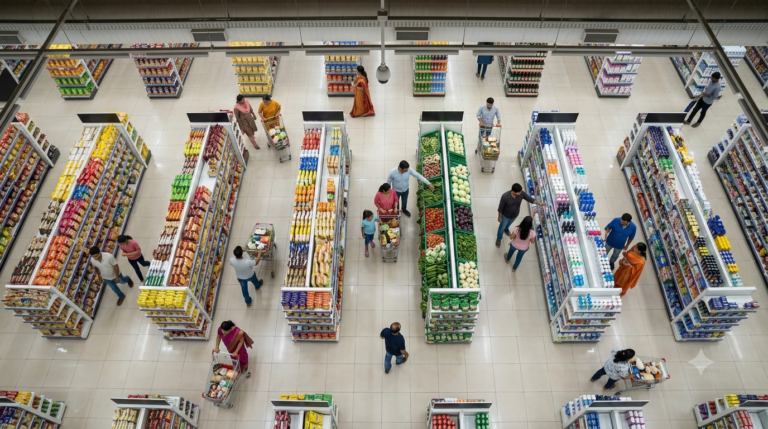
Every store has a dead zone — a corner, an aisle, an endcap that shoppers walk past without engaging. Retail video analytics generates anonymised heatmaps that surface these dead zones in real time, then routes weekly merchandising alerts to the visual merchandising and category management teams with specific zones flagged for repositioning, signage change, or planogram review.
This is the use case that quietly compounds. A 3-minute weekly merchandising review built on real heatmap data, applied across 100 stores, surfaces an annual revenue lift of 4–7% in high-margin SKUs. Best for: apparel, beauty, electronics, and any retail format where visual merchandising drives basket size.
7. Customer Prospect Scoring: Direct Floor Staff to High-Intent Visitors
Not every visitor is equally likely to convert. Retail video analytics scores visitors by behavioral signals visible from existing cameras: time spent in high-margin product zones, repeated engagement with specific displays, pick-up-and-examine sequences, and movement toward checkout rather than back toward the exit. Floor staff receive a prioritized list of high-intent visitors to approach, updated in real time.
This works without facial recognition, without CRM integration, and without any biometric data. The signal is observable behavior, not stored identity. For premium and luxury formats where the average transaction justifies assistant-led selling, this use case directs staff attention to the visitors most likely to buy, without adding headcount or changing store layout.
Best for: jewellery, luxury apparel, consumer electronics, and any high-consideration retail format where staff attention has a direct impact on average transaction value.
8. After-Hours Intrusion and Perimeter Alert — Security Routing
Retail formats — particularly stand-alone supermarkets, pharmacies, and luxury stores — face after-hours intrusion, vandalism, and perimeter risks that legacy CCTV cannot respond to until the next morning’s footage review. Retail video analytics monitors the store perimeter and interior 24/7 and routes silent alerts to the regional security team and the security video analytics operations centre the moment intrusion is detected.
The autonomous routing and escalation logic is what separates this from legacy alarm systems. A perimeter event that does not get acknowledged within 60 seconds escalates automatically up the chain — all the way to local police integration where configured. Best for: pharmacies, luxury, electronics, and any retail format with high after-hours risk.
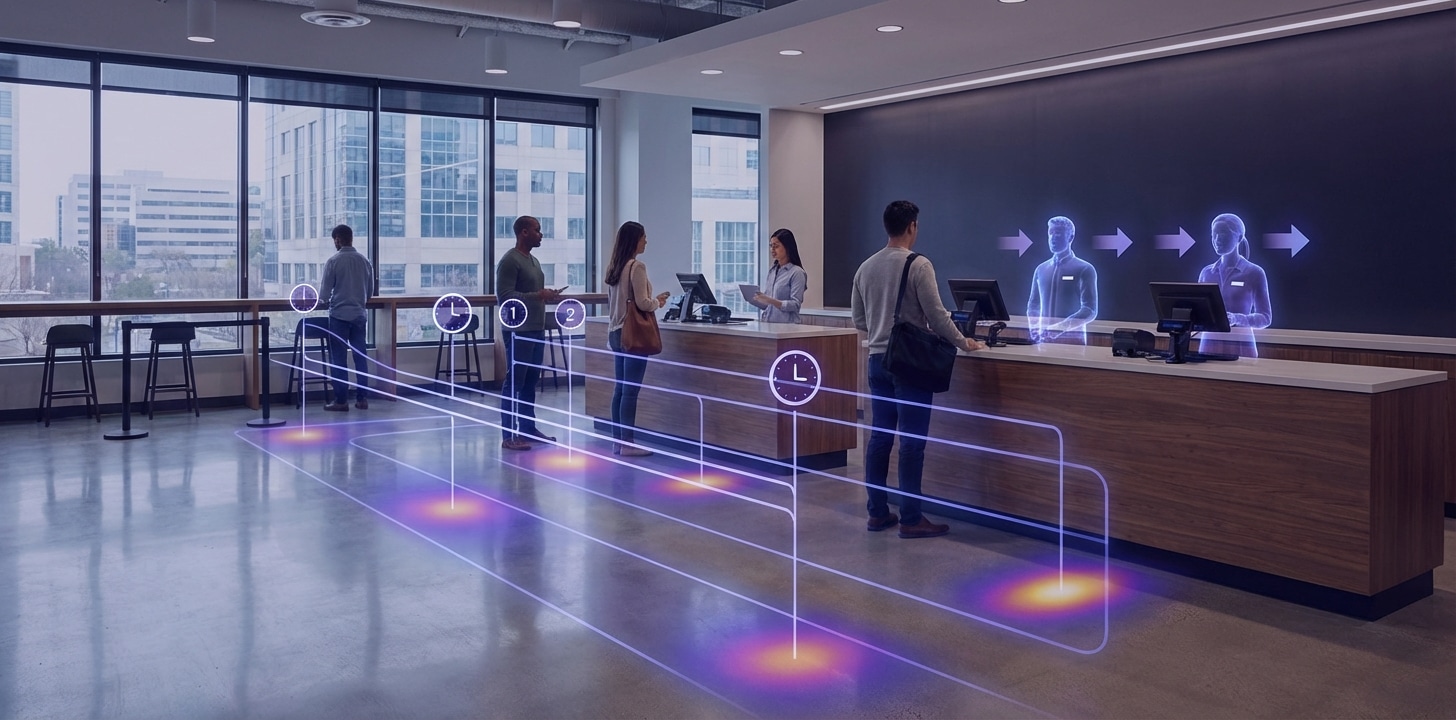
Legacy Retail CCTV vs Modern AI-Powered Retail Video Analytics
The difference between a legacy CCTV setup and a modern retail video analytics deployment is not the camera — it is everything that happens after the camera captures the frame.
| Capability | Legacy Retail CCTV | Modern AI-Powered Retail Video Analytics |
|---|---|---|
| Detection mode | Manual review, end-of-shift | Autonomous AI agents per zone, 24/7 |
| Response time | Hours to days | Under 60 seconds from detection |
| False positive rate | High — operator fatigue | Under 5% with zone-aware decision logic |
| Alert routing | Walkie-talkie, manual call | Auto-routed to role and zone, escalated if unacknowledged |
| Conversion measurement | None — cameras and POS unconnected | Footfall ↔ POS correlation in real time |
| Shrinkage detection | Forensic, post-event | Real-time pattern detection with same-shift recovery |
| Hardware cost | Separate analytics box per site | Software overlay on existing IP cameras and NVRs |
| Operational ROI | Pure cost centre | 30% average operating cost reduction in 3–6 months |
The Retail Conversion Funnel Every Indian Store Should Be Measuring
Modern retail video analytics turns the physical store into a measurable funnel — the same way Google Analytics turned the website into a measurable funnel two decades ago. Every stage maps to a specific camera, a specific event class, and a specific operational lever.
- Passerby (100%) — measured by exterior-facing cameras counting people walking past the storefront
- Walk-in (30–45%) — entrance cameras counting directional crossings
- Browser (20–30%) — interior cameras measuring dwell beyond 60 seconds
- Buyer (8–15%) — POS integration correlating buyers with browsers
- Repeat (3–8%) — returning customer recognition via opt-in loyalty linkage
The point of measuring this funnel is not the dashboard. It is the operational lever exposed at every drop-off. A weak passerby-to-walk-in ratio is a window display problem. A weak walk-in-to-browser ratio is a layout or first-impression problem. A weak browser-to-buyer ratio is a staff engagement or checkout-friction problem. Retail video analytics is what makes each of these levers visible, measurable, and — most importantly — actionable inside the same shift.
For a deeper breakdown of each funnel stage and the metrics that matter most, see our complete guide to retail footfall analytics in 2026.
Real Results — What Indian Retail Networks Are Seeing in 90 Days
A multinational footwear chain with 1,800+ stores across India, the Middle East, and Southeast Asia rolled out retail video analytics across its entire network using existing CCTV infrastructure. The results documented across the deployment are representative of what well-implemented retail video analytics delivers in Indian retail in 2026.
- Conversion rate: lifted by 32% across the network
- Queue wait times: reduced 45% via real-time counter staffing alerts
- Staff-at-counter compliance: 58% to 91% in 90 days, no headcount added
- Shrinkage: down 23% in pilot supermarket cluster
- Walkouts: down 18% in apparel format
- ROI: under 4 months, calculated on shrinkage savings alone
The full deployment story across formats — apparel, supermarket, electronics — is documented in the Agrex AI retail case studies library, with format-specific breakdowns available for apparel, supermart, and operational efficiency.
How Retail Video Analytics Integrates With Your Existing Store Stack
A common objection from retail IT teams is that adding retail video analytics means another vendor, another integration, another rip-and-replace project. In practice, modern retail video analytics platforms are designed to be hardware-agnostic and to layer on top of the systems a retailer already runs.
- Cameras: any IP/RTSP-compatible CCTV — Hikvision, Dahua, CP Plus, Axis, Bosch, or enterprise-grade models already deployed
- NVRs and VMS: direct feed integration with major brands and ONVIF-compliant recorders
- POS: API integration with the largest Indian and global POS platforms — essential for true conversion rate calculation
- CRM and loyalty: integration with Salesforce, HubSpot, and major Indian loyalty platforms for recognition-based use cases
- Workforce management: integration with WMS and rostering tools for staffing alerts
- Communication: alerts routed via WhatsApp, SMS, email, push notification, Slack, Microsoft Teams, or webhook into the retailer’s incident management tool
- Business intelligence: dashboards, exports, and APIs into Power BI, Tableau, or in-house analytics stacks
This is why a 100-store retailer can roll out retail video analytics in under 30 days — there is no camera replacement, no cabling work, no store downtime. The deployment is a software overlay and a configuration exercise.
Data Privacy and DPDP Act Compliance for Retail Video Analytics
Every Indian retailer running cameras now operates under the Digital Personal Data Protection Act, 2023 (DPDP Act), and many also fall under GDPR if they serve EU customers or are part of a multinational group. Retail video analytics is fully compatible with both regimes when implemented correctly — and in fact often improves compliance posture compared to legacy CCTV.
The technical principle is straightforward. Modern retail video analytics processes video at the edge or in a privacy-compliant cloud region, generates anonymised insights — silhouettes, demographics estimates, heatmaps, dwell times — and does not store personally identifiable images by default. Identification-based use cases such as VIP recognition operate strictly on opt-in loyalty data, with explicit consent recorded under DPDP Act Section 6 and matching GDPR Article 6 requirements.
Detailed guidance on the DPDP Act is available on the Government of India Ministry of Electronics and IT website, and the Retailers Association of India publishes ongoing compliance guidance for member retailers.
The broader compliance bonus that retail video analytics delivers is auditability. Every alert, every acknowledgement, every escalation, and every resolution is timestamped, logged, and exportable — creating an evidentiary trail that legacy CCTV simply cannot produce.
How to Get Started With Retail Video Analytics in India: 5-Step Checklist
Implementing retail video analytics does not require a large upfront investment, a multi-month project plan, or new hardware. The pragmatic deployment path that India’s leading retailers follow looks like this.
- Audit existing camera coverage — Map every IP camera at entrances, interior aisles, checkout counters, and perimeter. Most retailers discover they already have 80–90% of the coverage they need.
- Define the top three alert use cases — Resist the temptation to deploy all eight use cases at once. Pick the three with the highest revenue or margin impact for your specific format and prove ROI on those first.
- Connect POS and loyalty data — POS integration is the single most impactful step because it unlocks true conversion rate measurement. Loyalty data unlocks recognition-based use cases.
- Pilot in 5–10 stores for 60 days — Tune detection thresholds against real foot traffic to suppress false positives. The pilot phase is configuration-heavy; production scaling is fast.
- Roll out across the network with central dashboards — Once thresholds are tuned, scale to the rest of the network with role-based access — store managers see their store, regional heads see their circle, central ops sees everything.
Most multi-store Indian retailers move from pilot to full network deployment in under 90 days using this approach. The first measurable ROI — typically queue management or staff-at-counter compliance — usually surfaces within the first 30 days of pilot.
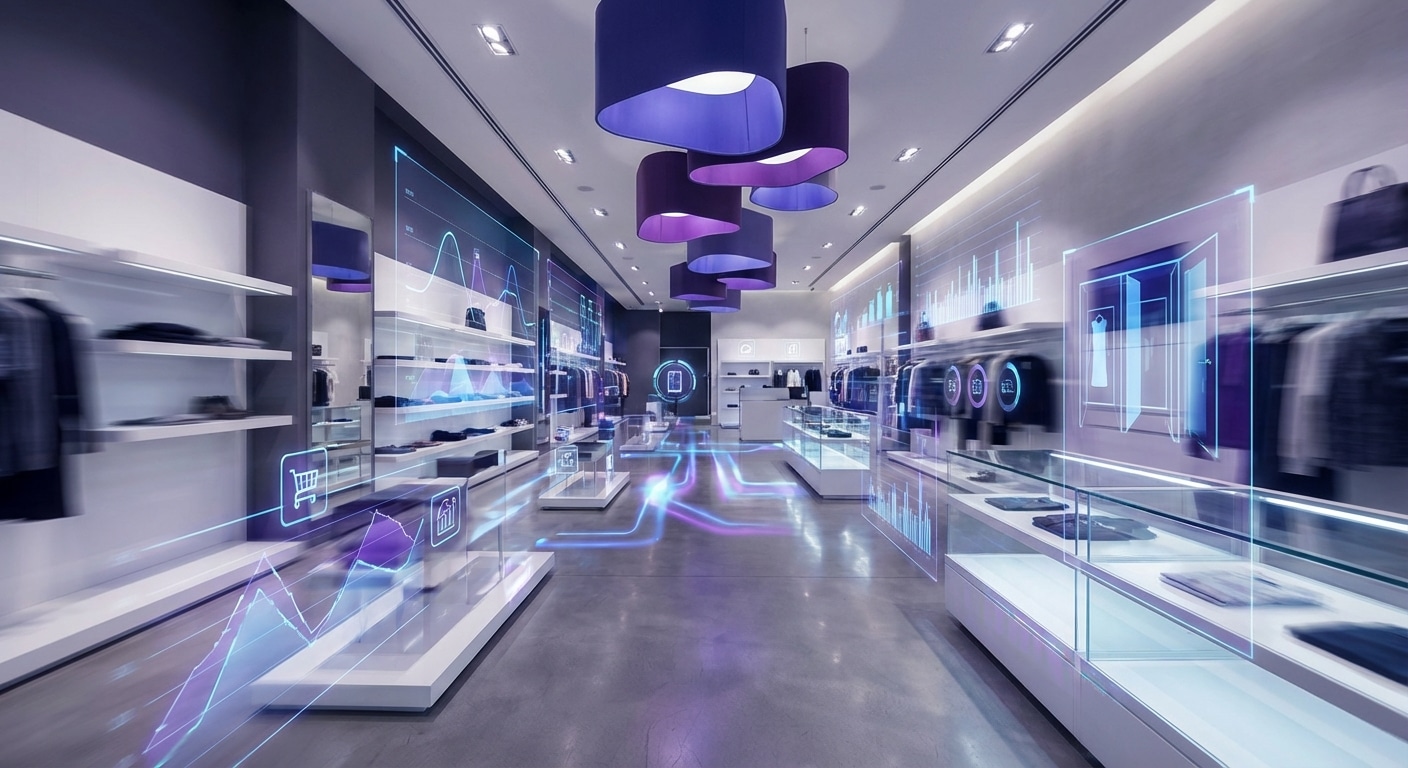
See Retail Video Analytics in Action
Frequently Asked Questions About Retail Video Analytics
What is retail video analytics?
Retail video analytics is a software layer that uses computer vision and deep learning on existing IP CCTV cameras to extract operational and customer intelligence — footfall counts, dwell time, queue length, staff compliance, shrinkage patterns — and route real-time alerts to the right person on the store floor. It turns passive recording into autonomous, in-shift action.
How accurate is AI-based retail footfall counting in 2026?
Modern AI-based footfall counting in retail video analytics delivers 95–98% accuracy under typical Indian retail conditions, including crowded weekends, varying lighting, and partial occlusion from shopping bags or other customers. This significantly outperforms thermal sensors at 80–85% and WiFi-based tracking at 60–75%.
Do I need to replace my existing CCTV cameras for retail video analytics?
No. Modern retail video analytics platforms are hardware-agnostic and work with any ONVIF-compliant IP camera, including Hikvision, Dahua, CP Plus, Axis, and Bosch models. The platform connects via RTSP to the existing camera or NVR feed — no rip and replace, no new cabling, and no store downtime.
What is the typical ROI from retail video analytics in India?
Retailers using retail video analytics in India typically see ROI within 3–6 months. Documented results include 32% conversion rate lift, 23% shrinkage reduction, 45% faster queue resolution, and 30% average operating cost reduction. The fastest ROI usually comes from queue management and staff-at-counter compliance use cases.
How does retail video analytics integrate with my POS system?
Leading retail video analytics platforms offer API integrations with all major Indian and global POS systems, ERP platforms, and BI tools. POS integration is what enables true conversion rate measurement — without it, the platform reports footfall but cannot calculate the conversion percentage that ultimately drives operational decisions.
Is retail video analytics compliant with India’s DPDP Act and GDPR?
Yes, when implemented correctly. Modern retail video analytics processes video at the edge or in privacy-compliant cloud regions, does not store personally identifiable images by default, and operates identification-based use cases like VIP recognition only on explicit opt-in consent. Every alert and access is logged, creating an auditable trail that strengthens overall compliance posture compared to legacy CCTV.
How fast can a multi-store retail chain deploy retail video analytics?
A typical 50–100 store retail chain in India can complete a full retail video analytics rollout in under 30 days, because there is no camera replacement, no cabling work, and no store downtime. Pilot phase is usually 60 days across 5–10 stores to tune detection thresholds; full network scale-up is rapid once thresholds are validated.
What is the difference between legacy CCTV and AI-powered retail video analytics?
Legacy CCTV records and waits for a human to review footage, usually after the event. AI-powered retail video analytics monitors every camera autonomously, detects events in real time, decides which role should respond, and routes the alert in under 60 seconds — closing the loop between detection and action without a human in the routine monitoring layer.
See Retail Video Analytics in Action on Your Existing Cameras
Book a 30-minute live demo with the Agrex AI team. We will show you autonomous retail video analytics running on a real Indian retail feed — covering footfall, dwell, queue, shrinkage, and conversion correlation — using your existing camera infrastructure. No hardware swap, no commitment.
Written by the Agrex AI editorial team. Agrex AI is India’s leading agentic video analytics platform, helping retailers, banks, QSRs, and enterprises turn existing camera infrastructure into real-time decision systems. Connect with us on LinkedIn.