Published: 30 June 2026 · Last Updated: 30 June 2026 · ⏱ 12 min read · By Dhruv Jearath
Quick Answer
AI video analytics is software that uses computer vision and machine learning to automatically analyze live camera feeds — detecting objects, behaviors, and events in real time without human monitoring. Unlike basic CCTV which only records, AI video analytics software classifies what it sees, triggers context-aware alerts, and generates operational reports. For Indian enterprises, it runs on existing cameras (no hardware replacement), deploys on-premise or at the edge, and converts footage that was previously only useful after incidents into live intelligence that prevents them.
Most buyers searching for AI video analytics are solving the same problem: cameras installed across every facility, but zero operational visibility from them. Footage sits in storage, reviewed only after something goes wrong. The technology to fix this has existed for years — but the gap between a genuine AI video analytics platform and a motion-detection system with a dashboard is enormous, and most vendors won’t tell you where their product sits.
I’ve worked with enterprise deployments across retail, manufacturing, banking, and logistics in India. In this guide, I’ll explain exactly what AI video analytics is, how it works, which industries get the fastest ROI, what it costs in India in 2026, and what separates a deployment that delivers versus one that becomes shelf-ware three months in.
87%
Fewer false alerts vs traditional motion detection
<30 Days
Typical go-live on existing cameras
$21B+
Global AI video analytics market by 2030, per IBEF (14%+ CAGR)
3–6 mo
Typical ROI window for Indian enterprise deployments
What Is AI Video Analytics and How Is It Different from CCTV?
Traditional CCTV is a storage system. AI video analytics is a decision-making system. That one-line difference explains why enterprises that have spent crores on cameras still can’t answer basic questions like: how many people entered zone B between 2pm and 4pm, which shift had the most PPE violations last week, or why shrinkage spiked at the Gurugram store last quarter.
AI video analytics puts a software intelligence layer on top of those same cameras — using computer vision models to detect, classify, and respond to events in real time. No guard watching a monitor. No manual footage review. The system watches everything, flags what matters, and gives you data you can act on.
| Capability | Traditional CCTV | AI Video Analytics |
|---|---|---|
| Monitoring | Manual (human guards) | Automated 24/7 AI processing |
| Alerts | Motion detection — high false positives | Context-aware — 87% fewer false alerts |
| Output | Footage only (passive) | Reports, dashboards, operational data |
| Use | Post-incident review | Real-time intervention + retrospective analysis |
| Hardware | Camera-dependent | Works on existing cameras (hardware-agnostic) |
In short: AI video analytics transforms passive CCTV infrastructure into a live intelligence layer. It detects, classifies, alerts, and logs — without a human watching the screen. Existing camera investments finally generate measurable business value beyond compliance.
How Does AI Video Analytics Actually Work?
The core engine runs on a six-step processing loop. Understanding this helps you ask better questions during vendor evaluations — and immediately spot the platforms that are genuinely AI versus the ones that slapped the label on a motion sensor.
Step 1 — Ingest: Video streams from IP cameras, NVRs, or edge devices are fed into the analytics engine via RTSP, ONVIF, or direct SDK integration.
Step 2 — Detect: Object detection models (YOLOv8, custom CNNs) identify people, vehicles, and objects of interest in each frame — in real time, at scale.
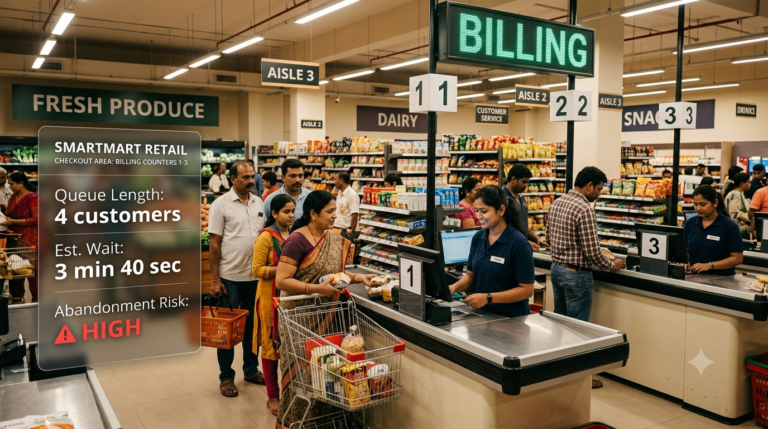
Step 3 — Classify: The system classifies what it detected. Is this person wearing a helmet? Is this vehicle authorized? Has queue length crossed the 4-minute threshold?
Step 4 — Alert: When a defined rule fires — zone breach, PPE violation, crowd density spike — an alert goes out instantly. Mobile app, email, WhatsApp, or integrated incident management system.
Step 5 — Log: Every event is timestamped, tagged, and stored with a tamper-proof audit trail. This is what holds up in compliance reviews, insurance claims, and legal proceedings.
Step 6 — Report: Dashboards aggregate event data into operational reports — footfall trends, alert frequency by zone, safety compliance %, throughput per shift.
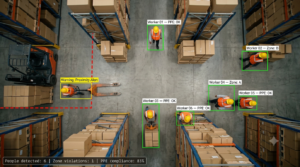
The key differentiator in 2026 is where this processing happens. On-device at the edge means alerts in under 2 seconds without video leaving your premises. Cloud adds cross-site aggregation and reporting. Most serious Indian deployments now use hybrid — edge for alerting, cloud for reporting — because it solves the latency problem without sacrificing multi-site visibility.
In short: AI video analytics processes video through a six-step loop: Ingest → Detect → Classify → Alert → Log → Report. Hybrid edge-cloud architecture is the dominant deployment model in India in 2026. Ask any vendor which steps run where, and whether the event log is tamper-proof.
What Business Problems Does AI Video Analytics Actually Solve?
Before buying anything, answer this: which specific operational problem are you solving, and how will you measure success? AI video analytics maps to four enterprise problem categories — and the strongest deployments pick one to start.
Security and loss prevention
Retail chains, banks, and logistics companies use AI video analytics to automatically detect theft attempts, unauthorized access, and perimeter breaches — without guards watching every monitor. A retail video analytics platform can flag shoplifting behavior patterns in real time, something traditional CCTV fundamentally cannot do.
Workplace Safety and Compliance
manufacturing plants use AI video analytics to automatically detect PPE violations — missing helmets, vests, gloves — zone breaches near machinery, and unsafe behaviors. The system fires alerts before incidents happen, not after. According to the National Safety Council, preventable workplace injuries cost Indian manufacturers an estimated ₹19,000+ crore annually — and McKinsey research confirms AI-based safety monitoring reduces incident rates by up to 50%. AI safety monitoring addresses this directly and creates an audit trail that satisfies regulatory inspectors.
Operational Efficiency
QSR chains, hospitals, and airports use footfall analytics, queue monitoring, and dwell-time analysis to optimize staffing and reduce wait times. I’ve seen QSR clients cut average queue wait by 28% within 60 days of deployment — purely from AI video analytics triggering real-time staff routing alerts.
Compliance and Audit Readiness
In regulated sectors — banking, pharma, food processing — tamper-proof video logs and automated compliance reports are now expected in audits. AI video analytics platforms generate these automatically, reducing manual compliance effort by 60–70% while producing better documentation than any human-managed process.
In short: AI video analytics solves four enterprise problems: loss prevention, workplace safety, operational efficiency, and compliance readiness. The fastest-ROI deployments target one primary use case with a measurable success metric before expanding to others.
Which Industries in India Are Seeing the Highest ROI from AI Video Analytics?
Not all verticals are equal when it comes to AI video analytics payback. Here’s where I’ve seen the fastest returns — and why each works differently.
| Industry | Primary Use Case | ROI Timeline | Key Metric |
|---|---|---|---|
| Retail | Loss prevention, footfall | 3–4 months | Shrinkage % reduction |
| Manufacturing | PPE detection, safety compliance | 4–6 months | Safety incident rate |
| QSR / F&B | Queue monitoring, hygiene | 2–3 months | Average wait time, CSAT |
| Banking / BFSI | ATM security, branch surveillance | 5–7 months | Fraud incident reduction |
| Logistics | Perimeter security, asset tracking | 4–5 months | Inventory shrinkage, dwell time |
Retail and QSR deliver the fastest payback because the ROI metric — shrinkage percentage or queue wait time — is already being tracked before deployment. The baseline exists. The AI video analytics system plugs into it and moves the number. Manufacturing takes slightly longer because safety incident reduction requires a longer observation window to be statistically valid, but the long-term value is typically higher.
In short: Retail and QSR deliver the fastest ROI from AI video analytics — 2–4 months — because the success metric is already tracked before deployment. Pick the industry deployment closest to your context, demand a live pilot, and measure the same KPI you already track.
Which AI Video Analytics Use Case Fits Your Operations?
I work with enterprise teams across retail, manufacturing, and banking to map the right deployment to their specific site conditions. A 30-minute call is usually enough to identify your highest-ROI use case — and tell you honestly whether your cameras need any upgrades first.
Should You Deploy AI Video Analytics on Edge, Cloud, or Hybrid?
This is the most underrated question in every Indian enterprise RFP — and most vendors avoid a direct answer. Here’s what actually matters in the Indian context.
Edge AI processes video on-device — at the camera or a local GPU box. Alerts fire in under 2 seconds. Video never leaves your premises. For sectors like banking or defence where data residency is non-negotiable, this is not optional. For manufacturing plants and warehouses in tier-2 cities where internet connectivity is unreliable, edge processing means the system works whether the connection is up or down.
Cloud deployment enables what edge cannot: aggregated dashboards across 50 retail stores, cross-site benchmarking, centralized model updates, and historical analytics at scale. A 100% edge deployment means every site is an island — no unified operational view.
Hybrid is what most Indian enterprises actually need. Edge inference for real-time alerts + cloud aggregation for reporting and model management. According to NASSCOM’s 2025 AI Infrastructure Report, over 68% of Indian enterprise AI video deployments now use hybrid architecture. Ask any vendor which processing steps run on-premise versus cloud — if they can’t answer clearly, that’s a red flag.
In short: Hybrid wins for Indian enterprises — edge for sub-2-second real-time alerts and data residency compliance, cloud for multi-site reporting and model management. Always ask vendors: which steps run where, and what happens to alerting when the internet goes down?
How Much Does AI Video Analytics Cost in India? (2026 Real Numbers)
Most vendors won’t publish pricing. Here are realistic ranges based on actual deployments — use these to sanity-check quotes before committing.
| Scale | Cameras | Annual Cost (India) | Notes |
|---|---|---|---|
| Pilot / POC | 5–20 | ₹2–6 lakh | 60–90 day live deployment |
| Single Site (SME) | 20–100 | ₹8–25 lakh/year | SaaS license + support |
| Enterprise Single Site | 100–500 | ₹30–80 lakh/year | Includes edge hardware + integration |
| Multi-Site Enterprise | 500+ cameras, 5+ sites | ₹1–5 Cr/year | Custom pricing, per-site/per-use-case |
What’s typically included in these numbers: software license, edge device (if applicable), onboarding, initial model training, API integrations, dashboard access, and support SLA. What’s often hidden: annual model retraining fees, camera upgrade costs if resolution is below minimum, and per-alert overage pricing above a monthly threshold.
In short: AI video analytics in India ranges from ₹2 lakh for a pilot to ₹5 Cr/year for large multi-site enterprises. The most common trap is optimizing on year-1 license price while ignoring model retraining, camera upgrade, and integration costs. Always compare 36-month TCO.
What Should You Evaluate Before Buying an AI Video Analytics Platform?
After working through dozens of enterprise evaluations in India, these eight questions consistently separate platforms that deliver from ones that look impressive in demos and disappear from conversations six months into production.
Does It Work on Your Existing Cameras?
The right answer is yes. Any ONVIF-compliant IP camera at 2MP and 15fps can support AI video analytics without hardware replacement. If a vendor says you need to replace cameras, get a second opinion. Most Indian enterprise sites run AI analytics on cameras that are 5–7 years old without any hardware swap.
What Is the Accuracy in Indian Conditions — Not a Lab?
Models trained on Western datasets consistently underperform in Indian environments: high crowd density, harsh sunlight alternating with low-lux interiors, dust interference, and monsoon weather. Always demand a live POC on your actual site with your actual cameras. Benchmark accuracy, false positive rate, and missed detection rate under your conditions — not vendor-provided lab numbers.
What Happens When the Internet Goes Down?
If the platform depends on cloud connectivity for alerts and your internet drops, does the system go dark? For tier-2 cities and remote manufacturing plants across India, this is a real scenario. The platform should buffer events and sync when connectivity returns — not fail silently.
How Long Does Model Retraining Take?
Environments change — new equipment, seasonal lighting shifts, workforce changes. A platform that takes 6–8 weeks to retrain models will drift in accuracy within one production cycle. Ask specifically: how long does retraining take, who initiates it, and what’s included in the annual price?
What Integrations Are Pre-Built?
AI video analytics delivers full value only when integrated with existing systems — access control (HID, Honeywell), ERP (SAP, Oracle), HRMS, and incident management tools. Ask for an integration map and whether connections are pre-built or require custom development. Custom development at enterprise scale costs ₹15–40 lakh and adds 3–4 months to go-live.
Is the Audit Log Tamper-Proof?
For legal proceedings, insurance claims, and regulatory audits, the evidence trail must be immutable. Ask whether logs are write-once, whether entries are cryptographically hashed, and how chain of custody is maintained across a multi-site deployment.
What Is the DPDP Act 2025 Compliance Posture?
Any platform processing video that can identify individuals is processing personal data under India’s DPDP Act 2023 / Rules 2025. The platform must support consent management, data retention controls, breach notification workflows, and biometric data safeguards. This is non-negotiable in 2026 — and your compliance exposure sits with your organization, not the vendor.
In short: Seven questions for any AI video analytics vendor: camera compatibility, live-site accuracy, offline resilience, retraining timeline, pre-built integrations, tamper-proof logs, and DPDP Act 2025 compliance. A 30–60 day live POC on your actual site answers most of these faster than any vendor demo. For a full platform comparison, see my guide on best AI video analytics software in India 2026.
What Are the DPDP Act 2025 Compliance Requirements for AI Video Analytics?
The Digital Personal Data Protection Act 2023 and Rules 2025 make AI video analytics a regulated activity in India when footage can identify individuals. Understanding this before you buy is essential — compliance is your organization’s obligation, not the vendor’s.
You Are a Data Fiduciary
Any organization deploying AI video analytics that processes identifiable video is classified as a Data Fiduciary under DPDP. This means you own all compliance obligations — you cannot transfer them to your AI vendor contractually.
Notice and Consent
Prominent signage at camera locations is mandatory. For employee monitoring, written consent or contractual acknowledgment is required. For public and customer areas, notice boards with your data retention policy must be visible at entry points.
Data Retention and Minimization
You cannot retain video footage longer than necessary for the stated purpose. Define retention periods per use case (security footage: 30 days; compliance evidence: 90 days) and enforce them through platform controls — not manual deletion schedules that no one follows.
DPIA for Biometric Processing
For deployments involving face recognition or emotion detection, a formal Data Protection Impact Assessment is required. This covers accuracy risk, bias assessment, third-party data sharing, and breach response procedures.
72-Hour Breach Notification
Under DPDP Rules 2025, a data breach involving video data must be reported to the Data Protection Board within 72 hours. Your vendor must have a documented breach response protocol and your contract must specify liability for breaches originating from their infrastructure.
In short: Under DPDP Act 2025, Indian enterprises deploying AI video analytics are Data Fiduciaries with five mandatory obligations: visible camera notice, defined retention periods, DPIA for biometric inference, 72-hour breach notification, and technical safeguards. Build compliance into procurement criteria — not as an afterthought after go-live.
How Do You Implement AI Video Analytics Without Disrupting Operations?
Implementation failure in AI video analytics is almost always a process failure, not a technology failure. The five-phase approach below is what I recommend to every enterprise team that asks me how to do this right.
Phase 1 — Site Audit (Weeks 1–2): Audit existing cameras for resolution, frame rate, lighting conditions, network bandwidth, and NVR compatibility. This determines whether any hardware needs upgrading before analytics deployment — and prevents scope creep and surprise costs mid-project.
Phase 2 — Use Case Definition (Weeks 2–3): Define exactly one primary use case for the pilot. Set the success metric before deployment — not after. “Reduce shrinkage by 15% in 90 days” is a good success metric. “Improve security” is not.
Phase 3 — Pilot Deployment (Weeks 3–7): Deploy on 10–20% of cameras at one site. Run the AI system in parallel with existing processes — don’t replace anything yet. Measure accuracy, false positive rate, and alert response time in live conditions.
Phase 4 — Model Tuning (Weeks 7–10): Use pilot data to retrain models for your specific environment. This is where deployments move from 70% accuracy to 92%+. It requires real data from your site — not generic training sets.
Phase 5 — Full Rollout (Weeks 10–16): Expand to remaining cameras, integrate with access control/ERP/HRMS, train your security and operations teams, and set up automated reporting. Establish a quarterly review cadence with your vendor for model accuracy checks and updates.
In short: Five-phase implementation — Site Audit → Use Case Definition → Pilot → Model Tuning → Full Rollout. Phase 2 is the most critical: defining a single measurable success metric before anything is deployed. Skipping this is the single biggest cause of failed AI video analytics projects in Indian enterprises.
Frequently Asked Questions: AI Video Analytics
What is the difference between AI video analytics and video surveillance?
Video surveillance records; AI video analytics understands. Traditional surveillance stores footage for post-incident review — you watch it after something goes wrong. AI video analytics processes video in real time, detects events as they happen, and generates operational data. For Indian enterprises, the practical difference is: surveillance requires people watching monitors. AI video analytics requires no one watching — it alerts the right person the moment an event occurs.
Can AI video analytics work on existing CCTV cameras?
Yes — in most cases. Any ONVIF-compliant IP camera at 2MP resolution and 15fps supports AI video analytics without hardware replacement. Analog cameras need an encoder or NVR bridge. I’ve seen successful deployments on cameras that were 7 years old. The exception: very low-resolution cameras in consistently poor lighting — here the input quality limits what any AI system can detect. A site audit before deployment resolves this question definitively.
How accurate is AI video analytics in Indian conditions?
Models trained on Western datasets underperform in India. High crowd density, harsh sunlight, low-lux interiors, dust, and monsoon weather all degrade accuracy. A platform trained on India-specific data and calibrated through a live POC typically achieves 92–97% detection accuracy with false positive rates below 5%. The benchmark to demand from any vendor: accuracy and false positive rate in a live pilot at a comparable Indian site — not lab test results.
Is AI video analytics legal in India under DPDP Act 2025?
Yes — AI video analytics is legal. Deployments that process identifiable video carry compliance obligations under DPDP Act 2023 / Rules 2025: visible notice at camera locations, defined retention periods, DPIA for biometric processing, and 72-hour breach notification. Analytics that processes only aggregate data — people counts, zone occupancy without face identification — has lower compliance complexity. Classify your use case with your legal team before deployment, not after.
What ROI can Indian enterprises expect from AI video analytics?
Most Indian enterprise deployments reach payback within 3–6 months. Retail: shrinkage reduction of 25–40% in 90 days. Manufacturing: safety incident rates down 30–50% in year one. QSR: 20–30% reduction in average queue time. The fastest ROI comes from targeting a single measurable metric in the pilot — not deploying every available use case simultaneously and expecting the numbers to sort themselves out.
What is CCTV analytics vs AI video analytics?
CCTV analytics is a subset — and usually a basic one. Traditional CCTV analytics means rule-based systems: motion detection, trip-wire alerts, simple counting. High false positives. Explicit rules required for every scenario. AI video analytics uses machine learning models that understand context — distinguishing normal waiting from suspicious loitering, or a worker carrying equipment from a security breach. In 2026, vendors use the terms interchangeably in marketing. Always ask what the underlying detection mechanism is: rule-based or model-based.
See AI Video Analytics Working on Your Cameras
Agrex AI deploys across retail, manufacturing, banking, and logistics in India — on your existing cameras, with a live 30-day pilot before any long-term commitment.