Warehouse video analytics is the application of computer vision and AI models to existing CCTV camera feeds to extract actionable operational data — without adding new hardware. Indian logistics operations are haemorrhaging margin in plain sight. Dock bay congestion, cargo pilferage, forklift near-misses, and SOP violations happen on camera every shift. The problem is those cameras have never done anything except record. Warehouse video analytics changes that equation fundamentally: the same CCTV infrastructure you already run becomes a live operational intelligence layer that measures, alerts, and proves compliance in real time. For 3PL operators, e-commerce fulfilment centres, and cold-chain DCs across India, this is no longer a pilot technology — it is a P&L lever.
What Is Warehouse Video Analytics?
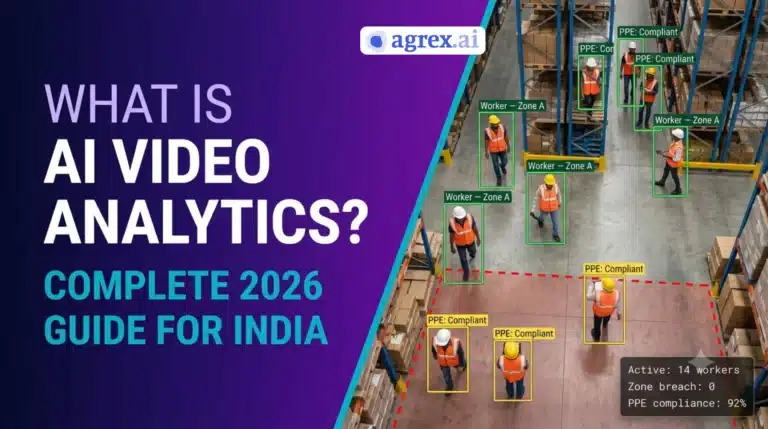
Warehouse video analytics is the use of AI-powered computer vision to automatically analyse CCTV footage from warehouse and distribution centre cameras — converting raw video into structured operational data. Rather than recording footage for post-incident review, the system processes each frame in real time: detecting people, vehicles, pallets, and events; measuring dwell times and throughput; flagging policy violations; and pushing alerts to supervisors before a problem escalates. The output is a live operations dashboard that shows exactly what is happening across every zone of your facility at any given moment.
Deployed across 100+ enterprise facilities in India, AI video analytics typically delivers measurable results within the first 30 days: dock turnaround time drops by 18–25%, shrinkage rates fall 30–40%, and compliance audit time is reduced from days to minutes.
Why Indian Warehouses Need AI Video Analytics Now
India’s warehousing sector crossed ₹1.2 lakh crore in revenue in 2025 (source: IBEF), driven by e-commerce expansion, GST-consolidated distribution networks, and the growth of 3PL. But margin pressure is intense. Labour productivity in Indian warehouses runs 35–40% below global benchmarks, and shrinkage costs range from 0.5% to 1.8% of revenue — figures that directly erode EBITDA. Traditional approaches — CCTV for post-incident, manual audits, shift supervisor walk-rounds — scale poorly against the 24/7 operational demands of modern fulfilment.
AI video analytics for logistics solves the visibility problem at the root. Rather than reviewing 8 hours of footage after a theft event, the system flags the anomaly in real time. Rather than counting pallets manually, the AI counts automatically and reconciles against the WMS. The operational intelligence layer that previously required a team of supervisors now runs continuously from existing infrastructure.
What Gets Monitored: Core Use Cases in Indian Warehouses
1. Dock Bay Management and Truck Turnaround
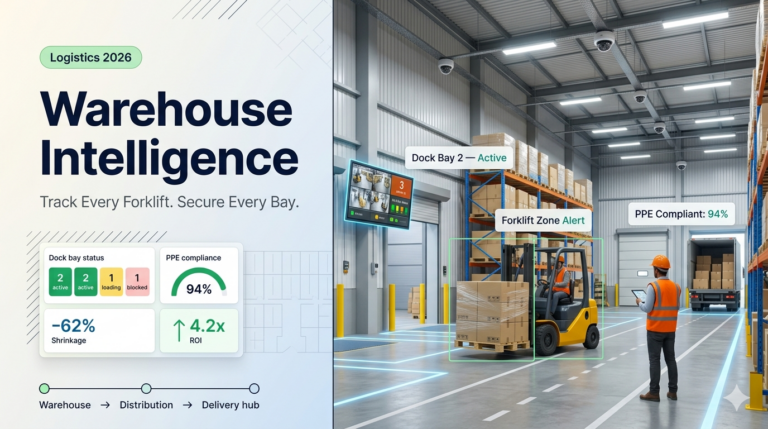
Dock congestion is the single largest source of unplanned delay in Indian distribution centres. AI video analytics monitors dock occupancy in real time, measures truck dwell time per bay, detects idle periods, and generates alerts when turnaround exceeds SLA thresholds. Operations managers receive automated reports on dock utilisation, average turnaround per shift, and lane-by-lane bottleneck identification — without manual counting or supervisor walk-rounds.
2. Warehouse CCTV Analytics for Shrinkage Prevention
Warehouse CCTV analytics goes beyond passive recording to active anomaly detection. The system learns normal movement patterns for each zone — packing, staging, dispatch, cold storage — and flags deviations in real time: unauthorised personnel in restricted areas, unusual dwell near high-value SKUs, and after-hours movement. Alert clips are auto-generated and timestamped, reducing investigation time from hours to minutes.
3. Forklift Safety and SOP Compliance
Forklift incidents account for 25% of all warehouse injuries in India (NSCI data). AI video analytics detects pedestrian-forklift proximity violations, monitors speed in restricted zones, and tracks PPE compliance across all operating shifts. Safety compliance data is logged automatically for audit purposes, replacing manual checklists with verified video evidence.
4. People Counting and Zone Utilisation
Footfall analytics within warehouse zones identifies over- and under-staffed areas in real time, enabling dynamic labour reallocation. For multi-zone DCs, zone-level occupancy data drives staffing decisions by shift, improving throughput per headcount by 12–20% in deployments across Agrex AI clients.
5. Inbound/Outbound Verification and Pallet Counting
AI video analytics automates pallet and carton counts at inbound receiving and outbound dispatch gates. Count data is reconciled automatically against purchase orders and shipment manifests, eliminating manual gate counting and reducing discrepancy disputes with carriers and suppliers.
How Warehouse Video Analytics Works on Existing CCTV
The most common objection from operations heads is infrastructure cost. Warehouse video analytics requires no camera replacement. The Agrex AI platform connects to your existing NVR or IP camera network via RTSP stream. AI inference runs server-side or on an edge device installed at the facility — there is no cloud-only dependency and no bandwidth bottleneck for multi-camera deployments.
- Cameras: Existing CCTV (2MP minimum recommended for analytics accuracy)
- Edge device or server: Agrex AI edge box installed at facility — processes video locally
- Dashboard: Web-based, accessible on any device — live + historical analytics
- Alerts: Push notifications to supervisor mobile, WhatsApp, or SCADA integration
- Integrations: WMS, ERP, access control — via API
Go-live typically takes 3–5 days per facility. No cabling changes, no camera replacement, no hardware procurement delays.
Warehouse Video Analytics India: Implementation Benchmarks
Based on Agrex AI deployments across 100+ enterprise warehouses in India across sectors including e-commerce, FMCG, pharma, and automotive logistics:
| Metric | Pre-Analytics Baseline | Post-Deployment (90 days) |
|---|---|---|
| Dock turnaround time | 45–65 minutes | 32–40 minutes |
| Shrinkage rate | 0.8–1.5% of throughput | 0.3–0.6% |
| Safety incident rate | Baseline | –35% on average |
| Labour productivity | Baseline | +14–22% |
| Compliance audit time | 2–3 days/quarter | Real-time dashboard |
Warehouse Surveillance AI vs. Traditional CCTV: What Changes
Traditional CCTV in warehouses is a liability tool — it proves what happened after an event. Warehouse surveillance AI converts CCTV from reactive to proactive. The shift is significant:
| Capability | Traditional CCTV | Warehouse Surveillance AI |
|---|---|---|
| Anomaly detection | Manual review | Real-time automated alerts |
| Shrinkage prevention | Post-incident | In-the-moment intervention |
| SOP compliance | Spot checks | Continuous monitoring |
| Operational data | None | Throughput, dwell times, zone utilisation |
| Reporting | Manual | Automated dashboards |
| Evidence quality | Raw footage search | Timestamped AI-clipped events |
Supply Chain Video Analytics: Beyond the Four Walls
As Indian logistics networks mature, supply chain video analytics is extending visibility beyond single warehouse facilities to multi-node networks. A 3PL operating 15 DCs across India can run a unified analytics layer that compares operational KPIs across sites — identifying which facility has the longest dock turnaround, which has the highest shrinkage rate, and which shift pattern consistently underperforms — all from a single dashboard without visiting a single site.
Frequently Asked Questions: Warehouse Video Analytics
Does warehouse video analytics require replacing existing cameras?
No. Warehouse video analytics works with existing CCTV infrastructure. The AI platform connects to your current NVR or IP camera network via RTSP stream. Most warehouses with standard 2MP+ cameras deployed for surveillance can activate analytics on day one. Camera replacement is rarely required unless cameras are positioned poorly for analytics coverage zones.
How long does warehouse video analytics deployment take in India?
For a single facility, deployment takes 3–5 days including edge device installation, camera stream connection, AI model configuration for site-specific zones, and dashboard setup. Multi-facility rollouts for enterprise 3PLs are typically completed in 4–6 weeks. No civil work, no cabling changes, and no downtime to existing operations.
What is the ROI of warehouse video analytics for Indian logistics companies?
The ROI calculation for warehouse video analytics includes three components: (1) shrinkage reduction — typically 40–60% reduction in pilferage-related losses; (2) productivity gains — 14–22% improvement in throughput per labour headcount; (3) compliance and audit cost savings — automated evidence replaces manual audit processes. Most deployments across Agrex AI’s client base in India recover implementation cost within 6–9 months.
Can warehouse video analytics integrate with our WMS or ERP?
Yes. The Agrex AI platform offers API-based integration with major WMS platforms (SAP EWM, Oracle WMS, Manhattan Associates, Increff) and ERP systems (SAP, Oracle). This enables automatic reconciliation of video-counted inbound/outbound quantities against WMS records, real-time discrepancy alerts, and unified operational reporting across systems.
Which warehouse zones benefit most from video analytics?
The highest-ROI zones for warehouse video analytics are: dock bays (turnaround optimisation), receiving and dispatch gates (automated pallet/carton counting), high-value SKU storage areas (shrinkage prevention), packing lines (throughput and SOP compliance), and common corridors (safety compliance and footfall routing). Prioritise these five zones first, then expand to full-facility coverage.
Get Warehouse Video Analytics for Your Facility
Agrex AI has deployed AI video analytics across 100+ enterprise warehouses and distribution centres in India — across e-commerce, FMCG, pharma, cold chain, and automotive logistics. No hardware procurement, no camera replacement, no operational downtime. Go-live in 3–5 days. Book a free site assessment and see what your existing cameras can deliver.