Quick Answer
AI video analytics manufacturing has moved Indian factories past passive CCTV. Modern platforms detect PPE gaps, conveyor defects, forklift intrusions, and restricted-zone breaches in real time — then route alerts to the right supervisor and track resolution autonomously. This guide covers 8 deployed use cases, the detect-decide-act loop, and the ROI Indian manufacturers are seeing in 3–6 months.
AI video analytics manufacturing is no longer about recording footage and reviewing it after something has already gone wrong on the factory floor. Indian factories are moving from passive CCTV to autonomous video AI that detects a violation, decides what to do, and alerts the right supervisor — before the next shift begins.
The next generation of factory safety and quality control in India is not about adding more cameras. It is about making existing cameras capable of detecting, deciding, and acting autonomously — without a single human reviewing a live feed.
Indian factories run thousands of compliance events every shift across production lines, conveyor belts, forklift zones, and packaging stations. Safety violations, defects, and unauthorised access happen constantly. The difference between a safe, efficient plant and a dangerous, costly one is not detection — it is what happens in the seconds after detection.
According to the MDPI 2025 study on AI in manufacturing worker safety, over 70% of camera-based safety deployments underperform because alerts go unacted upon. This is exactly where autonomous AI video analytics manufacturing systems change the equation — by closing the loop between what the camera sees and what actually happens next.
Why Are Indian Factories Adopting AI Video Analytics in Manufacturing?
India’s manufacturing sector is scaling fast, but plant safety and quality control have not kept pace with production growth. Workplace injuries and defect rates remain high across steel, cement, chemicals, pharma, auto, and food processing units — and the cost of each incident keeps climbing.
The core problem is not a shortage of cameras. Most large Indian factories already have dense CCTV infrastructure. The problem is that these cameras record passively. A PPE violation happens, it gets captured on footage, and someone discovers it during an end-of-shift review — hours after the violation, and sometimes after an injury has already occurred.
AI video analytics manufacturing platforms change this by closing the loop between detection and action. The camera sees a violation. The AI classifies it. The right supervisor gets alerted instantly, with footage and zone location attached. The alert stays open in the system until resolution is confirmed. No manual review. No delays. No incidents slipping through the cracks.
Detect → Classify → Route → Alert → Track → Resolve — the autonomous loop that makes AI video analytics manufacturing different from legacy CCTV.
Use Case 1 — How Does AI Video Analytics Enforce PPE Compliance on the Factory Floor?
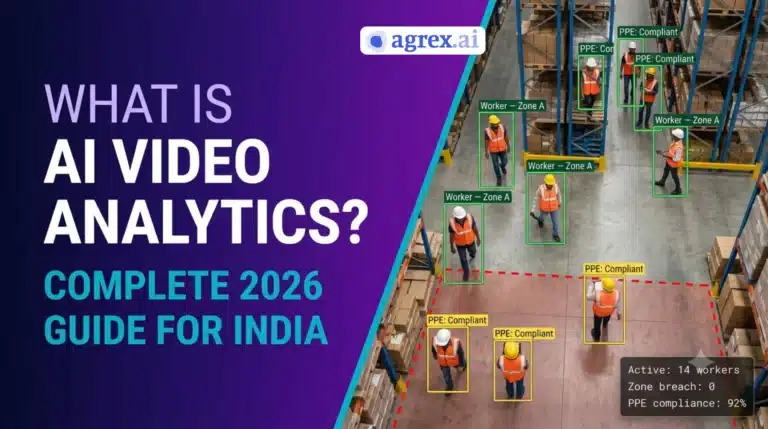
PPE compliance is the single most impactful safety use case in AI video analytics manufacturing. The system monitors every camera feed simultaneously and detects when a worker enters a designated zone without the required safety gear — helmet, gloves, goggles, safety shoes, or high-visibility vest.
- Camera detects missing helmet in Zone B → system identifies Zone B supervisor’s responsibility
- Supervisor receives WhatsApp alert with footage clip in under 60 seconds
- Supervisor approaches worker, violation resolved → marked closed in the system
- If not acknowledged in 5 minutes → follow-up alert escalates to plant manager
- Shift ends → compliance report auto-generated with violations, response times, and open items
Result: Plants deploying this loop have moved from 61% to 89% PPE compliance within 60 days — because workers know every violation triggers an immediate, real consequence instead of a report filed hours later.
Use Case 2 — How Does AI Video Analytics Catch Defects on the Conveyor in Real Time?
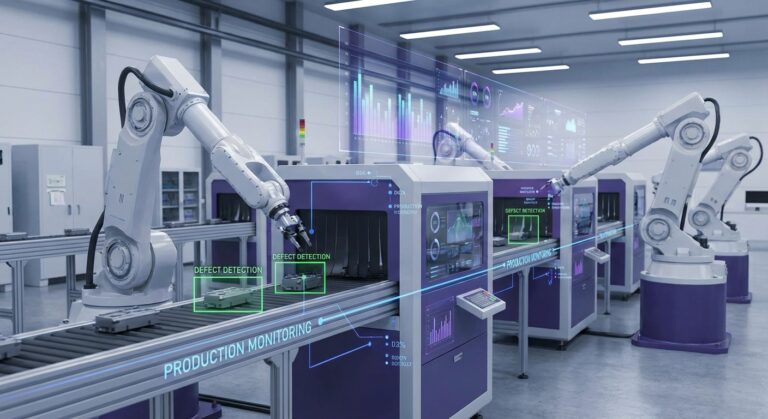
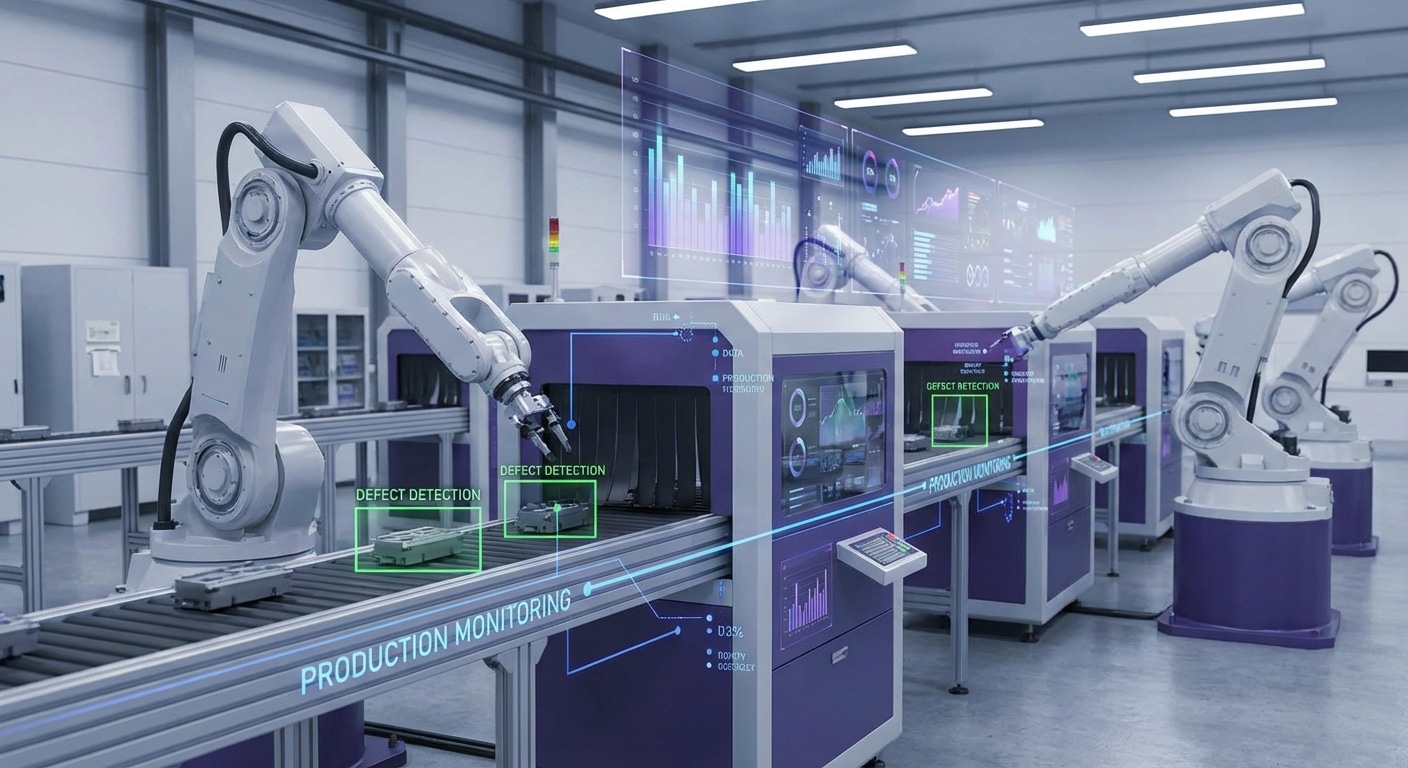
Quality control AI does not just flag a defect — it decides who needs to know, routes the alert, and tracks the defective item before it reaches the next station on the line.
- Open box or defect detected on conveyor → QC supervisor alerted with footage and timestamp
- Defective item flagged in system — tracked until manually removed from the line
- Production count discrepancy → line manager notified automatically
- Repeated defect in same zone → pattern alert escalated to QC head for root-cause review
- Shift QC report auto-generated: defects, catch rate, open items, resolution time
Result: Factories that moved from 3-checkpoint manual inspection to autonomous AI QC jumped from 71% to 94% defect catch rate, cut customer complaints by 22%, and hit ROI in 4 months.
Use Case 3 — How Does AI Monitor Forklift Zones and Prevent Collisions?
Forklifts moving through shared pedestrian zones are one of the highest-risk scenarios on any shop floor. With AI video analytics manufacturing, the response is instant — not a dashboard entry reviewed at shift end.
- Forklift detected in pedestrian zone → zone supervisor alerted immediately with location and footage
- Optional on-site PA trigger for audible warning inside the zone
- Repeated violation in the same zone → pattern tracked, escalation sent to operations head
- Every forklift zone breach logged with timestamp, camera ID, and resolution status
Use Case 4 — How Does AI Enforce Pathway Adherence Inside the Plant?
Factories designate pedestrian pathways to separate people from heavy machinery, moving conveyors, and vehicle routes. When workers deviate, collision and injury risk spikes.
- Worker detected off designated pathway → immediate alert to zone supervisor
- Repeated pathway violations in the same zone → pattern flagged, escalation threshold triggered
- Follow-up alert sent to the safety officer after repeated violations in a single area
Use Case 5 — How Does AI Catch Open Boxes and Damaged Packaging Before Despatch?
Open or damaged boxes leaving a plant mean customer complaints, RTOs, and warranty claims. Manual spot-checks cannot sustain the volume on a fast line.
- Open box or damaged packaging detected on the line → operations team alerted instantly
- Line hold triggered automatically if the rate of damaged units crosses a threshold
- Event logged with footage, timestamp, and SKU context where integrated
- Shift packaging quality report auto-generated — zero manual input
Use Case 6 — How Does AI Auto-Audit Safety Equipment Across Every Shift?
Safety equipment audits — helmets, gloves, face shields, hairnets, ear protection per zone — are traditionally manual, inconsistent, and performed only when an officer is present. AI changes that.
- Per-zone rule engine: which PPE is mandatory in each zone, which items are optional
- Continuous audit across every camera, every worker, every shift — no sampling
- Shift compliance log auto-generated with zone-level breakdown
- Audit-ready trail for regulatory inspections and internal reviews
Use Case 7 — How Does AI Detect Unauthorised Zone Access Inside a Factory?
Plants have restricted zones — hazardous chemical storage, high-voltage panels, clean rooms, finished-goods strongrooms, R&D labs. Unauthorised access must be detected and acted upon in real time.
- Person detected in restricted zone without authorisation → access event logged, security alerted with footage
- Alert includes zone ID, timestamp, and person image for verification
- Event stays open in the system until security confirms resolution
- Correlation with access card data when integrated — making every alert actionable
Use Case 8 — How Does AI Run the Full Incident Response Loop Without Humans?
This is the heart of AI video analytics manufacturing — a closed loop from camera to resolution, running 24/7.
- Detect — computer vision picks up the event from the existing IP camera
- Classify — severity, zone, event type, and responsible role identified
- Route — alert sent to the right person via WhatsApp, email, or dashboard
- Close — resolution tracked until the event is confirmed actioned
- Report — shift, weekly, and monthly reports auto-generated for ops and audit
Traditional CCTV vs AI Video Analytics Manufacturing: What Is the Real Difference?
| Capability | Traditional CCTV | AI Video Analytics Manufacturing |
|---|---|---|
| PPE Detection | Manual review after incident | Real-time detect → alert → resolve |
| QC on Line | 3-point manual inspection | Continuous per-unit AI inspection |
| Alert Response | Dashboard, wait for human review | Instant route to right supervisor |
| Escalation | None — alerts sit in a log | Auto-escalation if unacknowledged |
| Shift Reporting | Manual compilation | Auto-generated, audit-ready |
| Hardware | New cameras per upgrade | Runs on existing IP cameras |
How Can Indian Factories Deploy AI Video Analytics Without Replacing Cameras?
The most common misconception is that deploying AI video analytics manufacturing systems requires ripping out existing camera infrastructure. Modern platforms like Agrex.ai connect to existing IP cameras, NVRs, and VMS systems via standard RTSP and ONVIF protocols.
Typical Deployment Timeline
- Week 1–2: Camera audit, zone mapping, and per-zone rule configuration — PPE rules for production lines, QC rules for the conveyor, pathway and forklift rules for aisles.
- Week 3: Alert routing setup — mapping each alert type to the right supervisor per zone, configuring the escalation chain.
- Week 4: Go-live across all cameras. Real-time alerts active. Auto-reporting enabled. Deployment complete.
Enterprise rollouts across 50+ factory locations have been completed in under 30 days — because the platform sits on top of existing infrastructure instead of replacing it. For a deeper view into how this has worked at scale, see our warehouse safety use cases and our agentic AI video analytics guide.
Frequently Asked Questions
What is AI video analytics manufacturing?
AI video analytics manufacturing uses computer vision and AI to analyse live factory camera feeds in real time. It detects PPE violations, conveyor defects, forklift intrusions, pathway deviations, and restricted-zone breaches, and sends autonomous alerts to the right supervisor — all without manual footage review. The system runs on existing IP cameras and does not require new hardware.
How does AI improve PPE compliance in Indian factories?
AI closes the gap between detection and action. Instead of logging violations to a dashboard for later review, the system instantly alerts the right supervisor with footage, zone, and worker context. Unacknowledged alerts escalate automatically. Factories using this approach have moved PPE compliance from 61% to 89% in 60 days.
Can AI video analytics work with existing CCTV cameras in my factory?
Yes. Modern AI video analytics manufacturing platforms connect to existing IP cameras, NVRs, and VMS systems via standard RTSP and ONVIF protocols. There is no need to replace or upgrade camera hardware. The AI layer sits on top of current infrastructure and starts delivering insights from day one.
What is the ROI of AI video analytics in manufacturing?
Factories typically report 30% reduction in safety incidents, 20%+ improvement in defect catch rates, and measurable drops in customer complaints. Most plants hit ROI within 3–6 months of deployment.
How quickly can AI video analytics be deployed across multiple factory locations?
Enterprise rollouts across 50+ plant locations have been completed in under 30 days. The process covers camera audit, zone mapping, rule configuration, alert routing, and go-live — all without replacing existing cameras or disrupting production.
Which Indian industries are adopting AI video analytics manufacturing fastest?
Auto, steel, cement, chemicals, pharma, electronics, and food processing are leading adoption — driven by high worker density, mandatory PPE rules, tight QC specs, and regulatory audits.
See AI Video Analytics Running on Your Existing Factory Cameras
Agrex.ai is an agentic AI video analytics platform built for Indian manufacturing — hardware-agnostic, deployed across 50+ plants in under 30 days, closed-loop from detection to resolution.