TL;DR — Quick Answer
Autonomous incident response replaces the manual review cycle in bank security with a system that detects, classifies, routes, and logs every event — without waiting for a human to decide what to do next. Indian banks making this shift are cutting response times from hours to under 90 seconds.
A dashboard that shows you what happened is useful. A system that decides who to alert — instantly, with the right context — is transformational. This is the shift happening in Indian banking security right now, and it is called autonomous incident response.
For decades, the standard operating model for bank security has been: cameras record, NVRs store, someone reviews the footage later. Dashboards made this slightly better by surfacing events visually. But a dashboard still requires a human to notice, interpret, and act.
That three-step human dependency is exactly where incidents slip through. And that is exactly what autonomous incident response is designed to eliminate.
What Is Autonomous Incident Response in Banking Security?
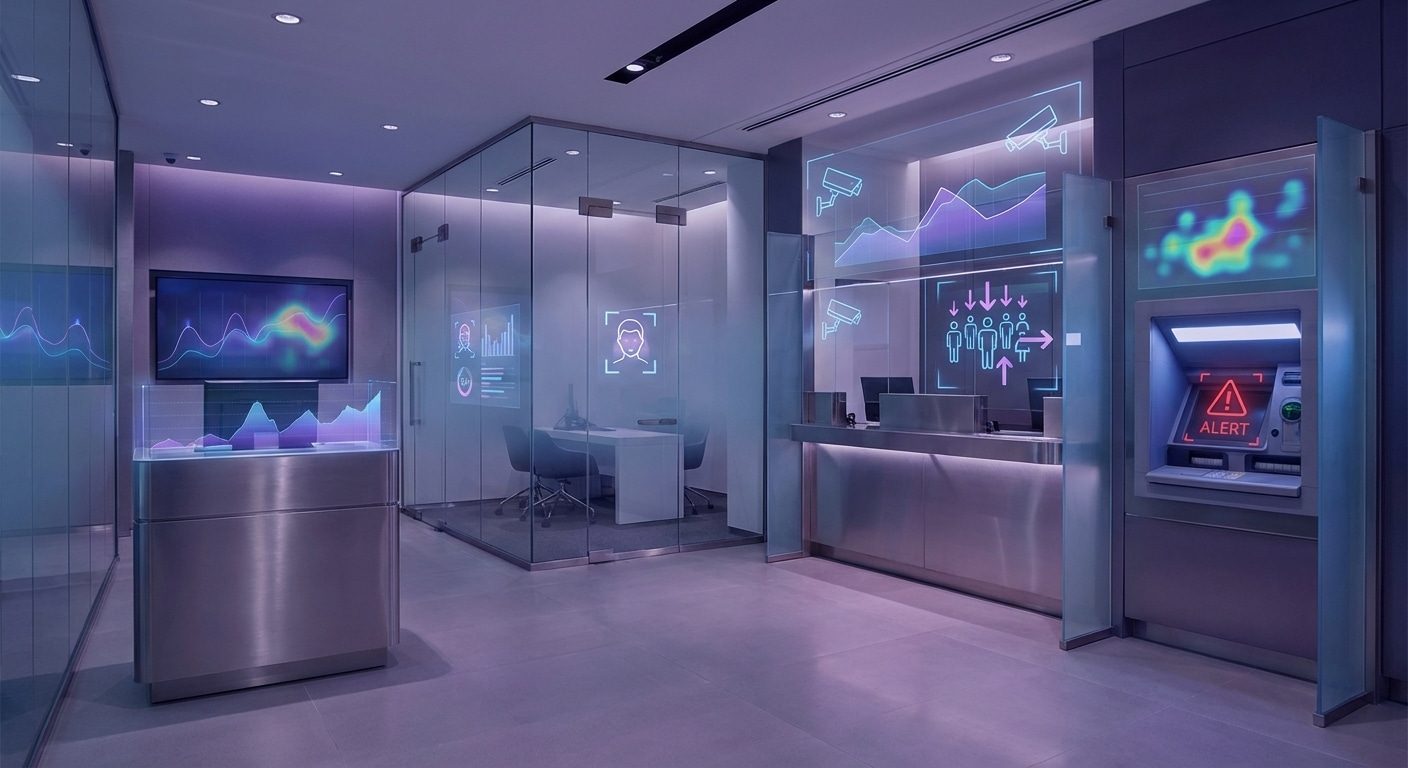
Autonomous incident response is a five-step loop that runs continuously on top of a bank’s existing camera infrastructure. It follows the sequence: detect → classify → route → alert → log.
Unlike a traditional dashboard that surfaces an event and waits for a human to act, an autonomous incident response system executes the entire workflow — from detection to alert delivery to audit logging — without requiring any manual intervention.
The AI agent assigned to each camera stream identifies the event type, maps it to the correct zone and severity tier, selects the right responder, delivers the alert through the fastest channel, and closes the loop with a timestamped audit record.
Why Security Dashboards Create a False Sense of Protection
Security dashboards were a genuine step forward when they first arrived. They replaced blind spot monitoring with visual event logs, graphs, and status panels. For many Indian banks, the dashboard became the de facto security incident management system.
But dashboards have a fundamental design flaw: they are passive. A dashboard does not decide. It does not route. It does not escalate. It displays — and then waits for someone to look at it.
In a branch with 12 to 16 cameras, the dashboard may surface 50 to 100 flagged events per shift. A security operator reviewing these events faces alert fatigue within the first hour. The critical events — a weapon signature, a vault door left open, an ATM loitering alert — drown in routine noise.
This is where the dashboard model breaks. And this is why Indian banks are moving to autonomous incident response — a model where the system itself decides what matters, who should know, and how fast.
The True Cost of Manual CCTV Review in Banking Operations
Most Indian banks treat their security camera infrastructure as a compliance checkbox. Cameras are installed, NVRs record, and footage is reviewed only after an incident has already occurred. The result is a system that documents failure rather than preventing it.
The operational cost is significant. A mid-sized private bank running 50 branches typically employs 2 to 3 security monitoring staff per branch for round-the-clock coverage. That is 100 to 150 headcount dedicated to watching screens — with proven attention degradation after just 20 minutes.
When you factor in missed incidents, delayed responses, and the cost of a single undetected fraud event or security breach, the economics shift heavily in favour of autonomous incident response. A platform like Agrex.ai replaces the reactive review cycle with real-time autonomous action — at a fraction of the headcount cost.
How Autonomous Incident Response Actually Works: The 5-Step Loop
The architecture behind autonomous incident response is deceptively simple. It maps to five layers that operate continuously on every camera stream.
Step 1 — Detect
Computer vision models analyse the RTSP feed from each IP camera 24/7. Detection classes include weapon signatures, face covering, loitering, intrusion, crowd formation, fire, smoke, and cashier absence — all running out of the box on existing hardware.
Step 2 — Classify
Each detection event is classified by severity, zone, and time context. A loitering event at the ATM vestibule at 2 AM is classified differently from the same event at 2 PM during peak hours. This classification layer is where autonomous incident response suppresses false positives.
Step 3 — Route
The classified event is routed to the right responder. Vault alerts go silently to the branch manager and central SOC. ATM alerts go to the security team. Queue alerts go to floor staff. Routing is role-based, zone-aware, and instant.
Step 4 — Alert
The alert is delivered through the fastest available channel: push notification, SMS, WhatsApp, email, dashboard overlay, or audible buzzer. If the first responder does not acknowledge within a set window, the event auto-escalates to the next tier.
Step 5 — Log
Every event — from initial detection through alert delivery, acknowledgement, and resolution — is logged with a timestamp, zone tag, responder ID, and footage clip. This creates the auditable compliance trail that RBI and internal audit teams require.
Security Dashboards vs Autonomous Incident Response: A Direct Comparison
| Dimension | Security Dashboard | Autonomous Incident Response |
|---|---|---|
| Response trigger | Human notices the event | AI routes automatically |
| Response time | 4–8 hours (post-event review) | Under 90 seconds |
| False positive handling | Manual filtering by operator | Zone-aware AI classification |
| Escalation logic | Manual calls or radio | Auto-escalation on acknowledgement timeout |
| Audit trail | Manual logs, footage review | Auto-generated, timestamped, searchable |
| Night shift coverage | Requires staffing | Fully autonomous 24/7 |
| Hardware change needed | Sometimes (dedicated appliance) | None — works on existing cameras |
What Happens When an Alert Goes Unacknowledged?
One of the most critical features of autonomous incident response is the follow-up escalation engine. In a dashboard model, if the operator misses an alert, the event simply sits in a log until someone stumbles upon it — hours, days, or never.
In an autonomous system, every alert carries an acknowledgement timer. If the designated responder does not acknowledge within the configured window — typically 60 to 120 seconds — the event auto-escalates to the next tier in the chain.
For example: an ATM loitering alert routes to the branch security guard. If unacknowledged in 90 seconds, it escalates to the branch manager. If still unacknowledged, it moves to the regional security head with a priority flag and live footage link. No event falls through the cracks.
This escalation logic is what separates autonomous incident response from every dashboard-based system on the market. It guarantees that every detected event reaches a human who can act — regardless of shift changes, breaks, or attention lapses.
From Reactive to Proactive: What the Data Shows About Incident Rates
Banks that have deployed autonomous incident response through Agrex.ai consistently report the same pattern in their first quarter of operation. Response times drop from an average of 4 to 8 hours to under 90 seconds.
Incident close-out rates — the percentage of detected events that reach confirmed resolution — climb from under 40% in dashboard-based systems to over 95% with autonomous routing. The reason is straightforward: when every alert is routed and escalated automatically, events do not get lost.
False positive rates drop below 5% because the zone-aware classification layer filters out context-inappropriate detections before they reach a human. Security teams stop chasing noise and start focusing on genuine exceptions and investigations.
The operational impact extends beyond security. Banks report a 30% reduction in security-related operational costs within 3 to 6 months of deployment, driven primarily by reduced manual monitoring headcount and faster incident resolution. For the full context on how intelligent video analytics closes operational gaps, see our detailed analysis.
The ROI Framework: Cost of One Prevented Incident vs Deployment Cost
The business case for autonomous incident response in banking is unusually clean because the cost of a single undetected or delayed incident is so high. A single ATM skimming event can cost a bank between ₹5 lakh and ₹50 lakh in direct fraud losses, customer remediation, and regulatory penalties.
A single vault breach or unauthorized access event carries reputational damage that is difficult to quantify but can affect customer trust across an entire branch network. Internal compliance failures flagged during RBI audits trigger remediation costs and management attention.
Against this, the deployment cost of an AI security analytics platform across 50 branches is a fraction of the cost of a single major security incident. Most banks see full ROI within the first prevented event — and the ongoing cost savings from reduced manual monitoring compound from month one.
How Indian Banks Are Deploying Autonomous Incident Response Today
The practical deployment path for autonomous incident response is designed to be non-disruptive. Agrex.ai connects to existing IP cameras and NVRs via RTSP — Hikvision, Dahua, CP Plus, Axis, Bosch, Milestone, Genetec, and all ONVIF-compliant devices are supported out of the box.
There is no camera replacement, no new cabling, and no branch downtime. Enterprise rollouts across 50+ locations complete in under 30 days. The first two weeks focus on zone mapping, detection threshold tuning, and routing rule configuration.
By week three, branch managers are receiving actionable alerts. By month two, central SOCs are reporting that nighttime monitoring shifts can be reduced because the autonomous incident response layer is handling routine triage. For a deeper look at how this maps zone-by-zone inside a bank branch, see our guide on bank branch security AI and autonomous alert routing.
Compliance, Audit Readiness, and the RBI Angle
The Reserve Bank of India’s evolving guidelines on branch security (see the RBI official website for current circulars) increasingly expect banks to demonstrate active monitoring and timely incident response — not just that cameras exist.
Autonomous incident response creates exactly the evidentiary trail that compliance teams need. Every event is logged with detection timestamp, classification, routing decision, alert delivery, acknowledgement, and resolution — all exportable in audit-ready format.
Banks running this system can demonstrate to RBI auditors that every security event in the review period was detected, routed, and resolved within defined SLA windows. That level of AI compliance monitoring is impossible to achieve with manual dashboard-based review.
What Comes Next for Autonomous Incident Response in Indian Banking
The current generation of autonomous incident response handles detection, routing, and audit logging. The next frontier is cross-branch orchestration — where a threat pattern detected at one branch automatically triggers heightened monitoring across nearby branches in the same geographic cluster.
Integration with transaction monitoring systems will allow banks to correlate physical events captured by CCTV video analytics with digital transaction anomalies, creating a unified fraud detection layer that spans both physical and cyber domains.
Related reading: our analysis of AI video analytics in banking and ATM security and how autonomous video analytics reduces queue abandonment across different verticals using the same Detect → Classify → Route → Alert → Log architecture.
Frequently Asked Questions About Autonomous Incident Response
What is autonomous incident response in banking?
Autonomous incident response is a security model where AI agents detect events on camera feeds, classify them by severity and zone, route alerts to the right responder, and log the entire lifecycle — all without human intervention. It replaces the manual dashboard review cycle with real-time automated action.
Do we need to replace our existing cameras?
No. The platform connects via RTSP to any ONVIF-compliant IP camera and works with major NVR and VMS platforms including Milestone and Genetec. Deployment is a software overlay — no hardware change required.
How fast does the system respond to a detected event?
From detection to alert delivery, the system responds in under 90 seconds. For critical events like weapon detection, the routing is near-instantaneous with parallel delivery to multiple channels.
What happens if an alert is not acknowledged?
Every alert has an acknowledgement timer. If the designated responder does not acknowledge within the configured window (typically 60–120 seconds), the event auto-escalates to the next tier — branch manager, then regional head, then central SOC. No alert gets lost.
How long does a multi-branch deployment take?
Enterprise deployments across 50+ branches complete in under 30 days. There is no camera replacement, no branch downtime, and no new cabling. Onboarding is primarily zone mapping, threshold tuning, and routing configuration.
What is the ROI timeline for autonomous incident response?
Most banks see ROI within the first prevented security incident — which typically occurs within the first month. Ongoing cost savings from reduced manual monitoring headcount and faster incident resolution compound from day one, with an average 30% operational cost reduction within 3–6 months.
See Autonomous Incident Response Running on Your Existing Cameras
Book a 30-minute live demo with the Agrex.ai team. We will show you how detect → classify → route → alert → log works on a real bank branch feed — no hardware swap, no downtime.
Written by the Agrex.ai editorial team. Agrex.ai is India’s leading agentic video analytics platform, helping banks, retailers, and enterprises turn existing camera infrastructure into autonomous incident response systems. Connect with us on LinkedIn.