QUICK ANSWER
AI video analytics for retail stores converts existing CCTV into a real-time operations intelligence layer — tracking footfall, queue lengths, staff SOP compliance, and billing fraud simultaneously on the same camera estate. Indian retail chains deploying ai video analytics report 45% conversion uplift, 30% queue wait reduction, and full go-live on existing cameras in under 10 days — without new hardware or IT infrastructure changes.
45% Conversion uplift in 90 days |
<10 Days Go-live on existing store CCTV |
200+ Pre-trained retail AI models |
Zero New cameras or IT overhaul needed |
Why 2026 Is the Year Indian Retail Adopts AI Video Analytics at Scale
Indian retail is running at a structural disadvantage. Store managers are making floor decisions — staffing, layout, promotional placement — based on gut feeling and end-of-day POS data. By the time a conversion problem, a queue spike, or a staff compliance gap shows up in the weekly report, the revenue is already lost. The shift happening in 2026 is from post-event reporting to real-time floor intelligence powered by ai video analytics.
The deployment model has changed fundamentally. AI video analytics no longer requires a dedicated server room, a camera replacement project, or a six-month IT migration. It runs on the IP cameras already mounted in your stores via an on-site edge box and goes live in under ten days. The economics of real-time retail intelligence are now accessible to any chain running more than five outlets. According to the India Brand Equity Foundation, India’s retail sector is on track to reach $2 trillion by 2032 — and the chains winning that growth will be the ones that turn their existing camera infrastructure into competitive intelligence assets.
The retail analytics market is projected to reach $9.8 billion by 2026 — with AI-powered video analytics as the fastest-growing segment. Indian chains that deploy now build a data advantage that compounds: every week of footfall, conversion, and compliance data makes the AI models sharper, the alerts more precise, and the operational decisions faster. Chains that wait are not standing still — they are falling behind competitors who are already running on ai video analytics.
What AI Video Analytics Actually Does Inside a Retail Store
AI video analytics is not a smarter NVR. A legacy CCTV stack records footage. Real ai video analytics turns that footage into actionable operations data — counting visitors, measuring conversion rates, flagging queue buildups, monitoring staff compliance, and detecting billing fraud — all simultaneously, all in real time, all routed to the right person via WhatsApp or dashboard alert.
What it is not: a post-incident review tool. The shift from “check the footage after something went wrong” to “receive an alert the moment it is happening” is the operative change in retail operations. A store manager receiving a queue alert with a live camera view has a fundamentally different intervention capability than one reading a Saturday morning exception report. For the cross-industry framing of the same platform, our guide on top video analytics companies in India covers the full capability stack.
Use this as your vendor shortlist filter. If a vendor cannot demonstrate all six capabilities inside an actual Indian retail store, they are selling a dashboard — not a real ai video analytics solution.
Capability 1 — Real-Time Footfall Counting & Conversion Rate
The AI counts every visitor entering each zone of the store and correlates them with POS transaction data in real time. Conversion rate per zone, per hour, per staff shift is visible on the dashboard — not in a weekly spreadsheet. Store managers see exactly which zones are pulling traffic but not converting, and which promotional placements are generating the highest footfall-to-purchase ratios.
Capability 2 — Queue Length & Wait Time Monitoring
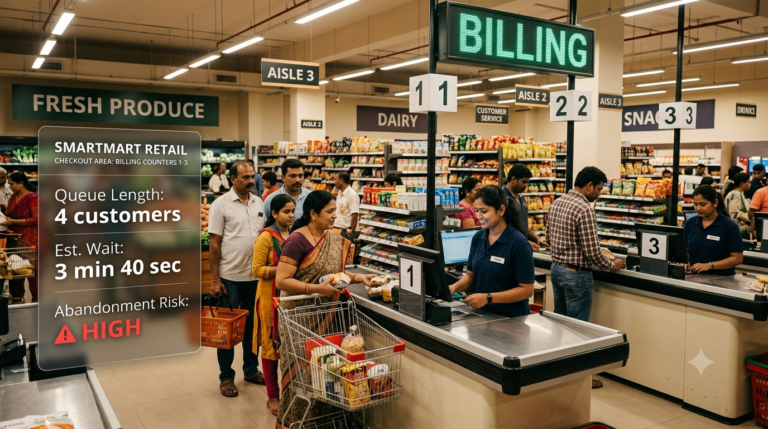
The ai video analytics system continuously measures queue depth at every billing counter and service point. When a queue exceeds a configurable threshold — say, three people waiting more than two minutes — an alert fires to the floor supervisor with the specific counter and a live camera view. Stores using queue monitoring consistently report 25–35% reduction in peak-hour abandonment, because interventions happen within the critical 90-second window before a customer walks out.
Capability 3 — Staff SOP Compliance Monitoring
Uniform compliance, greeting behaviour, station coverage, and designated zone staffing are monitored automatically by the ai video analytics engine. Supervisors receive alerts when staff leave their assigned zones during peak traffic, when uniform non-compliance is detected, or when a service counter goes unstaffed above a configured threshold. The system logs compliance scores per shift per staff member.
Capability 4 — Billing Fraud & Sweethearting Detection
The AI flags when a cashier skips items in the scan sequence, covers barcodes during checkout, or repeatedly scans the same low-value item instead of the correct high-value product. The alert goes to the LP supervisor with a timestamped footage clip at the moment of the transaction. Detection works on existing checkout-zone cameras without any POS hardware integration required.
Capability 5 — Zone-Level Heatmap & Dwell Analytics
Every square metre of your store generates a continuous heatmap showing traffic density, dwell time by product category, and cross-zone movement flows. Visual merchandising teams use this data to validate promotional placement, reposition high-margin SKUs into high-traffic zones, and identify the specific fixtures and layouts that correlate with longer dwell and higher basket size.
Capability 6 — Gender & Age Demographic Breakdown
Anonymous demographic analysis tracks visitor gender and age band distribution across store zones and time periods — without storing any biometric data. Category managers use this data to validate whether the customer segments actually shopping a zone match the intended target customer for the merchandise assortment. Mismatches have consistently led Indian retail teams to reposition entire fixture bays, with measurable conversion lifts within 30 days.
Manual Store Operations vs. AI Video Analytics — Side by Side
The manual observation model collapses at scale. Past 10 outlets it becomes statistical sampling. Past 50 outlets it becomes operational theatre — supervisors doing spot checks on the assumption that other stores are running correctly. The shift is from sample-based assurance to camera-based evidence: continuous, logged, and exportable for every store in the network simultaneously.
| Dimension | Manual / Traditional Operations | AIVIS AI Video Analytics |
|---|---|---|
| Footfall counting | Clicker counters, daily manual log | Automatic, real-time, per zone |
| Conversion rate visibility | End-of-day POS ÷ footfall estimate | Live per hour, per zone, per counter |
| Queue management | Floor supervisor observation | Automatic alert at configurable threshold |
| Staff compliance | Spot checks, subjective scoring | Continuous, objective, shift-level log |
| Billing fraud detection | Exception report, next morning | Real-time alert with footage clip |
| Shrinkage traceability | Quarterly inventory variance | Event-level, POS-correlated |
| Multi-store oversight | Requires proportional headcount | Same platform, same cost, any number of sites |
| Brand audit evidence | 3 people, 1 weekend per audit | Dashboard export in minutes |

How AIVIS Deploys on Your Existing Retail CCTV
No rip-and-replace. The deployment model for ai video analytics is an on-site edge AI box connected to the store’s existing IP cameras via RTSP/ONVIF. No server room is needed, no customer footage leaves the premises via cloud, and no VLAN reconfiguration is required from your IT team. A standard 40-camera store goes live in under 10 days. The edge box is the only new hardware; everything else is software running on your existing camera estate.
The same edge box runs all six ai video analytics capabilities simultaneously — footfall, queue monitoring, SOP compliance, billing fraud detection, heatmaps, and demographics — so the operations investment also serves the LP team, the visual merchandising team, and the HR team from day one. One platform, one camera layer, multiple business functions all reporting to the same dashboard.
For cross-vertical context, the same edge architecture powers our QSR video analytics deployments for quick-service restaurant chains, where the same platform monitors kitchen throughput, queue abandonment, and staff hygiene compliance.
The Retail Operations ROI Math — How AI Video Analytics Pays Back
For a store running ₹1.5 crore monthly revenue with a 3.2% conversion rate, a verified 1-percentage-point conversion improvement from ai video analytics-driven queue intervention and zone optimisation generates ₹4.7 lakh per month in incremental revenue per outlet. Across a 30-store network, that is ₹1.41 crore per month in recovered revenue — from the same customer traffic, the same staff, and the same camera infrastructure you already own.
The secondary ROI is headcount efficiency. Chains running AIVIS do not need to proportionally scale their operations and LP teams as the network grows. The same number of floor supervisors can cover a significantly larger store base because the ai video analytics engine surfaces only the events that require human judgment — a queue alert, a compliance flag, a fraud detection — rather than requiring supervisors to proactively inspect every counter, every zone, every shift.

Frequently Asked Questions
What is AI video analytics for retail stores?
AI video analytics for retail stores is a software platform that analyses live CCTV footage to generate real-time operational intelligence — counting footfall, measuring conversion rates, monitoring queue lengths, detecting billing fraud, and tracking staff SOP compliance — without adding cameras or changing IT infrastructure. The AI runs on existing IP cameras via an on-site edge box and delivers alerts to store managers via dashboard and WhatsApp.
Does AI video analytics for retail require new cameras?
No. AIVIS deploys on existing IP cameras via an on-site edge box using standard RTSP/ONVIF protocols. Most Indian retail stores — including those running Hikvision, Dahua, Axis, and CP Plus cameras — go live within 10 days without replacing cameras, changing the NVR, or modifying the IT network. The only new hardware is the edge AI processing box.
How does AI video analytics improve retail conversion rates?
AI video analytics improves retail conversion by identifying the specific moments and zones where customers are abandoning purchase intent — queue buildups that trigger walkouts, understaffed sections during peak traffic, promotional placements that are not reaching the right demographic. Store teams can intervene within the 90-second window that makes the difference between a conversion and a walkout.
What is the ROI timeline for retail AI video analytics?
For a store with ₹1.5 crore monthly revenue, a 1-percentage-point conversion improvement generates approximately ₹4.7 lakh per month per outlet in incremental revenue. At typical platform pricing for a 40-camera store, deployment pays back within 60–90 days. Billing fraud detection typically recovers platform cost within the first 60 days for stores running 15+ billing counters.
How does AI video analytics handle customer privacy in Indian retail?
AIVIS runs anonymised behavioural detection — identifying patterns such as footfall counts, dwell time, queue depth, and zone movement without storing identifiable biometric data. Facial recognition is disabled by default. Customer footage is processed on the on-site edge box and does not leave the store premises via cloud. PDPB 2025 compliance readiness is built into the deployment architecture.
Which Indian retail formats does AIVIS support?
AIVIS supports all major Indian retail formats: department stores, fashion and apparel, electronics and durables, grocery and supermarkets, QSR and food service, and banking branches. The platform runs 200+ pre-trained models covering footfall, conversion, queue management, SOP compliance, loss prevention, and demographic analytics.
Can AI video analytics integrate with existing POS systems?
Yes. AIVIS correlates video events with POS transaction logs in real time. Direct integration is available for GoFrugal, Marg ERP, LS Central, and Petpooja. The POS integration enables conversion rate calculation at the transaction level, giving category managers a granular view of which zones and promotions are actually driving purchase decisions.
How quickly can AI video analytics be deployed across a multi-store network?
A standard 40-camera single store goes live in under 10 days. Multi-store network rollouts scale to any number of outlets without proportional IT effort. The largest retail network deployments in India have gone from pilot approval to 50-store live deployment within 6 weeks, using the edge box shipping and remote activation model.
5-Step Checklist: Deploying AI Video Analytics in Your Retail Store
Retail teams deploying ai video analytics for the first time move fastest when they follow a structured activation sequence. Here is the exact checklist AIVIS uses with every new Indian retail client.
Step 1 — Camera Audit (Day 1)
AIVIS runs a remote camera audit across your existing CCTV network. Coverage gaps, resolution issues, and angle problems are flagged before deployment begins — eliminating surprises mid-project.
Step 2 — Zone Mapping (Days 2–3)
Each camera feed is mapped to a business zone — entrance, billing, aisle, high-value shelf. Zones determine what AI models activate and which alerts fire for each area of the store.
Step 3 — Edge Box Installation (Days 4–5)
The AIVIS edge box is shipped to site and connected to the NVR. No server room is required. The box handles all local inference, ensuring your store data never leaves the premises.
Step 4 — Alert Configuration (Days 6–8)
Alert thresholds are configured per zone: queue length, dwell time, SOP breach, and suspicious behaviour. Notification routing is set up for store manager, LP team, and operations dashboard.
Step 5 — Live Handover (Days 9–10)
Store team training is completed remotely. The dashboard goes live with real-time footfall, conversion rate, queue depth, and alert feed. First operational insights are typically visible within 48 hours of go-live.
SEE AIVIS RETAIL AI IN ACTION