Quick Answer
Bank branch security AI is shifting from passive CCTV recording to autonomous alert routing — where AI agents detect a threat, decide the correct response, and deliver the alert to the right person, zone, or system within seconds. For Indian banks running 50+ branches, this closes the detection-to-response gap that traditional video surveillance has never been able to solve.
Detecting a threat inside a bank branch is only the beginning. What happens in the next 30 seconds — automatically — is what determines whether an incident is prevented or just recorded.
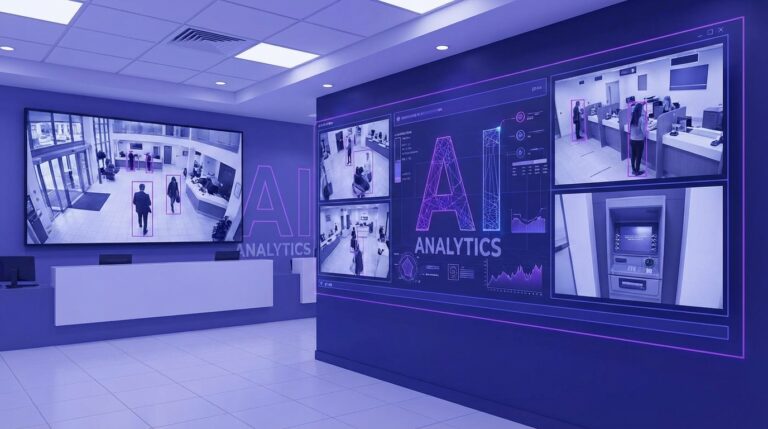
For decades, Indian banks have invested heavily in CCTV video analytics, NVRs, and VMS platforms, only to discover that 95% of the footage is reviewed after the event. Bank branch security AI changes that equation by layering agentic video analytics on top of existing camera infrastructure, turning silent recordings into real-time decisions.
This blog breaks down how autonomous alert routing works inside a live bank branch, the zone-by-zone action map, and why forward-thinking CISOs and branch operations heads across India are moving away from passive monitoring toward a Detect → Decide → Deliver framework.
Why Traditional Branch Security Is Failing the Modern Threat Model
Walk into any mid-sized private bank branch in India and you will see the same setup: 8 to 16 IP cameras, a DVR or NVR stack, and a security guard watching a wall of tiled feeds. The assumption baked into this design — that a human operator can reliably watch multiple screens, notice an anomaly, and trigger the right response — has been academically debunked for over twenty years.
Attention drops after 20 minutes. Pattern fatigue sets in. The guard blinks, and a skimmer installation, a weapon being drawn, or an unauthorized entry into the vault corridor slips past. This is why bank branch security AI has become a non-negotiable upgrade for India’s forward-thinking banking institutions.
This is the core operational gap that bank branch security AI is built to close. A modern video monitoring system does not ask a human to notice everything — instead, an AI agent is assigned to each camera stream, each zone, and each risk category. The agent does not sleep, does not glance away, and does not get distracted by a conversation at the counter.
And critically, once it detects something, it does not just light up a dashboard and hope someone looks — it routes the alert to the person, team, or system most likely to act on it.
What Is Autonomous Alert Routing in Bank Branch Security?
Autonomous alert routing — the core engine of bank branch security AI — is the decision layer that sits between video analytics detection and human response. It answers three questions for every event, in real time:
- What happened? (Detection — the output of the vision model: weapon drawn, vault door open >15 minutes, ATM loitering, face covered in lobby, queue breach at counter, etc.)
- Who should know? (Routing — branch manager, regional security head, bank’s central SOC, local police integration, or the customer-facing staff already on the floor.)
- How urgent is it? (Escalation — silent alarm, SMS, push notification, buzzer, on-screen overlay, or a combination, with auto-escalation if the first responder does not acknowledge within X seconds.)
This is what separates agentic video analytics from legacy “smart CCTV.” A legacy system might draw a red box around a person carrying a suspicious object and log it. An agentic system decides that because the event occurred in the teller zone, during business hours, and matches a weapon signature, the silent duress protocol must fire.
That means simultaneously alerting the branch manager on their phone, locking the vault corridor door, and sending the live feed to the regional SOC — without a single human click. That is bank branch security AI doing the work security teams were always expected to do, but could never physically deliver.
The Zone-by-Zone Autonomous Action Map for a Modern Bank Branch
Every bank branch has roughly five functional zones, and each zone has a different risk profile. An effective bank branch security AI platform maps alerts and responses to zones rather than to cameras — because a “person detected” event in the vault corridor means something very different from the same event at the customer waiting area.
Here is how the zone-by-zone action map plays out in live Agrex.ai deployments.
1. Vault & Cash Handling Zone
The vault is the highest-consequence zone in a branch. Autonomous agents continuously monitor vault door state, dwell time of authorized staff, and any presence of unregistered faces. The three most common alerts routed automatically: vault door open beyond the 15-minute compliance window, more than two people inside the strongroom simultaneously when policy mandates dual-control, and any intrusion after banking hours.
Alerts here route silently — no audible buzzer inside the branch — directly to the branch manager’s phone and the central security operations center. Loud alarms in a vault scenario can escalate risk if a robbery is in progress. This is where bank branch security AI delivers maximum value with minimum visibility.
2. Teller & Cash Counter Zone
The teller line is where the highest volume of customer interactions and the highest density of potential incidents overlap. AI agents here monitor for cashier absence beyond threshold, weapon signatures (gun or knife outlines), cell phone usage at the counter (a regulatory concern for some banks), cash visible on the counter for extended periods, and queue length breaches.
A weapon detection here triggers the silent duress protocol — the branch manager gets a push alert, the CCTV feed auto-escalates to the SOC, the entry door magnetic lock engages, and a pre-recorded police alert is queued for dispatch if the event persists beyond 45 seconds. Every second matters, and bank branch security AI handles this triage faster than any human team can.
3. ATM Lobby & Vestibule
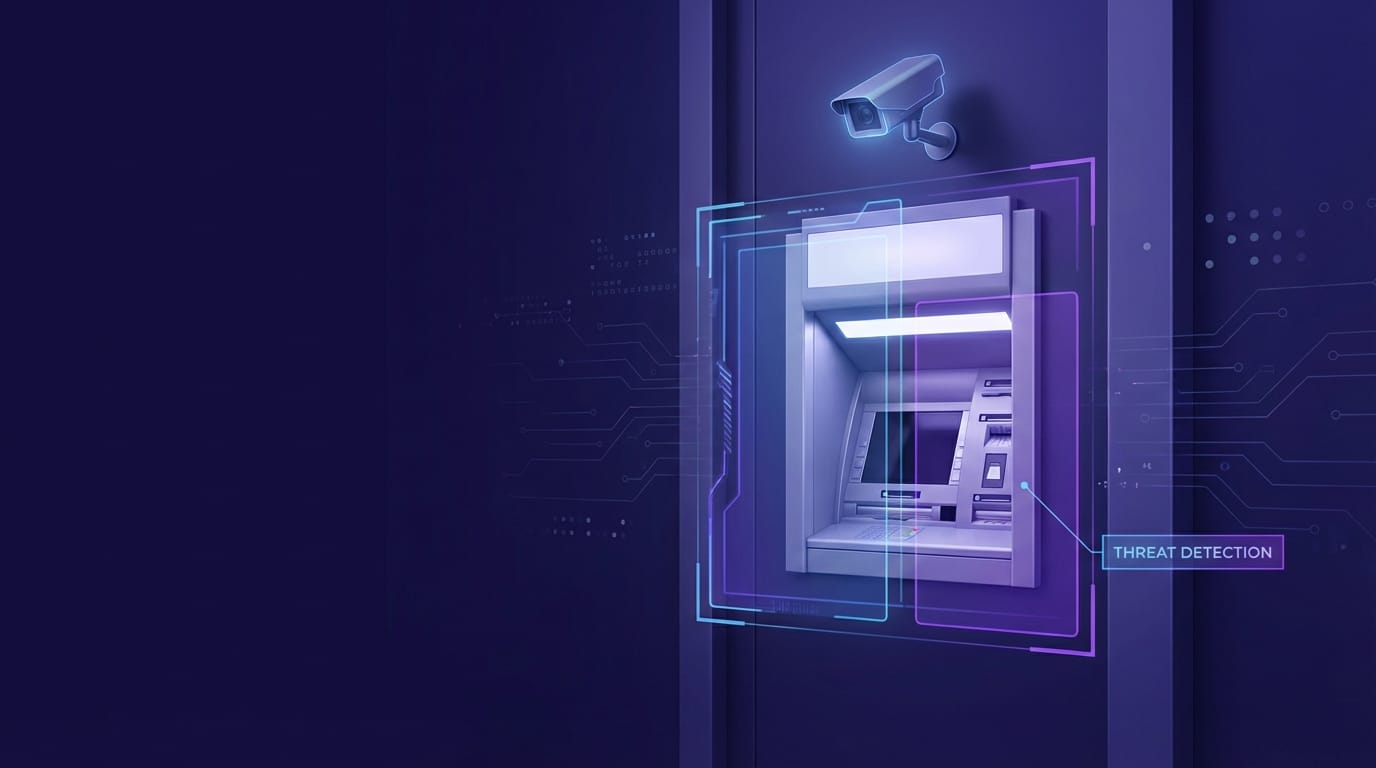
ATMs are the most commonly targeted surface in Indian retail banking for both fraud and physical crime. Autonomous agents watch for ATM loitering beyond normal transaction time, face-covering or helmet usage inside the lobby, skimming device installation patterns, garbage and spill detection (a compliance metric), and crowd formation.
Loitering alerts route to the branch manager first with a configurable delay; persistent events escalate to the regional head. Bank branch security AI treats each ATM vestibule as its own micro-zone with independent escalation rules. Our earlier deep-dive on AI-powered ATM security monitoring goes deeper into the detection models behind this.
4. Customer Lobby & Waiting Area
The lobby is the “soft zone” — lower consequence per event, but the highest footfall density. The AI agent here is less focused on threat detection and more on operational intelligence: queue wait times, customer dwell time at specific counters, heatmaps of movement flow, and unattended-customer alerts (a customer standing at a service desk for >3 minutes without an employee present).
Routing here is gentler — dashboard notifications to the branch manager, and aggregated analytics pushed to regional operations in a daily digest. Lobby intelligence is where AI video analytics quietly generates the operational gap insights that drive branch efficiency improvements.
5. Entrance, Perimeter & Parking
The entrance is the branch’s first line of detection. AI agents here run ANPR (Automatic Number Plate Recognition) on every vehicle, flag blacklisted plates against the bank’s internal watchlist, and monitor for after-hours loitering on the perimeter.
ANPR data is logged with timestamp and face-linked entry logs, creating an auditable compliance trail for every visitor entering the branch. Combined with forced-entry detection on shutters and doors, bank branch security AI makes the perimeter zone as intelligent as the vault zone.
Detect → Decide → Deliver: The Autonomous Alert Routing Framework
The architecture that makes all of the above possible is deceptively simple, and it maps to three agent layers that operate continuously on top of existing camera streams.
Layer 1 — Detect
Computer vision models run 24/7 on the RTSP feed from each IP camera. Agrex.ai is hardware-agnostic and integrates with existing NVRs and VMS platforms like Milestone and Genetec, so banks do not need to replace a single camera.
Models cover people counting, weapon detection, face covering, PPE (for back-office zones), ANPR, loitering, and object-left-behind classes out of the box. This is where bank branch security AI begins its work.
Layer 2 — Decide
Once a detection event fires, a decision agent evaluates it against three dimensions: zone (where), time (when), and role (who was involved).
The same “person in restricted area” event is handled differently at 2pm vs 2am, and differently inside the vault corridor vs the customer lobby. The decision agent is where false positives get suppressed and where the escalation logic of bank branch security AI lives.
Layer 3 — Deliver
Delivery is where legacy systems fail. An agentic platform pushes the alert to the right channel: silent duress SMS, branch manager’s mobile app, regional SOC dashboard, audible buzzer, door lock engagement, or an API call into the bank’s security incident management system.
If the first recipient does not acknowledge within a set window, the event auto-escalates up the chain. This is the final mile of bank branch security AI — closing the detection-to-response gap that traditional video surveillance has never solved.
Legacy CCTV vs Agentic Bank Branch Security AI: A Side-by-Side
| Capability | Legacy CCTV + NVR | Agentic Branch Security AI |
|---|---|---|
| Detection mode | Human operator review | Autonomous AI agents per zone |
| Response latency | Minutes to hours (post-event review) | Under 30 seconds from detection |
| False positives | High — operator fatigue & missed events | Under 5% with zone-aware decision logic |
| Alert routing | Manual calls / radio | Automated to role, zone, and escalation tier |
| Audit trail | Footage review, manual logs | Auto-generated, timestamped, searchable |
| Hardware requirement | Separate analytics box per site | Works on existing IP cameras & NVRs |
| Operational ROI | None — pure cost center | 30% average cost savings in 3–6 months |
Compliance, Audit, and the RBI Angle
Every bank branch in India operates under a compliance stack that includes RBI guidelines on physical security, internal vigilance policies, and increasingly, data protection obligations under the DPDP Act. Legacy CCTV gives you footage. An AI compliance monitoring layer like bank branch security AI gives you an auditable, timestamped, event-level record of every alert, acknowledgement, escalation, and resolution — exportable in the format internal audit teams actually need.
The Reserve Bank of India’s guidance on branch security (see the RBI official website for current circulars) increasingly expects banks to demonstrate not just that they have security systems in place, but that those systems are actively monitored and that incidents are responded to within reasonable windows.
Autonomous alert routing creates the evidentiary trail that closes this compliance loop without requiring additional headcount. This is where bank branch security AI pays for itself — not just in prevented incidents, but in audit readiness.
Integration with Existing Branch Security Infrastructure
A common objection we hear from bank IT and security teams is: “We have already invested in cameras, an NVR stack, a VMS, and a central SOC — we do not want to replace anything.” That is precisely the design principle behind the Agrex.ai platform. The AI surveillance software stack is hardware-agnostic and layers on top of what a bank already owns.
- Cameras: Any IP/RTSP-compatible camera — Hikvision, Dahua, CP Plus, Axis, Bosch, or enterprise-grade models already deployed.
- NVRs & VMS: Direct feed integration with Milestone XProtect, Genetec Security Center, and most standard ONVIF-compliant NVRs.
- Alerting channels: SMS, email, push notification (iOS/Android app), webhook into the bank’s incident management tool, audible alarm triggers via relay.
- Analytics dashboard: Single pane of glass across all branches with role-based access — branch managers see their branch, regional heads see their circle, central security sees everything.
This is why banks can roll out bank branch security AI via Agrex.ai across 50+ branches in under 30 days — there is no camera replacement, no cabling work, and no downtime for the branch. Onboarding is largely a configuration exercise.
What Does a Real Deployment Look Like?
A typical mid-sized private bank rollout across 50 urban and semi-urban branches covers 14 to 18 alert classes, mapped zone-by-zone. The first two weeks are spent tuning detection thresholds against the branch’s real-world foot traffic to suppress false positives.
By week three, branch managers are receiving an average of 4 to 7 genuine actionable alerts per day per branch — a mix of operational alerts (queue breaches, cashier absence) and security alerts (ATM loitering, after-hours perimeter events). By month two, the bank’s central SOC stops needing to staff nighttime shifts for passive monitoring because bank branch security AI is handling the triage layer autonomously.
The operational metrics that matter most to bank branch security AI decision-makers — mean-time-to-response, incident close-out rate, false-positive-to-true-positive ratio, and compliance audit pass rate — all trend in the same direction within the first quarter of deployment. For the broader context on how this fits into the Indian banking security stack, see our analysis of AI video analytics in banking and ATM security in India.
Where Bank Branch Security AI Goes Next
The next frontier for bank branch security AI is not detection accuracy — that is already at 95%+. It is orchestration. Over the next 12 to 18 months, the branches running autonomous alert routing powered by intelligent video analytics today will start connecting those alerts to downstream workflows.
That means auto-generating incident reports for internal audit, feeding anonymized pattern data into fraud models, and coordinating multi-branch responses when a coordinated threat signature appears across a geographic cluster.
Related reading from our blog: how autonomous video analytics reduces queue abandonment (different vertical, same Detect → Decide → Deliver architecture) and 10 warehousing use cases where AI video analytics is making Indian operations safer.
Frequently Asked Questions About Bank Branch Security AI
What exactly is bank branch security AI?
Bank branch security AI is a software layer that sits on top of a bank’s existing CCTV and IP camera network and uses computer vision plus autonomous decision agents to detect security and operational events in real time, then route alerts automatically to the right person or system. It replaces the passive human-monitoring model with a Detect → Decide → Deliver architecture.
Do we need to replace our existing CCTV cameras?
No. Agrex.ai is hardware-agnostic and integrates via RTSP with any ONVIF-compliant IP camera and with major NVR and VMS platforms like Milestone and Genetec. The entire deployment is a software overlay on top of existing infrastructure.
How fast is alert routing in a real incident?
Autonomous alert routing in live deployments delivers the alert to the designated responder in under 30 seconds from the moment of detection. For silent duress scenarios like weapon detection, the routing is instantaneous and goes to multiple parallel channels simultaneously.
What alert classes does the platform cover out of the box?
Standard coverage includes weapon detection, face covering or helmet usage in ATMs, vault door compliance timing, ATM loitering, cashier absence, queue breach, unauthorized access to restricted zones, perimeter intrusion, ANPR against watchlists, and fire or smoke detection. Custom alert classes can be added per bank’s internal policy.
How long does a 50-branch rollout take?
Typical enterprise rollouts across 50+ locations complete in under 30 days because there is no camera replacement, no new cabling, and no branch downtime. Onboarding is primarily configuration — mapping zones, tuning detection thresholds against real foot traffic, and setting up the routing and escalation rules.
What is the false positive rate?
Live deployments sustain a false positive rate below 5%. Zone-aware decision logic is the key — the same detection event is handled differently depending on where it occurs, when, and who is involved, which aggressively suppresses the noise that plagues legacy analytics.
See Bank Branch Security AI in Action on Your Existing Cameras
Book a 30-minute live demo with the Agrex.ai team. We will show you zone-by-zone autonomous alert routing running on a real branch feed — no hardware swap, no downtime, no commitment.
Written by the Agrex.ai editorial team. Agrex.ai is India’s leading agentic video analytics platform, helping banks, retailers, and enterprises turn existing camera infrastructure into real-time decision systems. Connect with us on LinkedIn.