Table of Contents
- What Is Camera Health Monitoring — and Why Manual Checks Are Not Enough
- How AI-Based Camera Health Monitoring Works: From Feed Detection to Automated Alerts
- The 5 Camera Health Metrics Every Operations Team Should Track
- How Indian Enterprises Use CHMS Dashboards to Cut Downtime and Cost
- What to Look for in a Camera Health Monitoring Platform (and What to Ignore)
- FAQ — Camera Health Monitoring for Multi-Site Operations
In a study by Genetec, over 30% of enterprise CCTV cameras are non-functional at any given time — and most organisations discover this only after a security incident has already occurred. That is the core problem camera health monitoring is built to solve.
When cameras go offline undetected across a multi-site retail chain, logistics hub, or bank branch network, the consequences are immediate. Incident footage disappears. Compliance audits fail. Insurers reject claims. Operations teams have no visibility — and no warning.
In India, where enterprises routinely manage 50 to 500+ cameras across distributed locations with lean IT teams, undetected camera downtime is not an edge case. It is a daily operational risk. Moreover, as regulatory requirements for physical security tighten across banking and logistics, the cost of a missed camera failure is no longer just operational — it is financial and legal.
In this guide, you will discover what camera health monitoring actually is, how AI-based systems detect failures before they cause damage, and which metrics and platforms deliver the highest uptime — without requiring a dedicated on-site IT team at every location.
Arush Kakkar, Co-founder and CEO of Agrex AI, has deployed camera health monitoring systems across 100+ enterprise clients in retail, logistics, and banking across India — maintaining 96%+ camera uptime across multi-site deployments.
See how AIVIS keeps every camera online across all your sites — in real time.
Book a Free Demo →What Is Camera Health Monitoring — and Why Manual Checks Are Not Enough
Camera health monitoring is the practice of continuously tracking the operational status of every camera in a CCTV network — including feed quality, connectivity, storage, and hardware health. For any organisation managing cameras across multiple sites, relying on manual checks creates dangerous gaps in coverage. Furthermore, as enterprise camera estates scale to hundreds of devices, the operational complexity of manual audits grows exponentially.
Manual inspection requires staff to physically visit each NVR or DVR, review playback, and log issues — a process that is slow, inconsistent, and impossible to scale. According to the Genetec Physical Security Report 2023, enterprises that rely on manual camera checks identify less than 60% of camera failures before an incident surfaces the problem.
Camera health monitoring is the automated, continuous tracking of a CCTV camera network’s operational status. It works by polling each camera for feed activity, signal strength, storage capacity, and NVR connectivity at regular intervals. Most commonly used for multi-site enterprise deployments in retail, logistics, and banking where manual monitoring is not feasible at scale.
Why Manual Checks Fail at Scale
A typical enterprise with 10 sites and 30 cameras per site has 300 cameras to check. Manual processes might audit each camera once a week at best. In that window, a camera can go offline, miss dozens of critical events, and come back online — leaving no trace of the failure until an incident review demands the footage. Consequently, operations teams operate with a false sense of security that erodes every time they need evidence that was never recorded.
The Compliance Risk in Indian Enterprises
In banking and financial services, camera uptime is a regulatory requirement. The Reserve Bank of India’s guidelines on physical security for bank branches mandate functional surveillance at all times. A camera failure that goes unlogged is not just an operational issue — it is a compliance exposure. Additionally, insurance policies at major retail chains increasingly require demonstrable camera uptime records as a condition of claim settlement.
How AI-Based Camera Health Monitoring Works: From Feed Detection to Automated Alerts
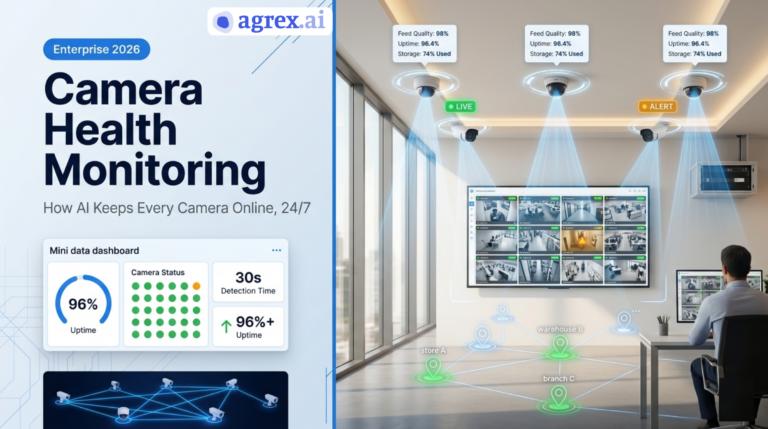
AI-based camera health monitoring goes beyond simple ping checks. It analyses the actual video feed — detecting frozen frames, black screens, obstructed lenses, and signal degradation — and triggers automated alerts before a human would notice. This is the technical foundation of a reliable camera health monitoring system.
At the infrastructure layer, the system connects to NVRs, DVRs, and IP cameras across all sites via a centralised cloud or on-premise dashboard. Every camera is polled on a defined interval — typically every 30 to 60 seconds — and any anomaly triggers an escalation to the assigned IT or operations contact. As a result, the detection window shrinks from hours to under one minute.
AI-based camera health monitoring works by analysing live video feed content — not just network connectivity — at 30-second intervals. It detects frozen frames, black screens, obstructed lenses, and NVR write failures automatically. Most commonly deployed across multi-site retail, logistics, and banking networks to eliminate undetected camera downtime and ensure continuous surveillance coverage.
What AI Detects That Ping Checks Miss
A ping check only confirms that a device is connected to the network. It cannot tell you whether the camera feed is actually producing usable video. AI-based systems analyse frame content — detecting the failure types that matter operationally:
| Failure Type | Ping Check | AI Feed Analysis |
|---|---|---|
| Camera disconnected from network | ✓ Yes | ✓ Yes |
| Frozen or static frame | ✗ No | ✓ Yes |
| Black/white screen (lens blocked) | ✗ No | ✓ Yes |
| Severe pixelation or image noise | ✗ No | ✓ Yes |
| NVR write failure (feed live, not saving) | ✗ No | ✓ Yes |
| Partial obstruction (camera shifted) | ✗ No | ✓ Yes |
The Automated Alert Workflow
When an anomaly is detected, the system logs a timestamped event, classifies the failure type, and sends an alert via SMS, email, or in-app notification to the assigned responder. The CHMS dashboard updates in real time, giving operations teams a single-pane view of every site’s camera health status. According to IHS Markit’s Video Surveillance Intelligence Service, AI-enabled camera monitoring platforms reduce mean time to detection (MTTD) for camera failures by up to 85% compared to manual check-based systems.
The 5 Camera Health Metrics Every Operations Team Should Track
Not all camera health data is equally useful. Operations and IT teams need a focused set of metrics that give them actionable signal — not noise. A well-configured camera health monitoring system surfaces exactly these five metrics across every site in real time.
Camera uptime monitoring tracks five core metrics: camera uptime percentage, feed quality score, NVR connectivity status, storage utilisation rate, and alert response time. These metrics give operations teams real-time visibility into CCTV network health. Used by retail, logistics, and banking enterprises to prevent undetected surveillance gaps and meet compliance requirements.
1. Camera Uptime Percentage
The percentage of time each camera is online and producing a live feed. Industry benchmark for enterprise deployments is 95%+. Anything below 90% signals a hardware, network, or power issue that needs immediate investigation. Tracking this metric per-camera and per-site creates an auditable uptime record for insurance and compliance purposes.
2. Feed Quality Score
A composite score assessing frame sharpness, exposure, and motion clarity. A camera can be “online” but delivering unusable footage. Feed quality scoring catches this. Agrex AI’s AIVIS platform scores feed quality on a continuous basis — flagging cameras that are technically live but operationally blind. Therefore, your compliance record accurately reflects usable coverage, not just connectivity.
3. NVR Connectivity and Storage Health
Even if a camera is recording, a full or failing NVR means footage is not being saved. Storage utilisation alerts — triggered at 80% and 95% thresholds — prevent data loss before it happens. NVR connectivity monitoring ensures every camera’s feed is reaching its recording destination. For enterprises managing 10+ sites, centralised NVR health monitoring eliminates the need for on-site storage audits entirely.
4. Offline Duration and Frequency
How long a camera was offline and how often it drops are more revealing than a single uptime number. A camera that drops 10 times a day for two minutes each time has the same uptime percentage as one that dropped once for 20 minutes — but the former indicates a network instability issue the latter does not. Consequently, frequency-based monitoring surfaces intermittent failures that uptime scores alone miss.
5. Alert Response Time
The time between a camera failure detection and a confirmed response from the assigned team. Tracking this metric surfaces which sites or teams are slow to respond — enabling targeted training or escalation policy changes. In multi-site enterprises, this single metric often reveals locations that have effectively no active monitoring coverage despite being “connected” to the system.
How Indian Enterprises Use CHMS Dashboards to Cut Downtime and Cost
A CHMS (Camera Health Monitoring System) dashboard gives operations managers a real-time, single-screen view of every camera across every site. For Indian enterprises managing distributed locations — retail stores, logistics warehouses, bank branches — this replaces daily status calls to site managers and manual NVR log reviews entirely. Furthermore, it creates a searchable audit trail that satisfies compliance and insurance requirements automatically.
A CHMS dashboard is a centralised interface that displays real-time camera uptime, feed quality, NVR status, and alert history across all sites. It works by aggregating data from all connected cameras and NVRs into a single view updated every 30 seconds. Most commonly used by IT heads and operations managers in multi-site retail, logistics, and banking enterprises to eliminate reactive camera monitoring.
Agrex AI’s CHMS is deployed across Bata India, Pantaloons, and Marks & Spencer India — maintaining 96%+ camera uptime across multi-site deployments. Operations teams receive real-time alerts when feeds drop, storage fills, or NVR connections break — without needing a dedicated IT team on-site at any location.
The impact is measurable. Before deploying a camera health monitoring system, these enterprises relied on incident reports or manual checks to discover camera failures. After deployment, the average detection time for a camera going offline dropped from hours to under two minutes. Moreover, the AI video analytics layer in AIVIS cross-references camera health data with footfall and incident data — so operations teams can identify whether a spike in security incidents correlates with a period of camera downtime at that specific location.
For retail video analytics deployments, loss prevention teams always know which cameras are live during peak trading hours. Similarly, for logistics video analytics clients, warehouse managers receive automated alerts when loading dock cameras go offline — before a shift starts, not after.
“What consistently surprises operations teams when they get real-time camera health data for the first time is the gap between what they assumed was working and what was actually working. In our deployments at Bata India and Pantaloons, teams discovered that on average, 12–18% of cameras across their estate had experienced undetected downtime in the previous 30 days. They only knew because AIVIS showed them the logs. Before that, they found out a camera was offline only when someone needed the footage and it wasn’t there — which is always after the fact. Real-time camera health monitoring changes the entire posture from reactive to preventive.”
Is Your Camera Network Actually Reliable?
Most operations teams don’t find out until an incident happens. AIVIS shows you the full picture — live, across every site.
Book a Free AIVIS Demo →What to Look for in a Camera Health Monitoring Platform (and What to Ignore)
The camera health monitoring market in India has grown significantly over the past two years. Not every platform delivers what enterprise operations teams actually need. Knowing which capabilities are essential — and which are marketing features that add complexity without operational value — saves months of wasted evaluation time and budget.
A camera health monitoring platform should provide real-time feed analysis, multi-site dashboard visibility, automated alerts, NVR and storage health tracking, and integration with existing infrastructure. Avoid platforms that rely solely on ping-based checks, require on-site servers at every location, or lack role-based alert routing. Prioritise vendors with proven deployments in Indian enterprise environments.
Must-Have Capabilities
- AI-based feed analysis — not just connectivity ping. The platform must analyse actual video content to detect frozen frames, black screens, and obstruction.
- Multi-site centralised dashboard — a single interface covering all locations, with per-site drill-down and cross-site benchmarking.
- Role-based alert routing — IT alerts go to IT. Security alerts go to security. Operations alerts go to store or site managers. Blanket alerts create noise and get ignored.
- NVR and storage health monitoring — camera uptime means nothing if footage is not being recorded and stored reliably.
- Mixed-vendor support — most Indian enterprise estates run Hikvision, Dahua, and CP Plus cameras across NVRs of varying age. ONVIF/RTSP compatibility is non-negotiable.
What to Deprioritise
- Highly customisable reporting templates that require weeks of configuration before delivering value.
- Platforms that require dedicated on-site edge servers at every location.
- Feature-heavy dashboards with dozens of metrics but no built-in alert workflow — data without action is just noise.
The Indian Enterprise Context
Most enterprise camera networks in India run a mix of IP cameras from multiple vendors across NVR setups of varying age. The right platform must support mixed-vendor environments via ONVIF or RTSP protocols. Agrex AI’s AIVIS platform supports multi-vendor NVR environments natively, making it deployable across existing infrastructure without a rip-and-replace cycle. Additionally, AIVIS operates on your existing NVR hardware, meaning no new device procurement is required at deployment.
FAQ — Camera Health Monitoring for Multi-Site Operations
The questions below are answered in a direct, standalone format. Each answer is complete on its own — covering the definition, mechanism, and use case without requiring you to read the full article.
Camera health monitoring is the automated, continuous process of tracking whether every camera in a CCTV network is online, recording, and producing usable video. It monitors feed quality, NVR connectivity, storage capacity, and hardware status — and sends alerts when any camera fails or degrades. It is used by IT teams and operations managers at multi-site enterprises in retail, logistics, and banking to prevent undetected surveillance gaps. Unlike manual checks, AI-based camera health monitoring operates continuously and detects failures within 30 to 60 seconds of occurrence.
Most CCTV systems do not include active monitoring by default. NVRs record footage passively and do not alert anyone when a camera disconnects. Without a dedicated camera health monitoring system, the only way to discover a failure is to manually review the NVR log or notice that footage is missing — both of which are reactive, not preventive. In multi-site operations, no single person has visibility across all cameras simultaneously. Additionally, cameras that suffer from frozen feeds or obstructed lenses appear “connected” on a basic network check — but are producing no usable footage.
A CHMS (Camera Health Monitoring System) dashboard is a centralised interface that displays the real-time status of every camera across all connected sites. It shows uptime percentage, feed quality score, NVR health, storage utilisation, and alert history in a single view — updated every 30 seconds. Operations managers and IT heads use it to identify and resolve camera failures without visiting each site physically. A good CHMS dashboard also logs every incident with a timestamp, creating an auditable record for compliance and insurance purposes.
Manual checks are periodic, inconsistent, and unable to detect failures in real time. They also only verify network connectivity — not whether the camera feed is actually producing usable video. AI-based camera health monitoring is continuous, running every 30 to 60 seconds, and analyses actual video feed content to detect frozen frames, obstructed lenses, black screens, and NVR write failures that manual processes routinely miss. As a result, detection time drops from an industry average of 4 to 6 hours to under two minutes. Furthermore, AI monitoring creates an automated audit trail that manual checks cannot produce.
A well-configured AI-based camera health monitoring system detects a camera going offline within 30 to 60 seconds of the failure occurring. Agrex AI’s AIVIS platform polls camera feeds at 30-second intervals and triggers alerts immediately upon detecting feed loss, NVR disconnection, or storage failure — enabling the operations team to respond before the downtime window extends. In contrast, manual check-based environments average 4 to 6 hours of undetected downtime per incident, based on Agrex AI’s deployment data across retail and logistics clients in India.
Final Takeaways
Camera health monitoring is not a luxury for large enterprises — it is a baseline operational requirement for any organisation running CCTV across multiple sites. Three things to take away: first, manual checks cannot detect failures in time to prevent damage; second, AI-based systems reduce detection time from hours to seconds; third, a CHMS dashboard gives operations and IT teams the visibility they need without adding headcount or on-site IT resources.
For Indian enterprises in retail, logistics, and banking, the gap between assuming cameras are working and knowing cameras are working is where incidents, compliance failures, and operational blind spots live. A camera health monitoring system closes that gap — and creates an auditable record that protects the organisation every time a claim or compliance review arises.
The right platform, deployed across your existing infrastructure, keeps uptime above 95%, routes alerts to the right people, and gives you a complete audit trail without a dedicated IT team at every location.
See How AIVIS Monitors Every Camera Across All Your Sites in Real Time
Book a free demo and see your full camera network health dashboard — live, across every site, in under 20 minutes.
Book a Free Demo at agrexai.com →