Quick Answer
An AI video analytics platform for Indian manufacturing in 2026 is no longer a single-plant pilot. It is the multi-site edge-AI compliance stack that runs PPE, SOP, and intrusion detection across every plant on existing CCTV — without a server-room overhaul. The leading top video analytics companies in india in 2026 are no longer judged on detection accuracy alone — they are judged on whether the platform replicates cleanly across 4, 12, or 40 plants. This is the 2026 buyer guide for shortlisting any ai video analytics platform india for an Indian manufacturing rollout.
200+
Pre-built manufacturing AI models
<30 Days
Go-live on existing plant CCTV
Multi-Site
Replicated across 4+ plants in weeks
24/7
PPE, SOP & intrusion compliance logging
Why 2026 Is the Year Indian Manufacturing Stops Buying Point Tools and Buys an AI Video Analytics Platform
For five years, Indian manufacturers bought factory video AI the same way they bought everything else — one plant at a time, one use case at a time, one vendor at a time. A PPE compliance tool here. An ANPR system at the gate. A separate intrusion-detection contract for the night shift. Each tool had its own dashboard, its own integration, its own renewal cycle. By 2026, every CFO running a multi-site Indian manufacturing operation has run the math and reached the same conclusion: the point-tool era is over.
The shift is to a single ai video analytics platform that runs every use case on every plant, on the cameras already installed, with one dashboard and one audit trail. Three forces are driving this in 2026.
First, customer-side audits are no longer optional. Tier-1 OEMs across auto, white goods, pharma, and electronics now run supplier compliance audits stricter than the Factory Act 1948. They want a 30-day PPE compliance log, by zone, by shift, exportable in 24 hours. No collection of point tools can produce that under audit conditions. Only a unified platform can. We covered the customer-audit framing in depth in our 2026 guide to video analytics software for manufacturing.
Second, IT teams are saying no to one-off integrations. The Indian manufacturing IT manager has been burned three times in five years by point-tool deployments that promised no overhaul and then asked for a VLAN change at month four. The 2026 platform expectation is: integrate with legacy NVR/VMS via RTSP/ONVIF, run on the existing camera estate, ship an on-site edge AI box, never touch the production network.
Third, insurers and OEM contract teams are pricing safety differently. Verified, continuous safety data — not anecdotal walk-throughs — is becoming a renewal-rate determinant on both insurance premiums and supplier contracts. The platform that produces that data continuously, across every plant, wins.
What an AI Video Analytics Platform for Manufacturing Actually Does
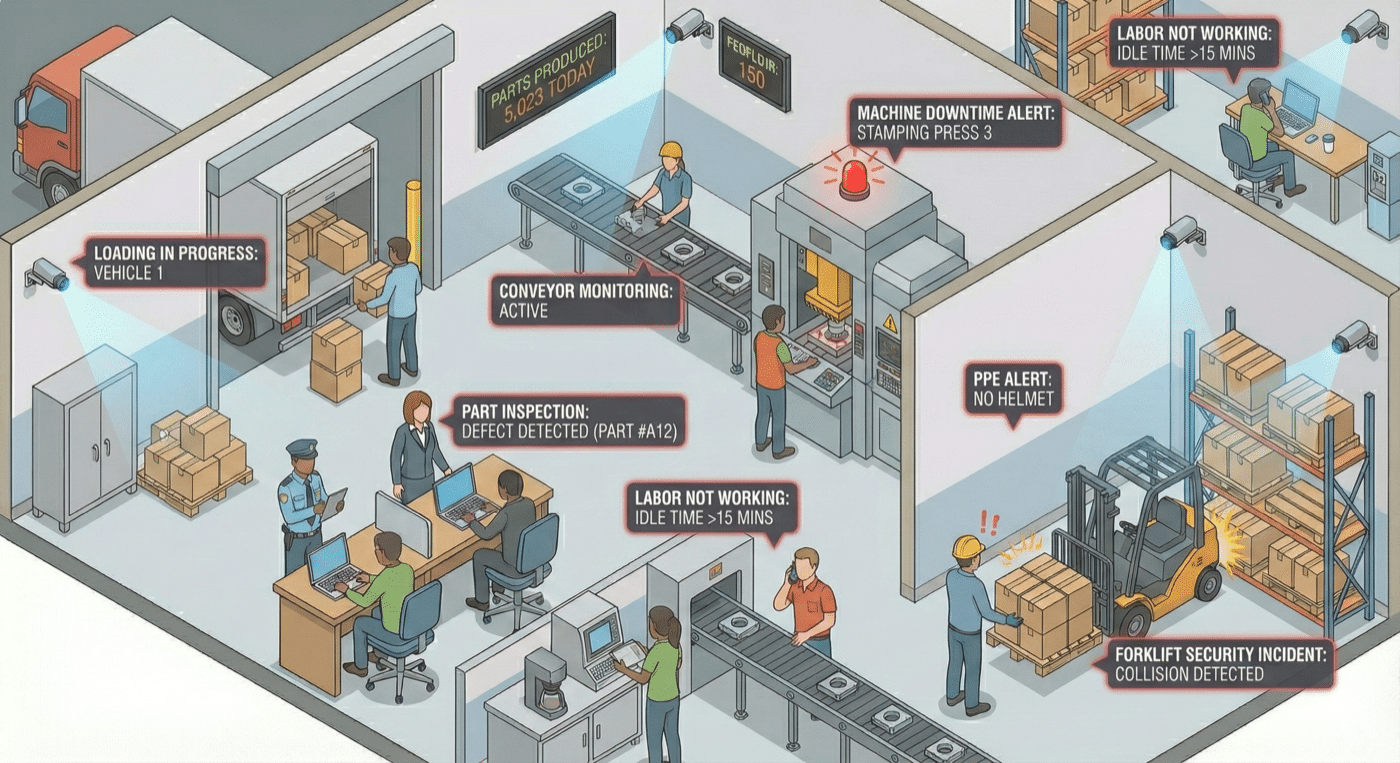
An ai video analytics platform is the layer that sits between the cameras already mounted on every line in every plant and the people who need to act on what those cameras see — the shift supervisor, the EHS lead, the plant head, the corporate ops team. It uses computer vision and agentic AI to detect specific factory events — a missing helmet at the welding bay, a forklift in a pedestrian aisle, an unauthorised vehicle at the gate, a hand-wash station bypass, an after-hours intrusion at the chemical store — classify the event, route the alert to the right person on the right plant, and log every step into a tamper-evident, audit-ready record.
What it is not: a smarter NVR. A legacy VMS records footage. A real ai video analytics platform india turns that footage into resolved events, with full closed-loop tracking — without adding a server room, a VLAN change, or a third-party cloud egress concern. For a deeper view of the use-case landscape, our AI video analytics manufacturing use cases guide covers eight live deployments in detail.
7 Capabilities Real AI Video Analytics Platforms for Manufacturing Must Deliver in 2026
Use this list as your shortlist filter. If a vendor positioning themselves as one of the top video analytics companies in india cannot credibly demonstrate all seven inside an Indian multi-site environment, they are selling a single-use point tool — not an ai video analytics platform.
Capability 1 — Edge AI Architecture on Existing CCTV
No server room, no cloud egress, no rip-and-replace of the camera estate. Inference runs on an on-site edge box wired to your existing IP cameras via RTSP/ONVIF. Production data stays on-premise, latency stays sub-second, and your plant IT team does not have to defend a VLAN change to head office for every new use case.
Capability 2 — 200+ Pre-Built Manufacturing AI Models, Day One
PPE compliance, SOP compliance, forklift safety, restricted-zone access, ANPR for gate and yard, fire-extinguisher obstruction, after-hours intrusion — a real ai video analytics platform ships these as pre-trained models, ready on the first plant rollout. Custom plant-specific scenarios train in days, not months.
Capability 3 — Zone-Based Rules Without Developer Dependency
A welding bay needs different rules than a clean room, and the same camera can serve both at different times. Your plant EHS lead — not a Python developer — should be able to draw a zone on a camera feed, attach a rule, and set the routing chain. If the platform needs a vendor ticket every time a line is reconfigured, it will not survive a year of plant changes.
Capability 4 — Role-Based Alert Routing Per Plant
A near-miss at Plant 3 should not land on Plant 7 shift supervisor WhatsApp. Real ai video analytics platforms route by role, zone, shift, and plant — with one-tap acknowledgement and a clip of the event. The corporate EHS team gets the aggregated view. The plant head gets only their plant events.
Capability 5 — Auto-Escalation on Unacknowledged Alerts
Half the safety events in Indian plants get logged. The other half get screenshotted and forgotten. A real platform escalates: if Zone B supervisor does not acknowledge a PPE violation in five minutes, the plant head phone lights up. If unacknowledged in fifteen, the corporate EHS director sees it. This is the loop that turns having cameras into having a response system.
Capability 6 — Closed-Loop Resolution Tracking, Audit-Ready
This is the capability that wins customer audits. Every event needs a four-stamp record: detected, acknowledged, actioned, resolved. When an OEM auditor asks how the Zone B violation on the 14th got resolved, the answer is on a dashboard, exportable in 30 seconds. That is the difference between a video monitoring system that records and one that defends contracts.
Capability 7 — Multi-Site Replication on One Dashboard
This is where pilots die. The platform has to deploy the same edge architecture, same rule sets, same dashboard across Plant 1, Plant 5, and Plant 40 — without a custom integration every time. The corporate ops team should see compliance trends across every plant on one screen. The plant head only sees their plant. Same data layer, different views.
AI Video Analytics Platform vs Single-Use-Case Point Tools — Side by Side
The fastest way to see why an ai video analytics platform wins in 2026 is to compare it to the alternative your competitors are still buying — three or four separate point tools, one per use case.
| Dimension | Stack of Point Tools | AI Video Analytics Platform (AIVIS-grade) |
|---|---|---|
| Dashboards | 3–5 separate logins | One platform, all use cases |
| Per-plant deployment | Custom integration each time | Replicated architecture per site |
| OEM customer-audit response | 3 people, 1 weekend per plant | Export from dashboard, 30 seconds |
| IT footprint | Multiple cloud egress paths, multiple VLAN asks | One edge box per plant, zero VLAN changes |
| Adding a new use case | New vendor RFP, 6–12 month cycle | Activate a pre-trained model in days |
| Per-site cost at site 12 | Linear — gets more expensive | Marginal — gets cheaper |
| Vendor governance | 3–5 vendor contracts to manage | One contract, one SLA |
A Real Indian Multi-Site Deployment — 20 Microns Limited
20 Microns Limited, an NSE/BSE-listed Indian manufacturer, deployed Agrex.ai AIVIS edge platform across its operations on its existing CCTV estate. From the IT side, Kalpesh Parmar, Manager — IT at 20 Microns, framed why the platform-versus-point-tool decision mattered:
“As an IT Manager, I value solutions that are powerful yet easy to integrate. Agrex.ai provided a scalable edge-AI solution that has enhanced our site visibility and security without requiring a total overhaul of our legacy systems.”
Kalpesh Parmar · Manager — IT · 20 Microns Limited
The signal worth reading there: the IT manager first criterion was integration economics, not AI accuracy. That is the buyer profile defining 2026 procurement among the top video analytics companies in india.
The Multi-Site ROI Math — How an AI Video Analytics Platform Pays Back Across Plants
Most ROI decks for a single-plant ai video analytics platform count incidents prevented at one site. That is an EHS case. The CFO-grade case is multi-site, and it has four lines on it.
The first line is customer-audit defensibility across every plant simultaneously. The cost of failing a Tier-1 OEM customer audit is not a fine — it is a contract revaluation that affects every plant supplying that customer. One avoided revaluation across a four-plant supplier relationship usually pays for the platform for three years.
The second line is insurance premium impact across the whole portfolio. Insurers writing factory cover in India are increasingly willing to price verified safety data into renewals. A five to ten percent premium adjustment on a portfolio of large plants is seven- to eight-figure annual savings.
The third line is operational time recovered across the whole EHS organisation. The hours your safety officers across every plant currently spend hand-compiling weekly compliance spreadsheets — typically eight to twelve hours per week per site — become hours spent on the floor.
The fourth line, often underestimated, is vendor-management cost. Replacing three to five point-tool contracts with one platform contract removes that many RFPs, that many renewal negotiations, that many SLA reviews. For the broader Indian manufacturing context, IBEF manufacturing sector report covers the macro picture.
Across these four lines, payback in Indian multi-site deployments commonly lands inside two quarters. The platform stops being a cost line and starts being a contract-defending asset.
How to Shortlist AI Video Analytics Platforms in India for a Manufacturing Rollout
A four-step filter that survives the procurement committee:
- Audit-first, AI-second. Ask the vendor: show me a 30-day PPE compliance export, by zone, by shift, by plant, with resolution stamps, from a live multi-site deployment. If they can only demo a single plant or recorded clips, the rest is theatre.
- Insist on the existing camera estate at the worst plant. Run the PoC on the cameras at your messiest plant — the one with a mix of CP Plus, Hikvision, Dahua, and Honeywell. If the platform handles that, it handles everything.
- Validate the IT path with corporate IT. Loop in your corporate IT lead, not just plant IT. The platform that scales is the one your central IT team approves. The intelligent video analytics manufacturing guide covers this in depth.
- Price the 12th plant, not the first. Real ai video analytics companies in india price the rollout, not the pilot. Ask for the per-site cost at plants 2, 5, and 12. That is where centralised architectures collapse and edge architectures shine.
Why Indian Manufacturers Are Standardising on Agrex.ai AIVIS
AIVIS — Agrex.ai agentic ai video analytics platform — is built around the seven capabilities above. It runs at the edge on existing manufacturing CCTV, ships with 200+ pre-trained factory models, trains custom plant-specific models in days, replicates cleanly across multi-site rollouts, and produces customer-audit-ready logs continuously. It is the same platform powering deployments across retail video analytics, logistics, and qsr video analytics — which is how a single video analytics company in india can give a multi-site manufacturer one platform, one log, one audit trail across every plant.
If you are at the point in 2026 where the third customer auditor is on your calendar this quarter, or you are tired of managing four point-tool contracts to do one job, this is the layer that is worth the conversation.
Frequently Asked Questions
What is an AI video analytics platform for manufacturing?
An AI video analytics platform for manufacturing is the unified software layer that runs every video-AI use case — PPE compliance, SOP monitoring, forklift safety, ANPR, intrusion detection, after-hours access — across every plant on a multi-site rollout, using existing CCTV. It detects, classifies, routes alerts to the right people, escalates if unacknowledged, and produces audit-ready logs. In 2026 the leading Indian platforms run at the edge on existing cameras and integrate with legacy NVR/VMS.
How is an AI video analytics platform different from a single-use-case point tool?
A point tool solves one problem on one plant — PPE detection, ANPR, intrusion — with its own dashboard, its own integration, its own renewal. A platform solves every problem on every plant from one dashboard, with one integration, on the existing camera estate. The cost difference is decisive at the third or fourth plant.
Do I have to replace my existing factory cameras to deploy an AI video analytics platform?
No. Real AI video analytics platforms in India are hardware-agnostic. Agrex.ai AIVIS deploys on the IP cameras already in your plants via RTSP/ONVIF, integrates with legacy NVR/VMS, and adds an on-site edge AI box per plant without firewall changes or cloud egress.
Which AI video analytics platform is best for Indian manufacturing in 2026?
The right shortlist filter is seven capabilities: edge AI on existing CCTV, 200+ pre-built models, no-code zone rules, role-based routing per plant, auto-escalation, closed-loop audit-ready logs, and multi-site replication. Agrex.ai AIVIS is deployed in this exact pattern across multi-site Indian manufacturers including 20 Microns Limited.
How long does an AI video analytics platform rollout take across multiple plants?
With edge architecture and existing cameras, an Agrex.ai deployment typically goes from day-7 site survey to compliance-ready dashboards in under 30 days for the first plant. Plants 2 through 4 replicate the same architecture in two to three weeks each. Plants 5 onward typically deploy in under two weeks per site.
Is an AI video analytics platform compliant with Indian data and privacy norms?
Yes. Edge-AI deployments keep video data on-premise — no third-party cloud egress, no facial data unless explicitly enabled, anonymised analytics by default. Indian IT managers consistently prefer edge architectures for multi-site manufacturing deployments.
What ROI does an AI video analytics platform deliver across multi-plant deployments?
Four lines: customer-audit defensibility across every plant, insurance premium impact across the portfolio, operational time recovered across the EHS organisation, and vendor-management cost reduction. Across these, payback in Indian multi-site deployments commonly lands inside two quarters.
See It Live
Agrex.ai — India Agentic AI Video Analytics Platform for Manufacturing
Agrex.ai is the ai video analytics platform trusted by India leading multi-site manufacturers. Hardware-agnostic. Edge AI. Deployed in under 30 days. Replicated cleanly across every plant. Customer-audit-ready evidence from day one, across every site.
Schedule a Demo →