Every day, millions of CCTV cameras across India record footage that nobody watches. Security guards monitor banks of screens, often missing critical events due to fatigue and distraction. Traditional CCTV is fundamentally passive — it records what happens but does nothing to help you understand it in real time. Video analytics in CCTV changes this equation entirely, transforming your existing cameras from passive recording devices into intelligent monitoring systems that detect, analyze, and alert automatically.
This comprehensive guide explains what CCTV video analytics is, how it works, the different types available, and how businesses across industries are using it to improve security, operations, and customer experience.
What is Video Analytics in CCTV?
Video analytics — also called video content analysis (VCA) or intelligent video analytics (IVA) — refers to the use of artificial intelligence and computer vision algorithms to automatically analyze video footage from CCTV cameras. Instead of relying on human operators to watch every feed, AI software processes the video streams and extracts meaningful information in real time.
At its core, video analytics in CCTV answers three fundamental questions:
- What is happening? — Detecting events like intrusions, falls, fights, or abandoned objects
- Who or what is involved? — Identifying people, vehicles, objects, and their attributes
- What should we do about it? — Triggering alerts, notifications, and automated responses
The technology works with your existing CCTV infrastructure — you do not need to replace cameras. Modern video analytics platforms like Agrex AI connect to any IP camera feed and add intelligence through software, not hardware.
How Does CCTV Video Analytics Work?
Understanding how video analytics processes CCTV footage helps you evaluate solutions and set realistic expectations. Here is the typical pipeline:
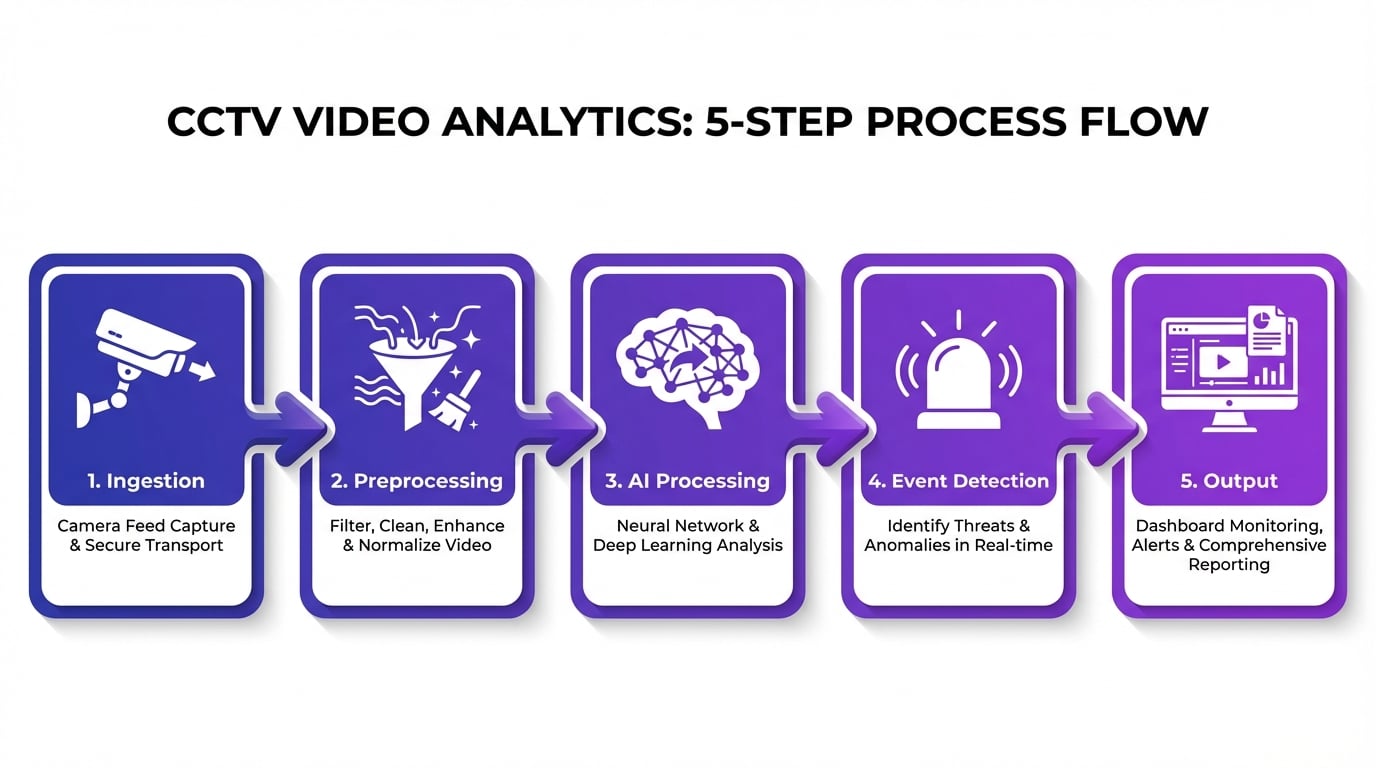
Step 1: Video Ingestion
The analytics platform connects to your existing camera feeds via RTSP (Real-Time Streaming Protocol) or ONVIF standards. It can process live streams from IP cameras, NVRs (Network Video Recorders), or even DVRs with network output. No physical changes to your camera setup are needed.
Step 2: Frame Preprocessing
Raw video frames are preprocessed for optimal AI analysis. This includes resolution normalization, noise reduction, image stabilization for PTZ cameras, and frame rate optimization. Processing typically occurs at 5-15 frames per second — sufficient for most analytics while conserving compute resources.
Step 3: AI Processing
This is where the intelligence happens. Deep learning models — typically convolutional neural networks (CNNs) — analyze each frame to detect and classify objects. Modern systems use architectures like YOLO (You Only Look Once) and SSD (Single Shot Detector) for real-time object detection, achieving over 95% accuracy in controlled environments.
Step 4: Event Detection & Analysis
The analytics engine correlates detections across frames and time to identify meaningful events. For example, detecting a person entering a restricted zone triggers an intrusion alert, while tracking customer movement patterns generates heatmap data. This layer applies business rules to raw detections.
Step 5: Output & Action
Results are delivered through multiple channels: real-time dashboard displays, instant mobile/email alerts, automated report generation, and API integrations with existing security or business systems. Advanced platforms like Agrex AI also provide a chat-based interface where users can query their video data in natural language.
Types of CCTV Video Analytics
CCTV analytics capabilities span a wide range, from basic motion detection to sophisticated behavioral analysis. Here are the primary categories:
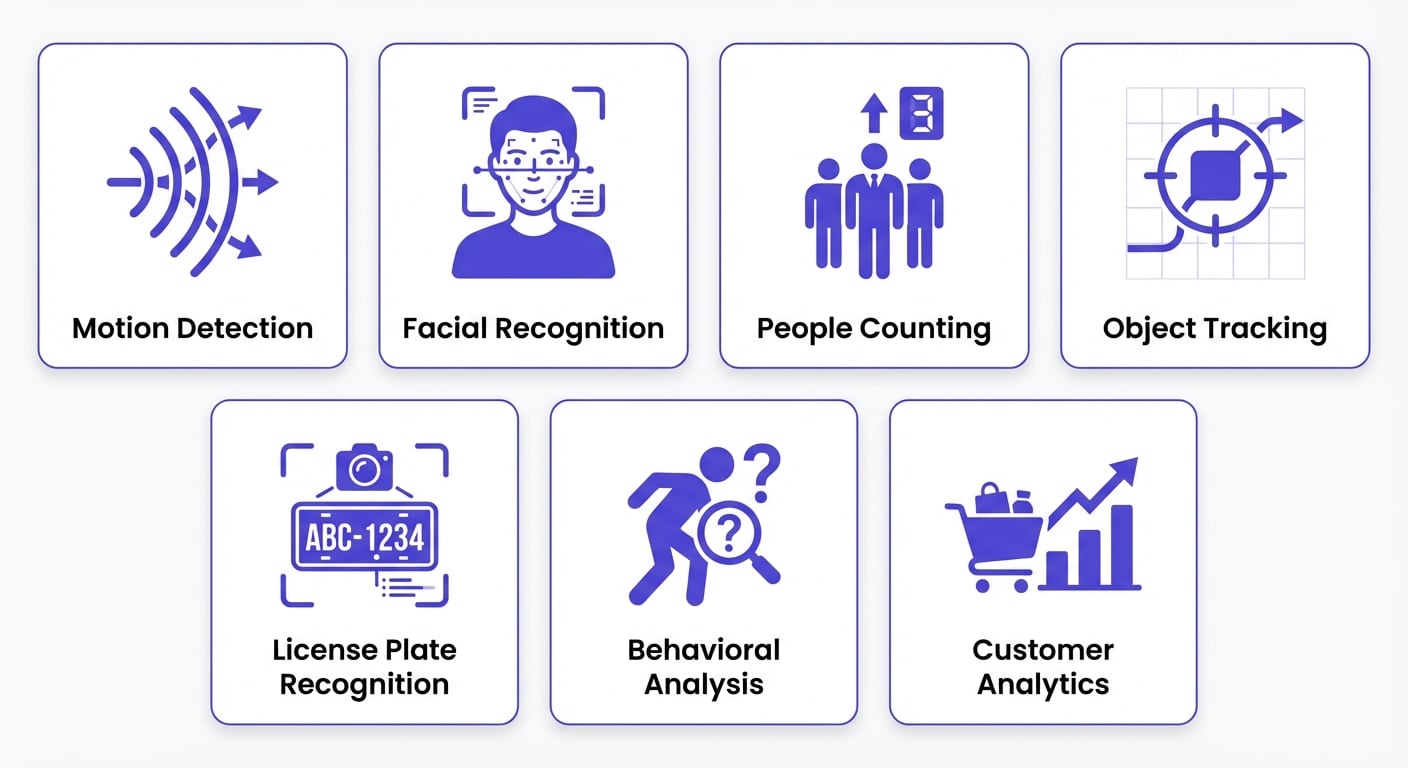
1. Motion Detection & Intrusion Detection
The most fundamental type of video analytics. The system identifies movement in defined zones and triggers alerts when unauthorized entry is detected. Modern AI-based motion detection dramatically reduces false alarms caused by shadows, animals, or weather — a chronic problem with older PIR-based systems.
- Virtual tripwire and perimeter breach detection
- Zone-based intrusion alerts with configurable sensitivity
- Loitering detection for suspicious behavior
- False alarm reduction of up to 90% compared to traditional systems
2. Facial Recognition & Identification
AI matches detected faces against watchlists or databases. Used in security applications for access control, VIP identification in retail and hospitality, and law enforcement. Modern systems achieve high accuracy even with partial face views, varying lighting, and aging.
3. People Counting & Crowd Analytics
Accurately counts individuals entering and exiting spaces, monitors occupancy levels in real time, and analyzes crowd density. Essential for retail footfall analysis, building occupancy compliance, event management, and public safety. AI-based counting achieves 95-98% accuracy even in dense crowds.
4. Object Detection & Tracking
Identifies and tracks specific objects across camera views — vehicles, packages, bags, or equipment. Applications include abandoned object detection in public spaces, vehicle tracking in parking lots, asset monitoring in warehouses, and package counting on conveyor belts.
5. License Plate Recognition (LPR/ANPR)
Automatically reads vehicle license plates from CCTV footage. Used for parking management, toll collection, law enforcement, and logistics fleet tracking. Modern LPR systems handle multiple plate formats, varying speeds, and challenging lighting conditions.
6. Behavioral Analysis
The most advanced category — AI analyzes patterns of behavior rather than just detecting objects. This includes fight/aggression detection, slip-and-fall detection, unusual movement patterns, crowd formation and dispersal analysis, and employee SOP compliance monitoring.
7. Customer Behavior Analytics
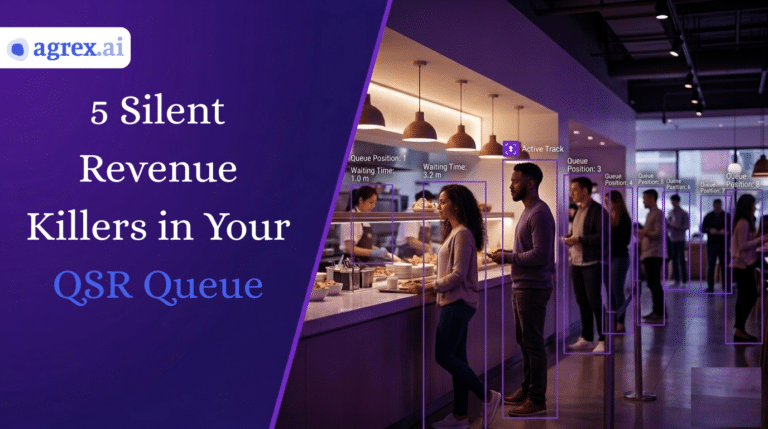
Specifically designed for retail and commercial environments. Tracks customer journeys through stores, generates dwell-time heatmaps, analyzes queue lengths, and measures engagement with displays and products. This data helps businesses optimize layouts, staffing, and marketing.
Benefits of Video Analytics Over Traditional CCTV Monitoring
The advantages of adding AI analytics to your existing CCTV system are substantial and measurable:
| Factor | Traditional CCTV | CCTV with Video Analytics |
|---|---|---|
| Monitoring | Human operators watching screens | AI monitors 24/7 without fatigue |
| Alert Speed | Minutes to hours (depends on guard attention) | Real-time (sub-second detection) |
| False Alarms | High (shadows, animals, weather) | 90% reduction with AI filtering |
| Coverage | 1 guard monitors 8-16 cameras effectively | AI monitors unlimited cameras simultaneously |
| Data Insights | None — just raw footage | Heatmaps, counts, trends, reports |
| Search | Manual scrubbing through hours of footage | Instant search by object, person, or event type |
| Cost per Camera | ₹2,000-5,000/month (guard cost allocated) | ₹500-1,500/month (software cost) |
| Scalability | Linear cost increase (more guards) | Marginal cost decrease at scale |
| Factor | Traditional CCTV | AI-Powered Analytics |
|---|---|---|
| Monitoring | Manual, human-dependent | Automated 24/7 |
| Alert Speed | Minutes to hours | Real-time <1 sec |
| False Alarms | High (30-40%) | Low (<5%) |
| Coverage | Limited by staff | Unlimited cameras |
| Data Insights | None | Rich analytics & trends |
| Cost Over Time | Increases with staff | Decreases with scale |
Key Measurable Benefits
- 65% faster incident response: AI detects events within seconds and sends immediate alerts, compared to minutes or hours with human monitoring
- 80% reduction in monitoring labor costs: One operator can effectively manage hundreds of cameras with AI assistance
- 30-40% reduction in theft and shrinkage: Real-time detection of suspicious behavior deters criminal activity
- 95%+ detection accuracy: Modern deep learning models outperform human observers, especially during night shifts
- 90% fewer false alarms: AI distinguishes between genuine threats and benign events like animals or moving shadows
How to Implement Video Analytics on Your CCTV System
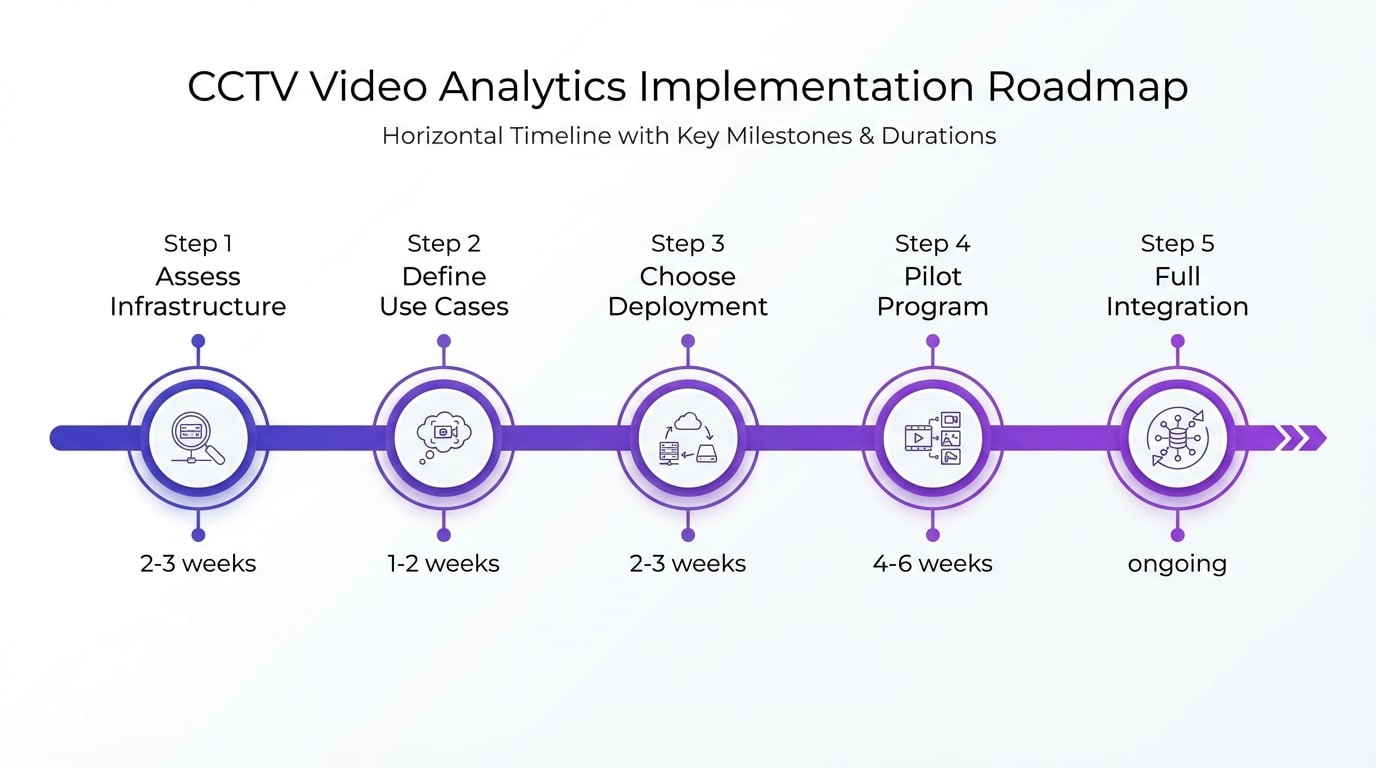
Adding video analytics to your existing CCTV infrastructure is straightforward with the right approach:
Step 1: Assess Your Current Infrastructure
Inventory your cameras — note IP vs. analog, resolution, frame rates, and network connectivity. Most modern analytics work with cameras of 1MP resolution or higher. Analog cameras can be connected through IP encoders.
Step 2: Define Your Use Cases
Identify what you want to detect or measure. Security-focused deployments prioritize intrusion detection and facial recognition. Retail deployments focus on people counting and customer behavior. Operations deployments target SOP compliance and safety monitoring.
Step 3: Choose Your Deployment Model
- Edge Processing: Analytics run on appliances at the camera site. Best for low-latency requirements and bandwidth-constrained locations.
- Cloud Processing: Video streams are sent to cloud servers for analysis. Best for centralized management of multi-site deployments.
- Hybrid: Time-sensitive analytics at the edge, aggregated analysis in the cloud. This is the approach most enterprise platforms like Agrex AI use.
Step 4: Pilot and Scale
Start with a pilot of 10-20 cameras at one location. Validate detection accuracy, alert relevance, and integration with your workflow. Once proven, scale to additional cameras and locations. Most pilots run 4-6 weeks.
Step 5: Integrate and Optimize
Connect analytics outputs to your existing systems — security operations center, building management, POS, or ERP. Continuously tune detection parameters based on real-world performance to minimize false positives while maintaining high detection rates.
Cost Considerations for CCTV Video Analytics
The cost of adding video analytics to existing CCTV varies based on several factors:
- Per-camera licensing: Typically ₹500-2,000 per camera per month for cloud-based solutions
- Edge hardware: ₹50,000-2,00,000 per appliance (processes 8-32 cameras each)
- Network upgrades: May need bandwidth increases for cloud-based processing
- Integration costs: One-time setup fees for connecting to existing systems
- Camera upgrades: Only needed if existing cameras are below 1MP resolution
Most businesses see positive ROI within 6-12 months through reduced security staffing costs, theft prevention, and operational improvements. Enterprise platforms like Agrex AI offer flexible pricing models based on camera count and selected analytics modules.
According to IPVM, the world’s leading authority on video surveillance, there are over 1 billion surveillance cameras installed globally, yet fewer than 5% use any form of AI analytics. According to IFSEC Global, organizations that add AI analytics to existing CCTV report a 70% improvement in actionable intelligence from their camera networks.
Industries Using CCTV Video Analytics in India
Video analytics adoption is growing across virtually every industry in India:
- Retail: Customer footfall counting, heatmap analytics, queue management, and shrinkage reduction across chains with thousands of stores
- Banking: Branch security, ATM surveillance, customer flow optimization, and cash handling compliance monitoring
- Manufacturing: Worker safety compliance (PPE detection), assembly line quality checks, and restricted zone monitoring
- Logistics: Warehouse safety, loading dock monitoring, vehicle tracking, and inventory verification
- QSR & Hospitality: Kitchen SOP compliance, hygiene monitoring, customer service quality, and drive-through optimization
- Smart Cities: Traffic management, crowd monitoring, public safety, and municipal infrastructure monitoring
Choosing the Right CCTV Video Analytics Platform
When evaluating video analytics solutions for your CCTV infrastructure, prioritize these factors:
- Camera compatibility — works with your existing cameras without hardware changes
- Detection accuracy — look for 95%+ accuracy with published benchmarks
- False alarm rate — low false positives are critical for operational trust
- Scalability — can grow from pilot to thousands of cameras
- Ease of use — non-technical staff should be able to manage alerts and reports
- Integration APIs — connects to your existing security and business systems
- Data privacy compliance — adheres to India’s DPDPA requirements
According to Grand View Research, the global video surveillance market is expected to reach $86.5 billion by 2030, with AI-powered analytics being the fastest growing segment.
Transform Your CCTV into an Intelligent System
Your existing cameras are already capturing valuable data — you just need the AI layer to unlock it. Agrex AI’s Agentic AI platform connects to your CCTV infrastructure and delivers real-time intelligence across security, operations, and business analytics.
Book a Free Demo — See Your Cameras Come Alive with AI →
Frequently Asked Questions
What is the difference between video analytics and video surveillance?
Video surveillance is the act of recording and monitoring video from cameras. Video analytics is the AI software layer that automatically analyzes surveillance footage to detect events, identify objects, count people, and generate insights — without requiring constant human monitoring.
Can video analytics work with my existing CCTV cameras?
Yes. Modern video analytics platforms are camera-agnostic and work with any IP camera. Even older analog cameras can be connected through IP encoders. You do not need to replace your cameras — the analytics is purely a software addition that processes your existing feeds.
How accurate is CCTV video analytics?
Modern AI-based video analytics achieves 95-99% accuracy for common tasks like people counting and object detection. Accuracy depends on camera quality, placement, lighting conditions, and the specific analytics task. Deep learning models continuously improve through training on more data.
Is CCTV video analytics expensive?
Cloud-based CCTV analytics typically costs ₹500-2,000 per camera per month in India, depending on the features selected. This is significantly less than the cost of human monitoring (₹2,000-5,000 per camera per month in allocated guard costs). Most businesses achieve positive ROI within 6-12 months.
Does video analytics violate privacy laws in India?
Video analytics is legal when implemented with proper safeguards. Under India’s Digital Personal Data Protection Act (DPDPA) 2023, businesses must ensure legitimate purpose, data minimization, and appropriate security measures. Many analytics platforms offer privacy features like face blurring and data anonymization to help with compliance.