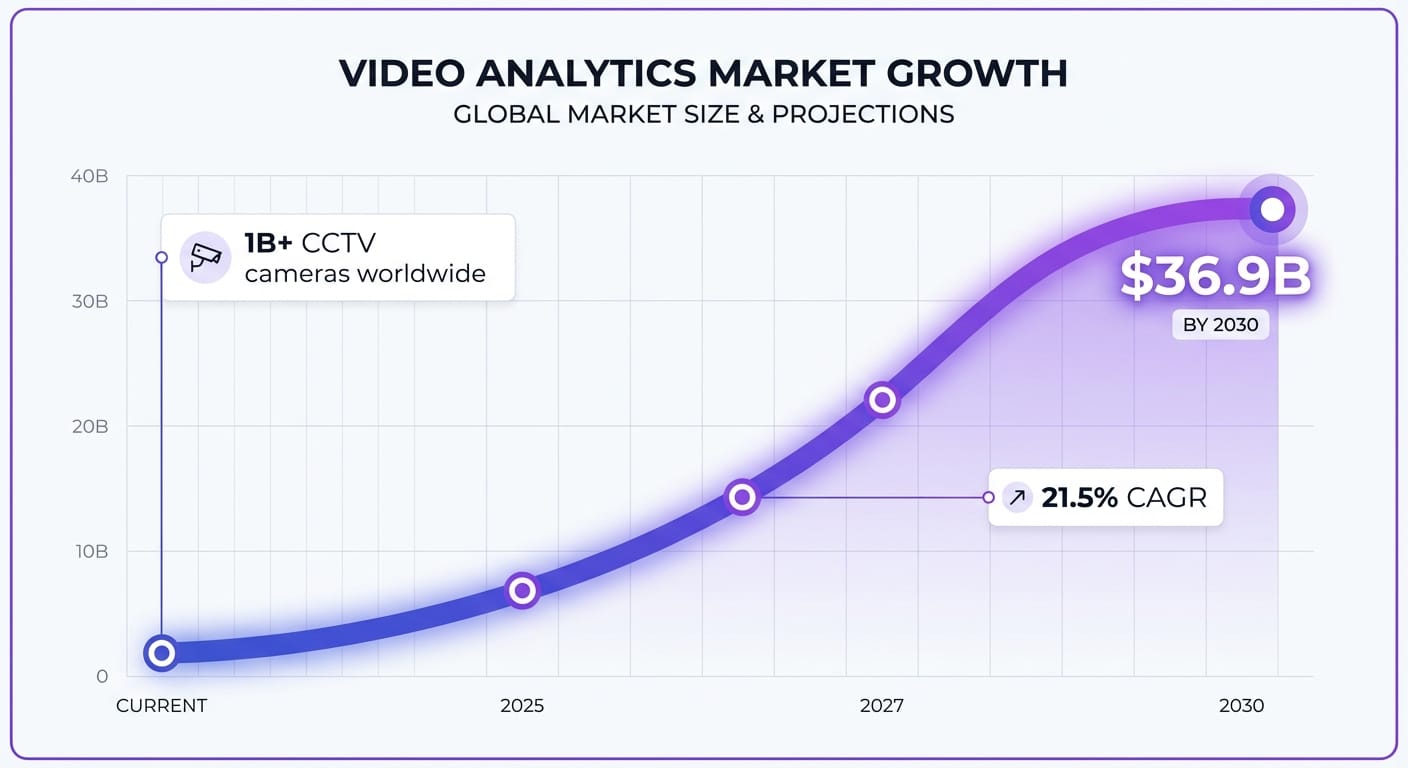
Video analytics is transforming how businesses understand and respond to real-world events captured on camera. According to MarketsandMarkets, the global video analytics market is projected to reach $21.5 billion by 2027, growing at a CAGR of 22.7%. Other estimates place the market as high as $36.9 billion by 2030. Organizations across every sector are racing to unlock the intelligence hidden in their video feeds. But what is video analytics, exactly — and why has it become one of the most important technologies in enterprise operations?
In simple terms, video analytics (also called AI video analytics or intelligent video analytics) is the use of artificial intelligence and computer vision to automatically analyze video footage in real time. Instead of relying on security guards watching dozens of screens, AI algorithms detect objects, recognize patterns, identify anomalies, and trigger alerts — all without human intervention.
The timing could not be more critical. There are now over 1 billion CCTV cameras installed worldwide, generating an estimated 2.5 quintillion bytes of video data daily. The vast majority of this footage is never watched. Traditional surveillance is passive — it records, but it does not think. AI video analytics changes this paradigm entirely, turning every camera into an intelligent sensor capable of driving decisions, automating responses, and generating actionable business insights.
Whether you are a retail chain trying to understand customer behaviour analysis, a logistics company optimizing dock operations, or a QSR brand ensuring food safety compliance, video analytics offers a path from guesswork to data-driven precision. In this comprehensive guide, we cover everything you need to know — from how the technology works to real-world use cases across seven industries, and how to choose the right solution for your business.
Ready to see video analytics in action? Book a free demo with our team to explore what is possible with your existing cameras.
What is Video Analytics?
Video analytics refers to the automated analysis of video content using computer algorithms to detect, classify, and interpret events, objects, and behaviors within video streams. At its core, it converts raw video data — pixels and frames — into structured, actionable information that organizations can use to make faster, smarter decisions.
The technology sits at the intersection of computer vision, deep learning, and real-time data processing. Modern video analytics platforms ingest live feeds from IP cameras, CCTV systems, body cameras, and even drones, then apply trained AI models to understand what is happening in the scene.
How Video Analytics Differs from Traditional CCTV Monitoring
Traditional CCTV is fundamentally a recording tool. Cameras capture footage, store it on DVRs or NVRs, and humans review it — usually after an incident has already occurred. This approach has well-documented limitations:
- Human attention fatigue: Studies show that after just 20 minutes of continuous monitoring, a human operator attention drops by over 45%. After 60 minutes, critical events are missed more than 90% of the time.
- Reactive, not proactive: Footage is typically reviewed only after something goes wrong — a theft, an accident, a compliance breach. By then, the damage is done.
- No data output: Traditional systems produce video files, not data. You cannot easily answer questions like “How many customers entered between 2 PM and 4 PM?” or “How long is the average queue wait time?”
Video analytics flips this model. Instead of passive recording, it provides active intelligence — real-time detection, instant alerts, and continuous data streams that feed into dashboards, reports, and automated workflows. The shift is from “What happened?” to “What is happening right now, and what should we do about it?”
This is what makes AI video analytics so powerful for enterprises. It does not replace cameras — it makes every existing camera exponentially more valuable by extracting meaning from footage that would otherwise sit unwatched on a hard drive.
How Video Analytics Works
Understanding the video analytics pipeline helps demystify the technology. While the underlying AI models are complex, the high-level architecture is straightforward.
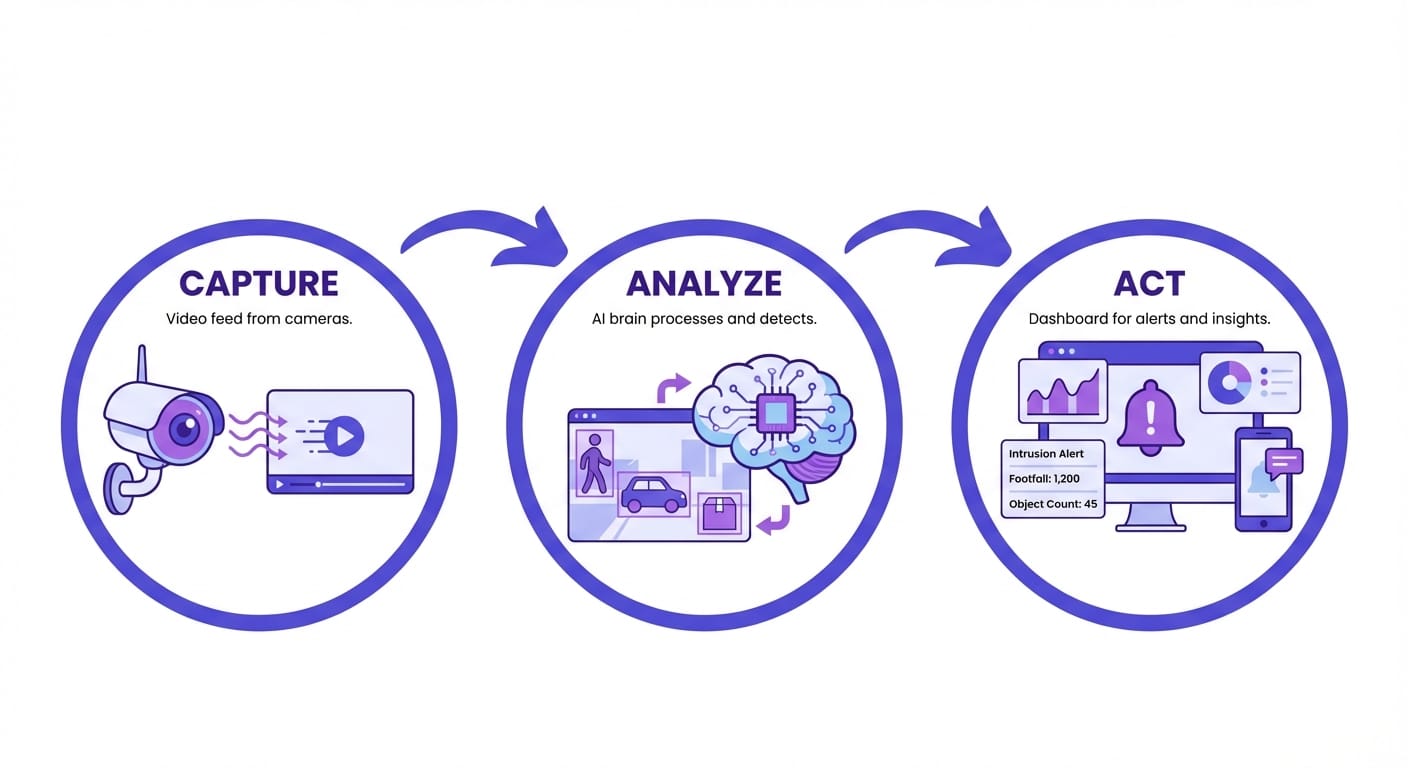
1. Video Ingestion
The process begins with video capture. Modern video analytics platforms are designed to work with your existing camera infrastructure — there is no need to rip and replace. The system connects to IP cameras, analog cameras (via encoders), NVRs, VMS platforms, and even RTSP streams. Feeds can come from fixed cameras, PTZ (pan-tilt-zoom) cameras, thermal cameras, or body-worn devices.
The ingestion layer handles protocol translation, stream optimization, and frame extraction. For real-time analytics, the system typically processes between 5 to 30 frames per second, depending on the use case and required accuracy.
2. AI/ML Processing Pipeline
This is where the intelligence lives. Incoming video frames pass through a series of AI models, each performing a specific task:
- Object Detection: Identifying and locating objects in the frame — people, vehicles, packages, animals, equipment. Modern systems use deep neural networks (like YOLO, EfficientDet, or custom architectures) trained on millions of labeled images.
- Object Tracking: Following detected objects across frames as they move through the scene. This enables counting (footfall, vehicle count), dwell time measurement, and path analysis.
- Classification: Categorizing detected objects — is that person wearing a hard hat? Is that vehicle a truck or a car? Is that item on the shelf or missing?
- Behavior Analysis: Understanding actions and interactions — detecting falls, fights, loitering, unauthorized entry, queue formation, or SOP violations.
- Anomaly Detection: Identifying events that deviate from normal patterns — unusual crowd density, unexpected objects in restricted areas, or abnormal traffic flow.
3. Real-Time Alerts and Dashboards
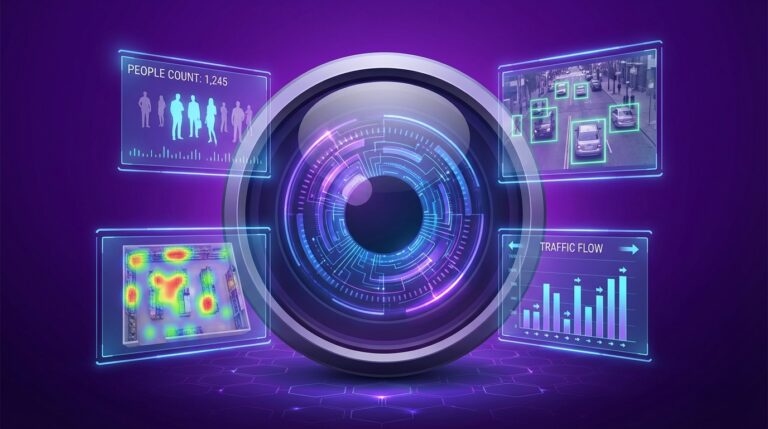
When the AI detects a relevant event, the system generates real-time alerts via SMS, email, push notification, or webhook integration. Simultaneously, all detected events feed into analytics dashboards that provide historical trends, heatmaps, occupancy data, compliance scores, and operational KPIs.
4. Edge vs. Cloud Processing
Video analytics can run on edge devices (hardware at the camera location), in the cloud, or in a hybrid architecture. Edge processing reduces latency and bandwidth costs — critical for real-time safety alerts. Cloud processing offers greater computational power and easier model updates. Most enterprise deployments use a hybrid approach: edge for real-time detection, cloud for deep analysis and long-term trend reporting.
Types of Video Analytics
Not all video analytics systems are created equal. The technology spans a spectrum from simple rule-based systems to sophisticated AI-powered platforms. Understanding the differences is essential for making the right investment.
Rule-Based Analytics (Traditional)
Early video analytics systems relied on predefined rules: virtual tripwires, motion detection zones, and simple pixel-change algorithms. If an object crossed a line or entered a zone, the system triggered an alert. These systems are:
- Inexpensive and easy to deploy
- Effective for simple use cases (perimeter breach, motion detection)
- Prone to high false-alarm rates (wind, shadows, lighting changes)
- Unable to understand context or complex behaviors
AI-Powered Analytics (Deep Learning)
Modern AI video analytics uses deep learning models trained on vast datasets to understand visual scenes with near-human accuracy. These systems can:
- Distinguish between people, vehicles, animals, and objects
- Recognize specific behaviors (slip-and-fall, fighting, loitering)
- Operate accurately across lighting conditions, weather, and camera angles
- Improve over time through continuous learning
- Process multiple simultaneous events in complex scenes
Rule-Based vs. AI-Based Video Analytics: Comparison
| Feature | Rule-Based Analytics | AI-Powered Analytics |
|---|---|---|
| Detection accuracy | 60-75% | 92-99% |
| False alarm rate | High (30-50%) | Low (2-8%) |
| Object classification | None / basic | Multi-class (people, vehicles, objects) |
| Behavior detection | Not supported | Falls, fights, loitering, SOP violations |
| Lighting adaptability | Poor | Excellent (day/night, indoor/outdoor) |
| Setup complexity | Simple (draw zones) | Moderate (model configuration) |
| Scalability | Limited | Highly scalable (cloud/edge) |
| Learning capability | Static rules | Continuous improvement |
| Cost | Lower upfront | Higher upfront, better long-term ROI |
Hybrid Approaches
Many organizations start with rule-based analytics and layer AI capabilities on top as their needs mature. A hybrid approach allows teams to address simple use cases immediately (e.g., motion detection for after-hours security) while deploying AI models for more complex scenarios (e.g., SOP compliance monitoring in kitchens or worker safety in warehouses).
Key Features of Modern Video Analytics
Today enterprise video analytics platforms offer a rich feature set that goes far beyond basic motion detection. Here are the capabilities that define a modern solution:
Object Detection and Tracking
The foundation of all video analytics. AI models detect and track people, vehicles, packages, and objects across camera fields of view. Advanced systems maintain object identity even through occlusions (when an object is temporarily hidden behind another).
Facial Recognition
Identifying or verifying individuals based on facial features. Used for access control, VIP identification in retail, and watchlist alerting in security applications. Important note: facial recognition is subject to privacy regulations and should be deployed responsibly.
Behavior Analysis
Understanding what people are doing — not just where they are. This includes detecting falls, fights, slip-and-fall incidents, tailgating through secure doors, loitering in restricted areas, and more. Behavior analysis is particularly valuable for safety and compliance applications.
Crowd Management
Estimating crowd density, detecting overcrowding, tracking crowd flow patterns, and triggering alerts when occupancy exceeds safe thresholds. Critical for retail stores, stadiums, transportation hubs, and public spaces.
Heat Mapping
Generating visual overlays that show where people spend the most time. Retailers use heat maps to optimize store layouts, product placement, and staffing. Facility managers use them to identify high-traffic areas that need more maintenance or security coverage.
License Plate Recognition (ANPR/ALPR)
Automatically reading vehicle license plates for parking management, toll collection, law enforcement, and logistics tracking. Modern ANPR systems achieve 98%+ accuracy across multiple countries and plate formats.
SOP Compliance Monitoring
Verifying that standard operating procedures are followed — PPE (personal protective equipment) detection, handwashing compliance, uniform checks, and workstation setup verification. This is one of the fastest-growing applications in QSR video analytics and manufacturing environments.
Video Analytics Use Cases by Industry
The real power of video analytics emerges when it is applied to specific industry challenges. Here is how organizations across seven major sectors are leveraging the technology.
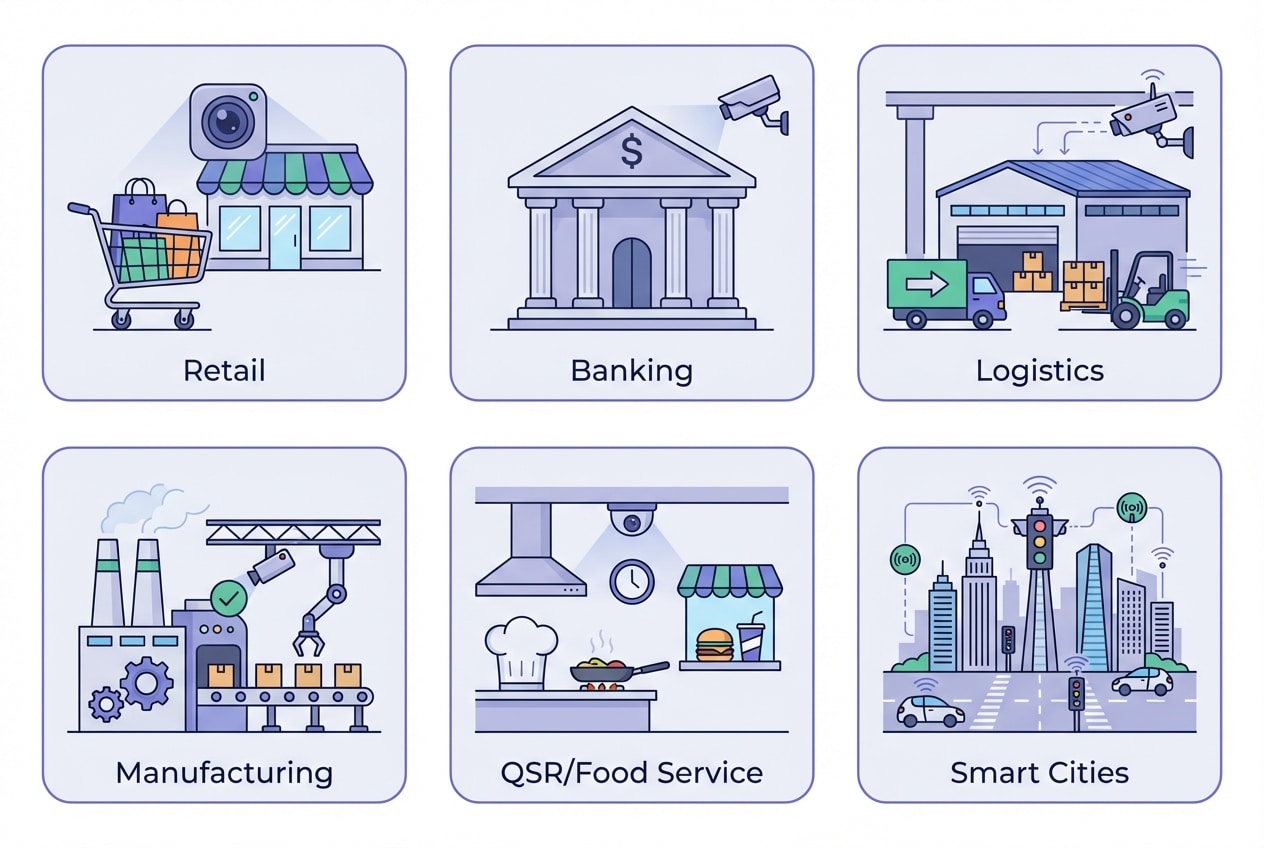
Retail
Retail is one of the largest adopters of video analytics, driven by the need to understand customer behavior and optimize operations. Key use cases include:
- Footfall counting and conversion tracking: Measure how many people enter, which zones they visit, and what percentage make a purchase.
- Queue management: Detect queue length in real time and trigger staffing alerts before wait times become unacceptable.
- Theft and shrinkage prevention: Detect suspicious behaviors like concealment, shelf sweeping, and organized retail crime patterns.
- Customer journey analysis: Track movement patterns through the store to optimize layout, signage, and product placement.
- Heat mapping: Identify high-dwell zones and dead spots to maximize revenue per square foot.
Leading retailers using AI video analytics report 15 to 25% improvements in conversion rates and 30 to 40% reduction in shrinkage incidents. Learn more about retail video analytics solutions.
Banking and Finance
Banks and financial institutions face unique security and operational challenges that video analytics addresses directly:
- ATM surveillance: Detect card skimming devices, shoulder surfing, and vandalism in real time.
- Branch security: Monitor for unauthorized access, after-hours intrusion, and suspicious loitering near vaults or restricted areas.
- Queue management: Optimize teller staffing based on real-time customer count and wait time analysis.
- Compliance monitoring: Verify that security protocols are followed — vault access procedures, cash handling SOPs, and dual-control requirements.
Explore how banking video analytics is transforming branch operations and security.
Logistics and Warehousing
The logistics sector generates enormous volumes of video data from warehouses, distribution centers, and transportation networks. Video analytics turns this footage into operational intelligence:
- Dock door management: Monitor loading/unloading operations, track turnaround times, and optimize scheduling.
- Worker safety compliance: Detect PPE violations (hard hats, safety vests, steel-toe boots) and unsafe behaviors like forklift-pedestrian proximity.
- Throughput tracking: Count packages, pallets, and containers moving through processing zones to identify bottlenecks.
- Inventory monitoring: Track stock levels visually, detect misplaced inventory, and verify put-away accuracy.
Discover how logistics video analytics can improve warehouse efficiency by up to 35%.
QSR and Food Service
Quick-service restaurants and food service operations use video analytics to maintain quality, speed, and compliance across hundreds or thousands of locations:
- Kitchen hygiene monitoring: Verify handwashing compliance, glove usage, hair net requirements, and food handling procedures.
- Drive-thru analytics: Measure service times at each station (order, payment, pickup), identify bottlenecks, and benchmark performance across locations.
- SOP compliance: Ensure food preparation follows brand standards — portion sizes, assembly order, temperature checks.
- Customer experience: Track dine-in occupancy, table turnover rates, and front-of-house service responsiveness.
See how QSR video analytics helps brands maintain consistency across every location.
Manufacturing
Factories and production facilities use video analytics to enhance safety, quality, and throughput:
- Worker safety: PPE detection, restricted zone monitoring, and slip-and-fall detection reduce workplace incidents by up to 60%.
- Production line monitoring: Track cycle times, detect stoppages, and identify assembly errors in real time.
- Quality control: Visual inspection of products for defects, dimensional accuracy, and labeling compliance.
- Energy and space optimization: Monitor equipment usage patterns and space utilization to reduce waste.
Learn how manufacturing video analytics drives operational excellence on the factory floor.
Education
Schools, colleges, and universities deploy video analytics to create safer campuses:
- Campus security: Perimeter monitoring, unauthorized access detection, and real-time threat alerting.
- Attendance tracking: Automated classroom attendance using facial recognition or head-count analysis.
- Crowd monitoring: Event management, cafeteria occupancy, and library utilization tracking.
- Behavioral incidents: Detect fighting, bullying, or suspicious packages on campus grounds.
Explore video analytics in education for safer, smarter campuses.
Security and Surveillance
Security remains the original and largest application of video analytics:
- Perimeter monitoring: Detect intrusion attempts across fences, walls, and restricted boundaries with near-zero false alarms.
- Intrusion detection: Distinguish between humans, animals, and environmental triggers (rain, wind) to eliminate nuisance alerts.
- Vehicle tracking: Monitor parking lots, entry/exit points, and vehicle movement across large facilities.
- Forensic search: Rapidly search hours of recorded footage for specific people, vehicles, or events.
See how security video analytics delivers proactive threat detection.
Benefits of Video Analytics
Organizations that deploy video analytics consistently report measurable improvements across security, operations, and business performance. Here are the six primary benefits:
1. Proactive vs. Reactive Security
Traditional surveillance tells you what happened. Video analytics tells you what is happening right now — and can even predict what is about to happen. Real-time alerts for intrusions, safety violations, and suspicious behaviors mean security teams can prevent incidents instead of investigating them after the fact. Organizations report 40 to 70% reductions in security incidents after deploying AI video analytics.
2. Operational Efficiency Gains
Video analytics generates continuous operational data that drives efficiency improvements. Queue management reduces customer wait times by 25 to 35%. Dock monitoring cuts truck turnaround time by 20%. SOP compliance monitoring reduces food safety violations by 50% or more. These are not theoretical gains — they are documented results from real-world deployments across industries.
3. Significant Cost Reduction
By automating monitoring tasks that previously required human operators, video analytics delivers substantial labor cost savings. A single AI system can monitor hundreds of cameras simultaneously — a task that would require dozens of security operators. Additionally, preventing theft, reducing workplace accidents, and optimizing operations compound into typical ROI of 200 to 400% within the first year.
4. Data-Driven Decision Making
Every camera becomes a data source. Footfall trends, dwell time analytics, traffic patterns, compliance scores, and occupancy data feed into business intelligence tools that empower managers to make evidence-based decisions rather than relying on intuition or manual audits.
5. Regulatory Compliance
Many industries face strict regulatory requirements — workplace safety (OSHA), food safety (FDA/FSSAI), financial security (RBI/PCI DSS), and occupancy limits (fire codes). Video analytics provides continuous, automated compliance monitoring with timestamped evidence for audits and incident reporting.
6. Scalability
Cloud-based video analytics platforms scale effortlessly from a single location to thousands. Adding cameras, locations, or new use cases does not require proportional increases in personnel. This makes the technology particularly attractive for multi-site enterprises like retail chains, QSR brands, and banking networks.
How to Choose the Right Video Analytics Solution
With dozens of video analytics vendors in the market, selecting the right platform requires careful evaluation. Here are the key criteria to consider:
Key Evaluation Criteria
- Accuracy and false alarm rate: Request documented accuracy metrics on use cases relevant to your needs. Best-in-class systems achieve 95%+ detection accuracy with less than 5% false alarm rates.
- Camera compatibility: Ensure the platform works with your existing camera brands and models. Avoid vendor lock-in to proprietary hardware.
- Deployment flexibility: Does the platform support edge, cloud, and hybrid deployments? Can it operate on-premise for data-sensitive environments?
- Use case coverage: Does the vendor offer the specific analytics you need — or will you need multiple vendors for different use cases?
- Scalability: Can the platform handle your growth? Test with your actual camera count and video resolution requirements.
- Integration capabilities: Does it integrate with your existing VMS, access control, POS, ERP, and business intelligence tools?
Questions to Ask Vendors
- What is your detection accuracy for [specific use case] in production environments (not just benchmarks)?
- How many cameras can a single server/instance handle at full resolution?
- What is the total cost of ownership over 3 years, including hardware, licensing, and support?
- Can I run a proof-of-concept on my own cameras before committing?
- How quickly can new use cases or analytics modules be deployed?
- What is your data retention and privacy compliance approach?
ROI Considerations
When calculating ROI, factor in both direct savings (reduced security staffing, theft prevention, compliance penalty avoidance) and indirect gains (improved customer experience, faster throughput, better space utilization). Most enterprise video analytics deployments achieve positive ROI within 6 to 12 months. Start with a pilot at 2 to 3 locations, measure impact over 90 days, then scale based on results.
The Future of Video Analytics
Video analytics is evolving rapidly, driven by advances in AI, computing, and connectivity. Here are the four trends shaping the next era of the technology:
Agentic AI
The biggest shift in video analytics is the move from passive dashboards to agentic AI — autonomous AI agents that do not just detect events but take action. Instead of generating an alert for a manager to review, an agentic video analytics system can automatically dispatch resources, adjust facility settings, escalate to the right team, and even hold a natural-language conversation about what it is seeing. This is the future Agrex AI is building: Video Analytics Agents that operate as intelligent teammates, not just monitoring tools.
According to Gartner, over 75% of enterprises will shift from piloting to operationalizing AI by 2026, with computer vision being one of the top three deployed AI technologies. This underscores the rapid mainstreaming of video analytics from pilot projects to production-grade enterprise infrastructure.
Generative AI in Surveillance
Large language models (LLMs) and generative AI are being integrated into video analytics platforms to enable natural-language querying (“Show me all instances of people entering the warehouse without hard hats last Tuesday”), automated report generation, and conversational insights. This dramatically lowers the barrier to extracting value from video data.
Edge Computing
As edge AI chips become more powerful and affordable, more processing is moving to the camera itself. Edge-native analytics reduces bandwidth costs, eliminates latency, and enables deployment in locations with limited connectivity. The combination of 5G and edge AI will make real-time video analytics accessible in previously underserved environments.
Privacy-First Analytics
Growing privacy regulations (GDPR, India DPDP Act, CCPA) are pushing the industry toward privacy-by-design approaches: on-device processing that never sends video to the cloud, automatic face blurring for non-security applications, anonymized analytics that track behavior patterns without identifying individuals, and configurable data retention policies. The best video analytics platforms will deliver powerful insights while respecting privacy.
Frequently Asked Questions About Video Analytics
What is video analytics?
Video analytics is the technology that uses artificial intelligence and computer vision algorithms to automatically analyze video footage. It detects, tracks, and classifies objects, people, and events in real time, converting raw video into actionable data and alerts. Unlike traditional CCTV monitoring that relies on human operators, video analytics works 24/7 without fatigue and can process hundreds of camera feeds simultaneously.
How does AI video analytics work?
AI video analytics works by processing video frames through deep learning models trained on millions of images. The pipeline typically involves: (1) video ingestion from cameras or recording systems, (2) object detection to identify people, vehicles, and objects in each frame, (3) tracking to follow objects across frames, (4) behavior analysis to understand actions and interactions, and (5) alert generation when predefined conditions are met. The entire process happens in real time, typically within 100 to 500 milliseconds per frame.
What industries use video analytics?
Video analytics is used across virtually every industry. The most common applications are in retail (customer analytics, theft prevention), banking and finance (ATM and branch security), logistics and warehousing (safety compliance, throughput tracking), QSR and food service (kitchen hygiene, drive-thru optimization), manufacturing (worker safety, quality control), education (campus security), healthcare (patient monitoring), and security and surveillance (perimeter protection, intrusion detection). Any organization with cameras can benefit from video analytics.
How much does video analytics cost?
Video analytics pricing varies based on the number of cameras, use cases, deployment model (edge vs. cloud), and vendor. SaaS-based platforms typically charge $15 to $75 per camera per month. On-premise solutions involve upfront hardware costs ($5,000 to $50,000 depending on scale) plus annual licensing fees. Most enterprise deployments achieve positive ROI within 6 to 12 months through reduced security costs, theft prevention, and operational efficiency gains. Contact your vendor for a customized quote based on your specific requirements.
Can video analytics work with existing CCTV cameras?
Yes. Modern video analytics platforms are designed to work with existing camera infrastructure. They support IP cameras from all major manufacturers (Hikvision, Dahua, Axis, Bosch, Hanwha, etc.), analog cameras connected via encoders, and video streams from NVRs and VMS platforms. You do not need to replace your cameras to deploy video analytics — the AI processing happens on separate hardware (edge devices or cloud servers) that connects to your existing video streams.
What is the difference between video analytics and video surveillance?
Video surveillance is the act of recording and monitoring video footage from cameras — traditionally a passive process that relies on human operators or post-incident review. Video analytics adds an intelligence layer on top of video surveillance by using AI to automatically analyze footage, detect events, and generate alerts in real time. Think of it this way: video surveillance is the eyes, video analytics is the brain. Surveillance records; analytics understands.
Is video analytics legal?
Video analytics is legal in most jurisdictions when deployed responsibly and in compliance with local privacy laws. Key legal considerations include: obtaining consent where required (e.g., signage informing people they are being recorded), complying with data protection regulations (GDPR, CCPA, India DPDP Act), avoiding use in protected spaces (restrooms, private areas), implementing data retention policies, and ensuring facial recognition usage (where applicable) complies with local biometric data laws. Organizations should consult with legal counsel and conduct a privacy impact assessment before deployment. Many modern platforms offer privacy-by-design features like automatic face blurring and anonymized analytics.
How much does video analytics cost?
Video analytics costs vary widely based on deployment scale, from $500-2,000 per camera for on-premise solutions to $15-50 per camera/month for cloud-based platforms. Enterprise deployments typically see ROI within 6-12 months through operational savings and loss prevention. Factors affecting cost include camera count, AI model complexity, storage requirements, and integration needs.
What is the difference between video analytics and video surveillance?
Video surveillance passively records footage for manual review, while video analytics uses AI to automatically analyze video in real-time. Surveillance requires human operators to watch feeds and review recordings after incidents. Video analytics proactively detects events, triggers alerts, extracts data patterns, and generates actionable insights — transforming cameras from passive recorders into intelligent sensors.
Can video analytics work with existing CCTV cameras?
Yes, modern video analytics platforms are designed to work with existing CCTV infrastructure. Most solutions support standard protocols like RTSP and ONVIF, allowing integration with IP cameras from any manufacturer. Edge analytics may require compatible cameras, but cloud and server-based solutions can process feeds from virtually any IP camera without hardware replacement.
Is video analytics GDPR compliant?
Video analytics can be GDPR compliant when implemented with proper privacy safeguards. Key requirements include data minimization (processing only necessary data), anonymization techniques like face blurring, clear signage about surveillance, defined data retention policies, and documented legitimate interest or consent. Leading platforms offer built-in privacy features including automatic PII masking and configurable retention periods.
What industries use video analytics the most?
According to industry reports, retail leads video analytics adoption (28% market share), followed by banking and financial services (18%), transportation and logistics (15%), manufacturing (12%), and healthcare (10%). The technology is also growing rapidly in smart cities, education, QSR/food service, and hospitality sectors. Retail drives adoption due to clear ROI from loss prevention and customer behavior insights.
Ready to transform your video infrastructure into an intelligent decision-making system? Agrex AI agentic video analytics platform works with your existing cameras to deliver real-time insights, automated compliance monitoring, and measurable operational improvements across retail, logistics, QSR, manufacturing, banking, and more.
Book a free demo to see how video analytics can work for your business — or contact our team to discuss your specific requirements.