Video analytics loss prevention is rapidly becoming the most powerful weapon in retail’s fight against shrinkage. With global retail shrinkage now exceeding $112 billion annually according to the National Retail Federation, retailers can no longer afford to rely on reactive, manual security approaches. The old model — guards watching banks of monitors, reviewing hours of footage after an incident, and hoping electronic article surveillance (EAS) tags deter shoplifters — is fundamentally broken.
AI-powered loss prevention video analytics changes the equation entirely. By applying computer vision and deep learning to existing CCTV camera feeds, retailers can detect suspicious behaviors in real time, correlate video with POS transaction data, and respond to theft before merchandise leaves the store. The result? Retailers deploying AI video analytics for loss prevention are reporting shrinkage reductions of 40–60%, dramatic drops in false alarms, and LP team productivity gains that deliver ROI within 90 days.
In this guide, we break down exactly how AI video analytics transforms retail loss prevention technology, the specific detection capabilities that matter most, and how to deploy these systems on your existing cameras — no new hardware required. Whether you manage loss prevention for a single store or a 2,000-location chain, this is the playbook for reducing shrinkage with AI.
Want to see AI loss prevention in action on your own camera feeds? Book a free demo with the Agrex AI team.
The State of Retail Shrinkage in 2026
Retail shrinkage — the loss of inventory due to theft, fraud, errors, and other causes — has reached crisis-level proportions. The NRF’s most recent National Retail Security Survey pegs total shrinkage at 1.6% of retail sales, translating to over $112 billion in losses for U.S. retailers alone. Globally, the figure is even more staggering.
But the headline number masks important detail. Shrinkage comes from multiple sources, and understanding the breakdown is critical for targeting your loss prevention investments effectively.
Sources of Retail Shrinkage
NRF National Retail Security Survey — Percentage of Total Losses
External theft — including both opportunistic shoplifting and organized retail crime (ORC) — accounts for the largest share at 37%. ORC in particular has surged, with coordinated groups targeting high-value merchandise and reselling through online marketplaces. Internal theft by employees represents 28%, often involving voided transactions, sweethearting (giving discounts to friends), and merchandise concealment. Administrative errors — pricing mistakes, receiving errors, inventory miscounts — make up 21%, a reminder that not all shrinkage is criminal. Vendor fraud and error (6%) and unknown losses (8%) round out the picture.
The takeaway: loss prevention must address multiple threat vectors simultaneously. A solution that only targets external theft leaves nearly two-thirds of shrinkage unaddressed. This is where AI video analytics excels — it can monitor for all of these categories through a single platform.
Why Traditional Loss Prevention Falls Short
Most retailers still rely on a combination of manual CCTV monitoring, electronic article surveillance (EAS), uniformed and plainclothes guards, and POS exception-based reporting. Each approach has fundamental limitations that AI video analytics addresses.
Manual CCTV review is reactive, not proactive. A typical retail store has 16–64 cameras feeding into a DVR/NVR. Even dedicated LP personnel can effectively monitor only 4–6 screens simultaneously. Research shows that after just 20 minutes of continuous monitoring, a guard’s attention drops by over 45%. The vast majority of CCTV footage is never watched — it exists only as a post-incident forensic tool, reviewed after the loss has already occurred.
EAS tags are circumvented daily. Booster bags lined with foil, tag detaching tools sold openly online, and the simple expedient of employees failing to tag merchandise all undermine EAS effectiveness. Industry estimates suggest EAS deters only 60–70% of casual shoplifters, and is virtually ineffective against organized retail crime rings that come prepared.
Guard patrols have gaps. Even the best-staffed stores cannot have LP associates covering every aisle, every fitting room, every exit, and every self-checkout lane simultaneously. Criminals observe patrol patterns and exploit the inevitable gaps. Hiring enough guards to provide comprehensive coverage is prohibitively expensive for most retailers.
POS exception reporting is after-the-fact. Exception-based reporting (EBR) systems analyze transaction data to flag anomalies — high void rates, excessive discounts, suspicious returns. But EBR only works after the transaction is complete. It identifies patterns over days or weeks, not incidents in the moment. And without correlated video evidence, EBR findings are difficult to act on.
The common thread: traditional LP methods are either reactive (reviewing after loss), limited in scope (covering only part of the problem), or too expensive to scale. AI video analytics solves all three limitations.
How AI Video Analytics Transforms Loss Prevention
AI-powered loss prevention video analytics applies deep learning models to live video feeds from existing cameras, detecting suspicious behaviors and events in real time. Unlike traditional CCTV, the system never blinks, never gets fatigued, and monitors every camera simultaneously — 24/7/365.
The technology works by training neural networks on millions of examples of both normal shopping behavior and theft-related actions. The AI learns to distinguish between a customer examining a product and a customer concealing it. It recognizes the difference between a shopper placing items in their basket and a grab-and-run event. And it does this across every camera in the store, in real time, with sub-second alert latency.
Here are the six core detection capabilities that make AI video analytics a game-changer for retail loss prevention.
Concealment Detection
Detects when shoppers hide merchandise in bags, clothing, or strollers using body pose estimation and object tracking algorithms.
Self-Checkout Monitoring
Identifies scan avoidance, ticket switching, pass-arounds, and deliberate mis-scans at self-checkout lanes in real time.
Shelf Sweep Detection
Alerts when someone rapidly clears an entire shelf section — a hallmark of organized retail crime grab-and-go operations.
POS-Video Correlation
Matches every transaction with synchronized video, flagging mismatches between scanned items and items at the register.
Employee Theft Patterns
Correlates void/refund anomalies with video evidence to identify sweethearting, unauthorized discounts, and cash register manipulation.
ORC Pattern Detection
Identifies coordinated theft patterns across time and locations — repeated visits, distraction techniques, and known ORC methodologies.
1. Real-Time Concealment Detection
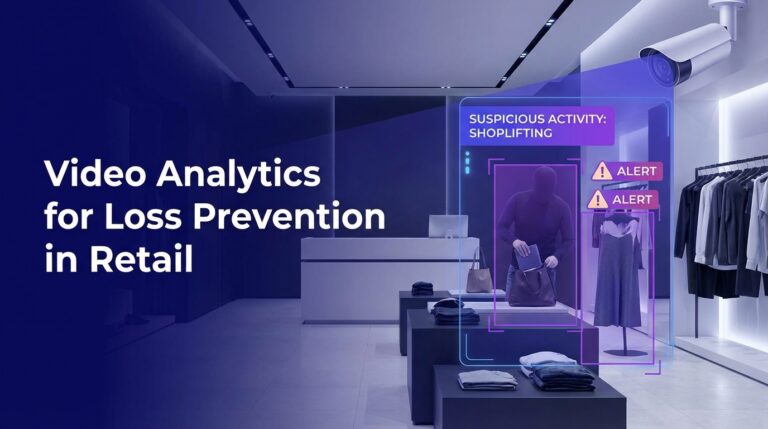
AI concealment detection uses body pose estimation, object tracking, and spatial analysis to identify when a shopper hides merchandise. The system tracks items from the moment they are picked up and monitors whether they move toward a basket, a fitting room, or somewhere they should not go — inside a jacket, under a shirt, or into an oversized handbag.
Unlike guards who might spot one in twenty concealment events, the AI monitors every aisle simultaneously. When a concealment is detected, the system sends an immediate alert to LP personnel with a video clip, camera location, and confidence score — enabling intervention before the suspect reaches the exit.
2. Self-Checkout Monitoring
Self-checkout theft accounts for an estimated 4% of all self-checkout transactions, making it one of the fastest-growing sources of retail shrinkage. Common methods include scan avoidance (passing items around the scanner), ticket switching (scanning a cheaper item’s barcode), pass-arounds (handing items to a companion), and the “banana trick” (weighing expensive items as cheap produce).
AI video analytics monitors the self-checkout area by correlating what the camera sees on the scanning surface with what the POS system registers. If the visual AI detects an item being placed in the bagging area without a corresponding scan event, it flags the transaction for attendant review. This dramatically reduces loss at self-checkout while keeping the customer experience frictionless for honest shoppers.
3. Shelf Sweep Detection
Organized retail crime groups increasingly use “sweep” tactics — quickly clearing an entire shelf section of high-value merchandise and heading for the exit. This brazen approach relies on speed: the entire theft takes under 30 seconds, and traditional LP cannot respond fast enough.
AI shelf sweep detection monitors shelf inventory levels in real time through computer vision. When the system detects a rapid, abnormal decrease in shelf stock — especially for high-value categories like fragrances, electronics, or premium brands — it triggers an instant alert. Some systems can even activate door locks or announce a security message automatically, buying LP staff time to respond.
4. POS-Video Correlation
This capability is one of the most powerful in the AI loss prevention toolkit. By integrating video feeds with point-of-sale transaction data, the system can match every line item in a transaction with what the camera sees at the register.
If a cashier scans a $5 item but the camera shows a $200 item being bagged, the system flags it. If a void is processed but no item is returned to the shelf, that is flagged too. POS-video correlation transforms exception-based reporting from a weeks-later pattern analysis tool into a real-time incident detection system.
5. Employee Theft Pattern Analysis
Internal theft is notoriously difficult to detect because employees know the systems, the blind spots, and the procedures. AI video analytics changes the calculus by continuously monitoring register activity, back-of-house operations, and receiving docks.
The system identifies patterns that would take human investigators weeks to uncover: a cashier who consistently processes voids when a specific “customer” is in line, an associate who takes merchandise to the trash compactor on every shift, or a receiving clerk who short-counts vendor deliveries. Each pattern is documented with time-stamped video evidence — making investigation and prosecution far more effective.
6. Organized Retail Crime (ORC) Detection
ORC is the fastest-growing threat to retailers, with the Coalition of Law Enforcement and Retail (CLEAR) estimating that ORC costs retailers $70+ billion annually. These are not opportunistic shoplifters — they are coordinated networks that target specific merchandise, use sophisticated techniques, and operate across multiple store locations.
AI video analytics combats ORC by analyzing patterns across time and locations. The system can identify repeat visitors who engage in suspicious behavior, detect distraction-and-grab team techniques, and flag unusual loitering patterns in high-value merchandise areas. When integrated across multiple store locations, the platform can identify ORC cells operating regionally — intelligence that is invaluable for law enforcement collaboration.
Modern AI loss prevention systems are designed to detect behaviors, not identify individuals. The AI analyzes body movements, object interactions, and spatial patterns — not faces. This ensures compliance with privacy regulations like GDPR and CCPA while still providing powerful theft detection. Retailers can protect both their merchandise and their customers’ privacy.
Traditional LP vs. AI Video Analytics: A Direct Comparison
The differences between legacy loss prevention and AI-powered systems are stark across every dimension that matters. Here is how they compare head to head.
| Capability | Traditional LP | AI Video Analytics |
|---|---|---|
| Detection Speed | Hours to days (post-incident review) | Real-time (sub-second alerts) |
| Coverage | 4-6 cameras monitored at once | All cameras, all the time |
| False Alarms | High (EAS gates, manual errors) | 80% fewer false positives |
| Documentation | Manual incident reports | Auto-generated clips + data |
| Scalability | Linear (more stores = more guards) | Exponential (software scales instantly) |
| Cost per Store | $80K-$150K/year (staffing-heavy) | 60-70% lower total LP cost |
The ROI of AI-Powered Loss Prevention
The business case for AI video analytics in loss prevention is compelling — and quantifiable. Retailers deploying these systems consistently report returns that far exceed the investment, typically achieving full payback within the first 90 days.
Average decrease in inventory loss within the first year of deployment
Reduction in false positive alerts vs. traditional EAS systems
More incidents investigated per LP associate with AI-assisted prioritization
Typical payback period from reduced shrinkage and operational savings
These numbers come from real-world deployments across multi-store retail environments. The 60% shrinkage reduction is driven by two factors: deterrence (when staff know the AI is watching, internal theft drops dramatically) and detection (catching incidents that would have gone unnoticed). The 80% reduction in false alarms means LP teams spend their time on real threats, not chasing EAS gate false triggers — which are responsible for the majority of traditional LP alerts.
The 3x efficiency gain reflects the power of AI-assisted investigation. Instead of an LP manager spending hours reviewing footage to build a case, the system provides pre-assembled evidence packages: timestamped clips, transaction data, behavioral pattern analysis, and frequency reports. What used to take a week of manual investigation now takes a single morning.
Implementation: Deploying AI Loss Prevention on Existing Cameras
One of the most common misconceptions about AI video analytics is that it requires a complete camera infrastructure overhaul. In reality, modern ai loss prevention platforms are designed to work with your existing CCTV cameras — IP cameras, analog cameras with encoders, and even older DVR/NVR systems. No new cameras, no rip-and-replace.
Connect Cameras
Plug your existing CCTV/IP cameras into the AI platform via RTSP streams. No new hardware needed — works with any camera brand.
Define Zones
Map detection zones on camera views: checkout areas, high-value shelves, exits, fitting rooms, receiving docks.
Set Alert Rules
Configure detection sensitivity, alert thresholds, escalation workflows, and integration with your incident management system.
Go Live
Start receiving real-time alerts. The AI improves continuously as it learns your specific store environment and patterns.
The typical deployment timeline is 2–4 weeks for a pilot store, with rollout to additional locations taking as little as 1–2 days per store once the initial configuration is validated. Because the AI runs on cloud or edge infrastructure (not on the cameras themselves), scaling is a software deployment — not a hardware project.
Integration with existing systems is key to maximizing value. The best AI LP platforms connect to:
- POS systems — for transaction-video correlation
- Inventory management — for reconciliation with detected events
- Incident management platforms — for automated case creation
- Access control systems — for back-of-house monitoring
- Business intelligence tools — for shrinkage trend dashboards
Best Practices for AI Loss Prevention
Deploying AI video analytics for loss prevention is not just a technology project — it requires thoughtful implementation to maximize effectiveness and maintain trust with employees and customers. Here are the best practices from retailers who have successfully deployed these systems at scale.
Start with high-impact zones. Do not try to boil the ocean. Begin your deployment at self-checkout lanes (highest loss density), high-value merchandise areas, and receiving docks. These zones deliver the fastest ROI and provide the clearest proof of concept for expanding to full-store coverage.
Combine AI with human judgment. The AI detects and prioritizes — humans decide and act. Set up escalation workflows where AI alerts route to trained LP associates who review the flagged incident, apply context that the AI cannot (a person may have a legitimate reason for their behavior), and decide on the response. This human-in-the-loop approach reduces false interventions and builds staff confidence in the system.
Train your team. LP associates need to understand what the AI can and cannot do, how to interpret alert confidence scores, and how to use the evidence packages the system generates. Invest in training before go-live, and refresh it quarterly as the system adds new detection capabilities.
Address privacy proactively. Communicate clearly with employees and customers about what the AI does and does not do. Post signage about video monitoring (as you already do for CCTV). Emphasize that the system analyzes behaviors and object interactions — not faces or identities. Ensure compliance with local privacy regulations, including data retention policies and access controls.
Use data to drive LP strategy. AI video analytics generates a wealth of operational data: shrinkage hotspots by time of day, day of week, and store section; incident frequency trends; detection-to-resolution times; and loss patterns by merchandise category. Use this data to inform staffing decisions, store layout changes, and merchandise protection strategies. The analytics are as valuable as the alerts.
Build an escalation workflow. Define clear protocols for different alert types: a self-checkout scan avoidance might trigger an attendant walk-by, while a shelf sweep triggers an immediate security response. Integrate with your security operations to ensure seamless escalation.
Real-World Impact: AI Loss Prevention at Scale
The impact of AI video analytics on retail loss prevention is already being demonstrated across major retail deployments. A national footwear chain with over 1,800 locations deployed AI-powered video analytics across its stores, leveraging its existing camera infrastructure. The platform monitors for concealment events, self-checkout anomalies, and organized retail crime patterns.
The results have been transformative: measurable shrinkage reduction across deployed locations, with LP team productivity increasing dramatically as AI-generated evidence packages replace hours of manual footage review. The system’s ability to detect patterns across multiple locations has been particularly valuable in identifying and disrupting organized retail crime rings operating regionally.
These outcomes mirror what retailers across the industry are experiencing: AI video analytics is not a future promise — it is delivering measurable, bottom-line results today.
Getting Started with AI Loss Prevention
Retail shrinkage is a $112 billion problem that traditional loss prevention methods cannot solve at scale. Manual CCTV monitoring, EAS tags, and guard patrols are necessary but insufficient — they miss too much, react too slowly, and cost too much to scale.
AI video analytics changes the fundamental equation. By turning every existing camera into an intelligent loss prevention sensor, retailers can detect theft in real time, reduce false alarms by 80%, triple their LP team’s effectiveness, and achieve ROI within 90 days. The technology works with your existing cameras, integrates with your existing POS and incident management systems, and scales from a single pilot store to thousands of locations.
The retailers who adopt AI loss prevention now will build a compounding advantage: lower shrinkage, better LP intelligence, and operational data that drives smarter decisions every quarter.
Ready to see how AI video analytics can reduce shrinkage in your stores? Schedule a demo with the Agrex AI team to run a live pilot on your existing camera feeds — no new hardware required.
Frequently Asked Questions
Does AI loss prevention require new cameras?
No. Modern AI video analytics platforms work with your existing CCTV and IP cameras. The system connects to your cameras via standard RTSP video streams, regardless of camera brand or age. If your cameras produce a video feed, the AI can analyze it. No new cameras, no infrastructure overhaul.
How does AI video analytics protect customer privacy?
AI loss prevention systems analyze behaviors and object interactions — not faces or personal identities. The system detects actions like concealment, scan avoidance, and shelf sweeps by tracking body movements and object trajectories. It does not perform facial recognition. This behavior-based approach ensures compliance with privacy regulations while still providing powerful theft detection.
What is the typical ROI timeline for AI loss prevention?
Most retailers achieve full payback within 90 days of deployment. The ROI comes from three sources: direct shrinkage reduction (typically 40–60%), operational savings from LP team efficiency gains (investigating 3x more incidents with the same headcount), and reduced false alarm costs (80% fewer false positives).
Can AI video analytics detect organized retail crime?
Yes. AI platforms analyze behavioral patterns across time and locations to identify ORC activity. This includes detecting repeat visitors who engage in suspicious behavior, identifying distraction-and-grab team techniques, flagging shelf sweep events, and — when deployed across multiple stores — recognizing ORC cells operating regionally.
How long does deployment take?
A pilot deployment at a single store typically takes 2–4 weeks from camera connection to full operation. Once the initial configuration is validated, rolling out to additional stores takes 1–2 days per location. The entire process is a software deployment — no construction, no camera installation, no store downtime.
Does AI replace loss prevention staff?
No — it amplifies them. AI handles the surveillance and detection workload that is impossible for humans to perform at scale (monitoring all cameras 24/7). LP associates shift from watching screens to responding to AI-prioritized alerts, investigating with pre-assembled evidence, and making judgment calls that require human context. The result is a more effective LP team, not a smaller one.
According to the National Retail Federation’s 2025 National Retail Security Survey, total retail shrinkage in the United States reached $112.1 billion in 2024, with external theft accounting for 37% of losses, employee theft 29%, and process/administrative errors 21%. AI video analytics addresses all three categories through real-time behavioral detection and SOP monitoring.