Restaurant queue abandonment is one of the most overlooked revenue leaks in the QSR industry. Research shows 73% of customers abandon a queue after just 5 minutes — and most of them never complain. They simply don’t come back. In this post, we break down the 5 silent revenue killers hiding inside your QSR queue, and how real-time AI queue monitoring can stop the bleed before it shows up on your monthly report.
Your restaurant is full during the lunch rush. Orders are coming in. The counter looks busy. Everything seems fine.
But while you’re focused on the customers you’re serving, a different kind of loss is happening — quietly, consistently, and completely off your radar. Customers are joining your queue, waiting too long, and walking out without ordering. No complaint. No alert. No record in your POS system.
This is the restaurant queue abandonment problem — and it is costing QSR operators far more than they realise.
According to industry research, businesses lose up to $130 billion annually due to poor customer wait experiences. For a single mid-sized restaurant, that translates to an estimated loss of $46,800 per year — just from queue walkouts. And the most alarming part? The standard tools QSR operators rely on — POS systems, sales reports, end-of-day reviews — are completely blind to it.
Below, we break down the 5 silent revenue killers hiding in your QSR queue right now, and what it takes to finally make them visible.
Why QSR Customers Leave Without Ordering
Before we get into the specific killers, it’s worth understanding the core behaviour driving QSR queue management failures. Research on customer wait time tolerance is clear and consistent. The thresholds are tighter than most QSR operators assume:
Customer Queue Abandonment Thresholds
| Wait Time | Customer Behaviour | Revenue Impact |
|---|---|---|
| 0–2 minutes | Acceptable — 75% will stay | Minimal loss |
| 3–5 minutes | Patience starts dropping | Up to 25% abandon rate |
| 5+ minutes | 73% will abandon | Significant revenue loss |
| 10+ minutes | Nearly all customers leave | Lost customer + lost loyalty |
The problem is not that customers are impatient — it is that most QSR operators have no system to act on queue wait time before it crosses the abandonment threshold. That is the gap the 5 killers below all share in common.
The 5 Silent Revenue Killers in Your QSR Queue
Each of the five killers below contributes to the same outcome — lost revenue that never shows up anywhere in your reporting:
Revenue Killer #1 — No Real-Time Queue Visibility
Your floor manager can see the queue with their eyes — but only when they are standing at the right place, at the right time. During peak hours, that is rarely the case. Without a system that tracks queue length and customer wait time in real time, you are always reacting after the damage is done. Customers have already walked out before the manager notices the build-up.
Revenue Killer #2 — No Wait Time Threshold Alerts
Even operators who monitor queues do so manually and reactively. There is no automated system that says: “Queue wait time at Counter B has crossed 6 minutes — action required.” Without threshold-based alerts, your team has no trigger to act. The queue builds silently, customers abandon, and the restaurant queue abandonment event is never logged. Your POS records what was ordered — not what was lost.
Revenue Killer #3 — Peak Hour Blindspots
Peak hours — typically 12–2 PM and 7–9 PM for most QSRs — are when your customer abandonment rate is highest and your management bandwidth is lowest. Staff are stretched, the kitchen is under pressure, and nobody has time to actively monitor queue build-up. This is the exact window where the most revenue is silently walking out the door. Without automated monitoring, peak hours remain your biggest blindspot.
Revenue Killer #4 — Staff Not Responding to Queue Build-Up
Counter staff serving orders are often unaware of the queue building behind them. They are focused on the current transaction, not the growing line. Without a system that alerts the right person — floor manager, shift lead, counter supervisor — at the right time, the responsibility for queue management in restaurants falls into a gap between roles. Nobody acts because nobody got the signal.
Revenue Killer #5 — No Data on Queue Abandonment Rate
This is the most damaging killer because it makes all the others invisible. Your POS records completed orders — it does not record abandoned queues, walk-out customers, or fast food queue optimization opportunities missed. Without data, there is no case for action. Operations reviews look at what was sold — never at what was lost. The problem compounds month after month, completely below the surface of your reporting.
What Is the Acceptable Queue Wait Time for QSR Customers?
The industry benchmark for acceptable restaurant wait time impact on sales is clear: anything beyond 5 minutes at a QSR counter is a risk. Beyond 8 minutes, you are actively losing customers who will not return.
A study tracking over 94,000 customers at a high-footfall food outlet found that customers who experienced wait times beyond the 5-minute threshold had a 34% lower return visit rate within 30 days compared to those served under 3 minutes. The revenue impact is not just the lost transaction — it is the lifetime value of a customer who quietly decides to go somewhere else.
Providing real-time wait time visibility to customers extends their patience by up to 35%. But the QSR operator needs the data first — and most do not have it.
How Smart QSR Operators Are Solving Queue Abandonment
The operators gaining a competitive edge in fast food queue management in 2026 share one common practice: they have replaced passive observation with active, data-driven queue monitoring. The shift looks like this:
| Before: Passive Monitoring | After: AI Queue Monitoring |
|---|---|
| Queue length checked manually | Queue tracked in real time via cameras |
| No alerts on wait time breaches | Alert raised the moment threshold is crossed |
| Walkouts never logged | Dashboard logs every queue event |
| Issues identified at end of day | Manager acts in real time, not next day |
| No data to act on | Data drives every operational decision |
The technology enabling this shift is not new hardware. It is AI video analytics applied to existing CCTV cameras — already installed in every QSR outlet, already pointed at the counter and queue zone, already recording. The intelligence layer is what changes.
How Agrex.ai Solves Restaurant Queue Abandonment in Real Time
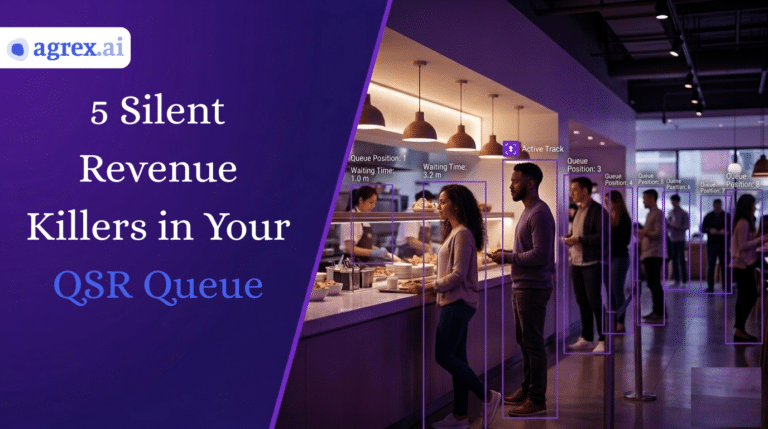
Agrex.ai’s AI queue management system uses your existing IP cameras to monitor queue zones continuously. No new hardware. No additional infrastructure. The platform connects to your current camera setup via RTSP and begins tracking everything your team was previously missing:
What Agrex.ai Monitors in Your Queue Zone
Individual Wait Times
Tracks how long each detected person has been waiting in the queue zone — per customer, per counter, in real time.
Queue Length Detection
Counts customers in the queue zone at any point in time, across all counters simultaneously.
Threshold-Based Alert Tickets
Raises an alert ticket on the dashboard the moment wait time crosses your defined limit — before the customer gives up.
Counter Idle Time & Staffing Insights
Historical queue data by hour and day — so you can staff and prepare for your actual peak, not an assumed one. Identifies counter idle periods so you can optimise shift allocation in real time.
Visual heatmaps showing how customers move through your floor — identifying congestion zones, underutilised areas, and queue hotspots so you can redesign for faster throughput.
Multi-Location Dashboard
Monitor queue performance across 50+ outlets from a single operations dashboard in real time.
Zero New Hardware Required
Connects to your existing CCTV infrastructure via RTSP — no new cameras, no new wiring, no capital expenditure.
When wait time crosses your set threshold, an alert ticket is raised immediately on the Agrex.ai dashboard. The right person sees it instantly and acts before the customer walks out. This is the difference between a camera system that records what happened and an intelligent one that prevents it.
Stop Losing Revenue You Cannot See
The 5 silent revenue killers in your QSR queue will never show up in your monthly sales report. Your POS records orders placed — not orders lost. Your end-of-day review tells you what your team sold — not how many customers walked away before they had the chance to order.
The only way to fix a restaurant queue abandonment problem is to make it visible. Real-time queue monitoring turns the invisible into the actionable — and even a 15% reduction in wait times can drive a measurable uplift in revenue per location.
You cannot improve what you cannot measure. Start measuring your queue.
Frequently Asked Questions
What is restaurant queue abandonment?
Restaurant queue abandonment happens when a customer joins your order queue, waits beyond their patience threshold, and walks out without ordering — without logging a complaint or leaving any trace in your POS system. Research shows 73% of QSR customers abandon after 5 minutes of waiting.
How long will customers wait in a QSR queue before leaving?
Industry research consistently shows that QSR customers begin abandoning queues at the 5-minute mark. At 3–5 minutes, up to 25% of customers will leave. Beyond 5 minutes, 73% will abandon. Beyond 10 minutes, nearly all customers walk out. The acceptable wait time window for a QSR is 0–3 minutes.
How does AI video analytics reduce queue abandonment in restaurants?
AI video analytics uses your existing CCTV cameras to monitor queue zones in real time — counting customers, tracking individual wait times, and raising alert tickets the moment wait time crosses a defined threshold. This gives managers the signal to act before customers abandon, turning a reactive process into a proactive one.
Does Agrex.ai require new cameras or hardware to monitor queues?
No. Agrex.ai connects to your existing IP cameras and NVR systems via RTSP — no new cameras, no rewiring, and no capital expenditure. The AI layer is deployed at the software level on top of your current infrastructure, typically across 50+ locations in under 30 days.
How does Agrex.ai alert staff when queue wait time is too long?
When wait time at a counter crosses your configured threshold, Agrex.ai raises an alert ticket directly on the dashboard. The alert is timestamped, counter-specific, and visible to the right person in real time — floor manager, shift lead, or supervisor — so action happens before the customer gives up.
What is the ROI of AI queue monitoring for a QSR?
QSR operators using AI queue monitoring typically see a 15–30% reduction in average wait times within the first 60 days. Even a 15% improvement in queue throughput translates to measurable revenue recovery per location. Most Agrex.ai clients see full ROI within 3–6 months of deployment.
See How Agrex.ai Monitors Your Queue in Real Time
Connect your existing CCTV cameras. Get real-time queue alerts. Reduce abandonment. No new hardware required.