Intelligent video analytics is transforming the way organizations use their existing CCTV infrastructure. Instead of relying on security guards staring at screens — or sifting through hours of recorded footage after an incident — intelligent video analytics uses artificial intelligence to automatically detect objects, recognize behaviors, and generate real-time alerts from live camera feeds. It turns passive surveillance into an active, decision-making system that works around the clock without fatigue or human error.
If you have ever wondered what is intelligent video analytics and why enterprises across retail, banking, logistics, manufacturing, and food service are rapidly adopting it, this guide breaks it all down. We will cover how the technology works under the hood, the core capabilities it unlocks, real-world industry applications, the emerging concept of agentic video analytics, and how you can deploy it on your existing cameras — without a hardware overhaul.
Traditional CCTV vs Intelligent Video Analytics
Traditional CCTV systems were designed for one purpose: recording footage. A camera captures video, stores it on a DVR or NVR, and someone reviews it later — usually after something has already gone wrong. The fundamental limitation is that traditional systems are reactive. They cannot tell you that a forklift just entered a restricted zone, that a queue has exceeded safe capacity, or that an employee skipped a hygiene checkpoint.
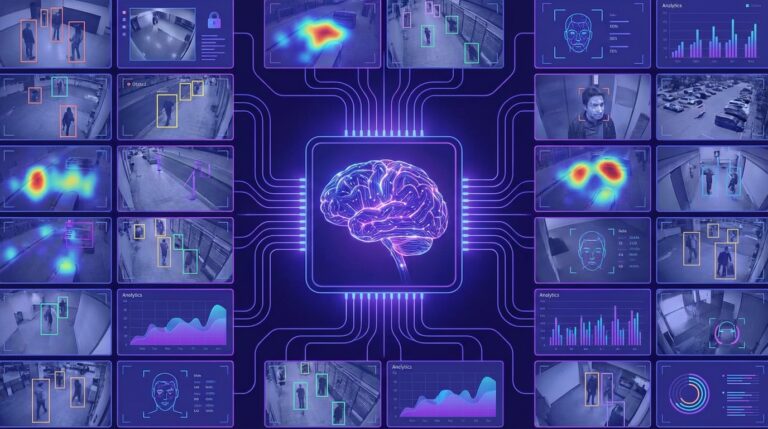
Intelligent video analytics flips this model entirely. By layering AI and deep learning models on top of existing camera feeds, the system actively processes every frame in real time. It detects, classifies, and tracks objects; recognizes patterns and anomalies; and triggers instant alerts to the right stakeholders. The cameras stay the same — the intelligence is in the software. Below is a side-by-side comparison of the two approaches.
| Feature | Traditional CCTV | Intelligent Video Analytics |
|---|---|---|
| Detection | ✗ Human-dependent, error-prone | ✓ AI-powered, automatic object & behavior detection |
| Response Time | Minutes to hours (post-incident review) | ✓ Real-time alerts in under 1 second |
| Analysis | ✗ No analytics — raw footage only | ✓ Heatmaps, people counting, behavior patterns |
| Storage | Stores all footage indiscriminately | ✓ Event-based storage, metadata indexing |
| Scalability | Requires more guards per camera | ✓ One platform monitors thousands of cameras |
| Cost Model | High recurring manpower cost | ✓ Software-based, decreasing cost per camera |
How Intelligent Video Analytics Works
At its core, an intelligent video analytics system follows a five-stage pipeline. Raw video from your existing IP or analog cameras is ingested, processed through AI models, and converted into structured, actionable data. Here is how each stage works.
Stage 1 — Ingest: The platform connects to your existing IP cameras using standard protocols like RTSP and ONVIF. Analog cameras work too via encoder boxes. No camera replacement is needed — this is a pure software layer that sits on top of your current infrastructure.
Stage 2 — Detect: Convolutional neural networks (CNNs) and transformer-based vision models process each frame in real time. They identify and classify objects — people, vehicles, license plates, PPE gear, open doors — with accuracy exceeding 95%. Object tracking algorithms (like DeepSORT) maintain identity across frames, enabling path analysis and dwell-time measurement.
Stage 3 — Analyze: This is where raw detections become intelligence. The system applies business-logic rules and behavioral models: Is that person in a restricted zone? Has the queue grown beyond five people? Did the employee follow the handwashing SOP? Spatial analytics generates heatmaps, trajectory plots, and occupancy trends.
Stage 4 — Alert: When a rule is violated or an anomaly is detected, the system fires instant alerts — push notifications, SMS, email, or webhook calls to integrated platforms like Slack, Microsoft Teams, or your operations dashboard. False-positive rates are kept below 5% through multi-frame confirmation and confidence thresholds.
Stage 5 — Act: In next-generation platforms like Agrex AI, the loop does not stop at an alert. Agentic AI takes autonomous follow-up actions — logging the incident, notifying the right supervisor, creating a compliance report, or triggering a corrective workflow in the connected system. The human stays in the loop for oversight, but the drudge work is automated.
Core Technologies Behind Intelligent Video Analytics
Several foundational technologies converge to make smart video analytics possible. Understanding these building blocks helps you evaluate platforms and separate genuine AI capabilities from marketing buzzwords.
Deep Learning and Computer Vision
Modern intelligent video analytics relies on deep neural networks — primarily CNNs for object detection (YOLO, EfficientDet) and vision transformers (ViT) for scene understanding. These models are trained on millions of labeled images, allowing them to generalize across lighting conditions, camera angles, and occlusion scenarios. Transfer learning and fine-tuning let platform vendors adapt pre-trained models to specific use cases — such as detecting hard hats on a construction site or uniforms in a QSR kitchen — without building from scratch.
Edge Computing
Processing video in the cloud introduces latency and bandwidth costs that are impractical at scale. Edge computing deploys AI inference directly at or near the camera — on edge servers, NVRs with GPU acceleration, or even smart cameras with onboard NPUs. This approach keeps latency under 100 milliseconds, reduces bandwidth consumption by up to 90% (only metadata and event clips are sent to the cloud), and ensures the system keeps working even during internet outages.
Natural Language Processing (NLP) for Agentic AI
The latest evolution in ai video analytics is the integration of large language models (LLMs) with video analytics platforms. This enables a conversational interface where operators can query camera feeds in plain English — “Show me all forklift near-misses from Dock 3 this week” — and receive structured results. NLP bridges the gap between the massive data output of computer vision and the human need for quick, intuitive answers. Agrex AI’s agentic platform is built on this paradigm, which we will explore in detail below.
Cloud-Edge Hybrid Architecture
Enterprise deployments typically use a hybrid model: edge devices handle real-time inference and alerting, while the cloud manages model training, long-term analytics, cross-site dashboards, and the agentic AI layer. This architecture offers the best of both worlds — low-latency response at the edge with centralized intelligence and scalability in the cloud.
Key Capabilities of Intelligent Video Analytics
An enterprise-grade intelligent video analytics platform offers a broad toolkit of capabilities that span security, operations, and compliance. Here are the six most impactful ones deployed across industries today.
Each of these capabilities operates simultaneously across hundreds of camera feeds. When combined, they give enterprises a comprehensive operational intelligence layer that was previously impossible without large teams of human monitors. For a deep dive into number plate recognition specifically, see our complete ANPR guide.
Industry Applications of Intelligent Video Analytics
The power of intelligent video analytics lies in its versatility. The same core AI engine adapts to vastly different use cases depending on the industry vertical. Here is how leading enterprises are deploying it across six major sectors.
Retail: Footfall, Conversion, and Loss Prevention
Retailers use intelligent video analytics to measure store footfall, track customer journeys through aisles, identify high-traffic zones via heatmaps, and correlate foot traffic with point-of-sale data to calculate true conversion rates. Shrinkage detection uses behavioral analytics to flag suspicious activity at self-checkout or high-value shelves — reducing losses by up to 25%. Agrex AI’s retail video analytics platform powers these use cases across multi-location retail chains.
Banking and Finance: ATM Security and Fraud Prevention
Banks deploy AI video analytics at ATMs, branch lobbies, and vaults to detect tailgating, loitering, card skimming behavior, and unauthorized after-hours access. Facial recognition cross-references against watchlists for known fraud suspects. Combined with transaction data, banking video analytics creates an integrated security and compliance layer that satisfies regulatory audit requirements.
Logistics and Warehousing: Dock Management and Safety
In warehouses and distribution centers, intelligent video analytics monitors dock door utilization, tracks forklift movements, detects safety violations (no hard hat, restricted zone entry), and measures loading/unloading cycle times. The result is measurable throughput improvement and a reduction in workplace incidents. Explore logistics video analytics use cases in detail.
Manufacturing: Safety Compliance and Process Monitoring
Manufacturers use smart video analytics to ensure PPE compliance (helmets, gloves, safety vests), monitor assembly line throughput, detect machine anomalies from visual inspection, and enforce safety buffer zones around heavy machinery. AI-based visual inspection also catches product defects at line speed — reducing quality escapes and recall risk.
QSR and Food Service: Drive-Thru Optimization
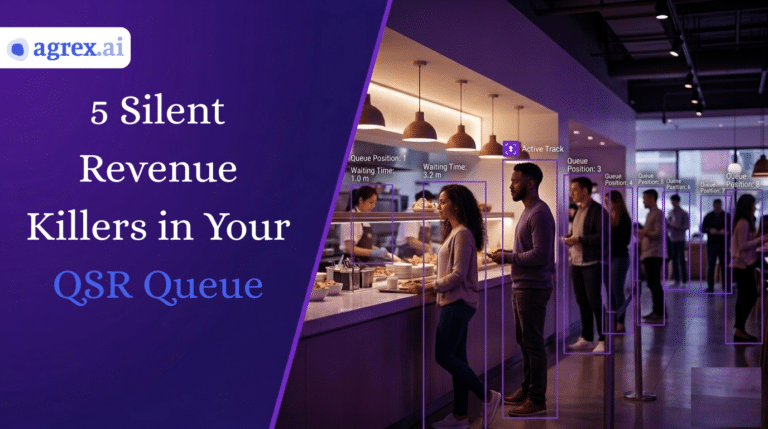
Quick-service restaurants leverage video analytics for drive-thru speed measurement, kitchen SOP compliance (handwashing, food prep hygiene), customer wait-time tracking at the counter, and real-time staffing recommendations based on observed demand patterns. Chains using Agrex AI have reported drive-thru time reductions of up to 20%.
Security and Surveillance: Perimeter Protection
For critical infrastructure, campuses, and high-security facilities, intelligent video analytics replaces passive CCTV with active perimeter monitoring. Virtual tripwires, abandoned object detection, crowd density monitoring, and license plate-based access control operate 24/7 with false alarm rates below 5%. Learn more about security video analytics solutions.
The Rise of Agentic Video Analytics
The most significant shift happening in intelligent video analytics right now is the move from dashboard-centric systems to agent-centric platforms. Traditional analytics platforms give you charts, heatmaps, and reports — but the human operator still has to interpret the data, decide what to do, and execute the action. Agentic video analytics eliminates that gap.
Here is what makes agentic video analytics fundamentally different from conventional platforms:
- Conversational interface: Instead of navigating complex dashboards, you type or speak natural-language queries — “How many trucks were at Dock 5 between 6 AM and noon?” — and get instant, structured answers.
- Autonomous monitoring agents: You define monitoring rules in plain English. The AI agent watches 24/7, detects violations, and takes predefined actions (notify, escalate, log, trigger workflow) — without a human in the loop for routine events.
- Closed-loop operations: When an event is detected, the system does not just send an alert and hope someone acts. It auto-creates an incident report, assigns it to the right person, and follows up until resolution. The human provides oversight; the AI handles execution.
- Contextual intelligence: Agentic systems combine video data with business context — POS transactions, shift schedules, weather data, inventory levels — to deliver insights that are operationally meaningful, not just visually interesting.
This paradigm shift is why analysts are calling agentic AI the next frontier in enterprise intelligence. According to MarketsandMarkets, the intelligent video analytics market is projected to grow from $8.1 billion in 2024 to over $24.3 billion by 2029, with AI-native platforms driving the majority of new deployments.
Benefits of Intelligent Video Analytics: The ROI Case
Enterprises adopting AI-powered video analytics consistently report measurable returns. The technology pays for itself — often within the first year — through a combination of cost reduction, efficiency gains, and risk mitigation. Here are the numbers that matter.
- 60% faster incident response: Real-time AI alerts replace post-incident review. Security teams act in seconds, not hours — reducing the damage window for theft, safety violations, and unauthorized access.
- 30% operational cost reduction: Automating manual monitoring eliminates the need for large guard forces watching screens. One AI platform replaces 10-20 human monitors while delivering higher accuracy.
- 50% SOP compliance improvement: Continuous, unbiased monitoring of standard operating procedures — handwashing, PPE usage, cleaning schedules — catches violations that periodic manual audits miss.
- 24/7 autonomous monitoring: Unlike human operators who fatigue after 20 minutes of continuous screen watching (a well-documented phenomenon in security research), AI maintains consistent vigilance around the clock across every camera simultaneously.
Beyond these headline metrics, intelligent video analytics delivers compounding value over time. The system learns from historical data, improving detection accuracy and reducing false positives with each passing month. Operational insights from heatmaps, traffic patterns, and dwell analysis inform strategic decisions — from store layout redesigns to warehouse workflow optimization — that generate ROI well beyond the security use case.
How to Get Started with Intelligent Video Analytics
One of the biggest misconceptions about AI video analytics is that it requires ripping out existing cameras and installing expensive new hardware. In reality, modern platforms like Agrex AI are designed to work with your existing camera infrastructure. Here is a practical roadmap for deployment.
Step 1: Audit Your Camera Infrastructure
Inventory your current cameras — IP and analog. Most intelligent video analytics platforms support any camera that outputs an RTSP stream (virtually all modern IP cameras). Older analog cameras can be connected via low-cost HDMI/SDI-to-IP encoders. You do not need 4K resolution for most use cases; 1080p and even 720p deliver strong results for people counting, intrusion detection, and SOP monitoring.
Step 2: Define Your Priority Use Cases
Start with 2-3 high-impact use cases rather than trying to deploy everything at once. Common starting points include intrusion detection for security teams, people counting for retail operations, and SOP compliance for manufacturing or QSR. Each use case should have a clear, measurable success metric (e.g., “reduce theft incidents by 25% in 90 days”).
Step 3: Deploy and Configure
A typical deployment takes 2-4 weeks for a mid-size facility (50-200 cameras). The platform connects to your cameras via network, you define zones and rules through a visual interface, and the AI begins learning your environment. No specialized IT staff is required — cloud-based platforms handle the heavy lifting. On-premise edge deployments are available for organizations with strict data residency requirements.
Step 4: Monitor, Refine, Scale
The first 30 days are a tuning period. The AI refines its models based on your specific environment, reducing false positives and improving detection confidence. After validation, you can scale to additional locations, add new use cases, and integrate with existing systems (ERP, access control, POS) via API. Enterprise customers using Agrex AI typically scale from a pilot site to 10+ locations within six months.
Ready to see intelligent video analytics in action? Book a demo with Agrex AI and experience the agentic difference — talk to your cameras, set up AI agents, and close operational loops automatically.
Frequently Asked Questions About Intelligent Video Analytics
What is intelligent video analytics?
Intelligent video analytics is the application of artificial intelligence — specifically deep learning and computer vision — to live and recorded video feeds from CCTV cameras. It automatically detects objects, recognizes behaviors, identifies anomalies, and generates real-time alerts and actionable insights without requiring constant human monitoring.
How is intelligent video analytics different from traditional video surveillance?
Traditional video surveillance is passive — cameras record footage for later review. Intelligent video analytics is active — AI processes every frame in real time, detecting events as they happen and alerting stakeholders immediately. It also generates structured data (heatmaps, counts, compliance scores) that traditional CCTV cannot provide.
Do I need to replace my existing cameras?
No. Modern intelligent video analytics platforms work with your existing IP cameras via standard protocols (RTSP, ONVIF). Even older analog cameras can be connected using inexpensive encoder devices. The AI processing happens on edge servers or in the cloud — your cameras simply provide the video feed.
What is agentic video analytics?
Agentic video analytics is the next evolution of AI-powered surveillance, pioneered by platforms like Agrex AI. Instead of just displaying dashboards, the system uses AI agents that autonomously monitor cameras, detect events, send alerts, and take follow-up actions (logging incidents, escalating to supervisors, triggering workflows) — all configurable in plain English.
How accurate is AI-based video analytics?
Enterprise-grade intelligent video analytics platforms achieve detection accuracy exceeding 95% for common use cases (people detection, vehicle detection, PPE compliance). Accuracy improves over time as models are fine-tuned to specific environments. False positive rates are typically kept below 5% through multi-frame confirmation and confidence thresholds.
What industries benefit most from intelligent video analytics?
Retail, banking, logistics, manufacturing, QSR (quick-service restaurants), and security are the top six industries driving adoption. However, intelligent video analytics is also expanding rapidly into healthcare, education, hospitality, and smart city applications. Any industry with existing camera infrastructure can benefit from AI-powered video analysis.
According to Gartner, intelligent video analytics is among the top 5 most impactful AI applications in physical security, with enterprise adoption expected to exceed 40% by 2027. Organizations deploying IVA report an average 85% reduction in false alarms and 60% improvement in incident response times compared to traditional surveillance systems.