Case Study • Education

How AI Video Analytics in Education Revolutionized Campus Operations

How a prominent North American university partnered with Agrex.AI to transform passive CCTV footage into actionable, real-time intelligence for campus safety and efficiency.

Book a Free Demo
65%
Faster Security Response
22%
Better Space Utilization
$200K
Annual Energy Savings
Overview

Enhancing Campus Efficiency through Video Analytics

In a rapidly digitizing world, educational institutions face mounting pressures to enhance safety, optimize operations, and improve resource management. Traditional, manual surveillance systems have proven inadequate in addressing these complex challenges. This case study details how a prominent North American university partnered with Agrex.AI to deploy an advanced education video analytics platform, transforming passive CCTV footage into actionable, real-time intelligence. See how AI analytics also transformed banking and ATM branch operations.

$5.04B
AI Video Analytics Market (2025)
$17.2B
Projected Market Size by 2030
23%+
Compound Annual Growth Rate
18%+
Facility Utilization Improvement
The Challenge

A Campus in Motion

Before partnering with Agrex.AI, the university grappled with a series of interconnected challenges rooted in its reliance on a legacy surveillance system and manual oversight.

Reactive Security

Thousands of cameras across a vast campus with only a handful of human operators. Incidents were identified only after the fact, delaying emergency response significantly.

Inefficient Resources

No reliable method for tracking foot traffic or occupancy, leading to overcrowded lecture halls while others remained underused, and HVAC running at full capacity in empty buildings.

Data Silos

Security, facilities, and academic administration operated with their own data silos. No centralized platform to correlate datasets for holistic campus understanding.

Privacy Concerns

The desire for enhanced surveillance was tempered by valid concerns regarding student and faculty privacy, requiring a transparent policy and strong ethical framework.

The Solution

Agrex.AI's Video Analytics Platform

Instead of replacing the existing camera network, Agrex.AI's comprehensive AI-powered platform was designed to integrate seamlessly, instantly transforming passive surveillance cameras into intelligent data-collection points. The solution was built on four key pillars, with a strict focus on privacy and ethical AI in education.

01

Proactive Security Monitoring

The platform uses machine learning algorithms to analyze video feeds in real time for loitering in restricted areas, unusual movements, and object-left-behind detection. The system instantly generates alerts with video clips and location data, enabling security to respond in seconds. Behavioral analytics detect fights, medical emergencies, and other events requiring immediate intervention.
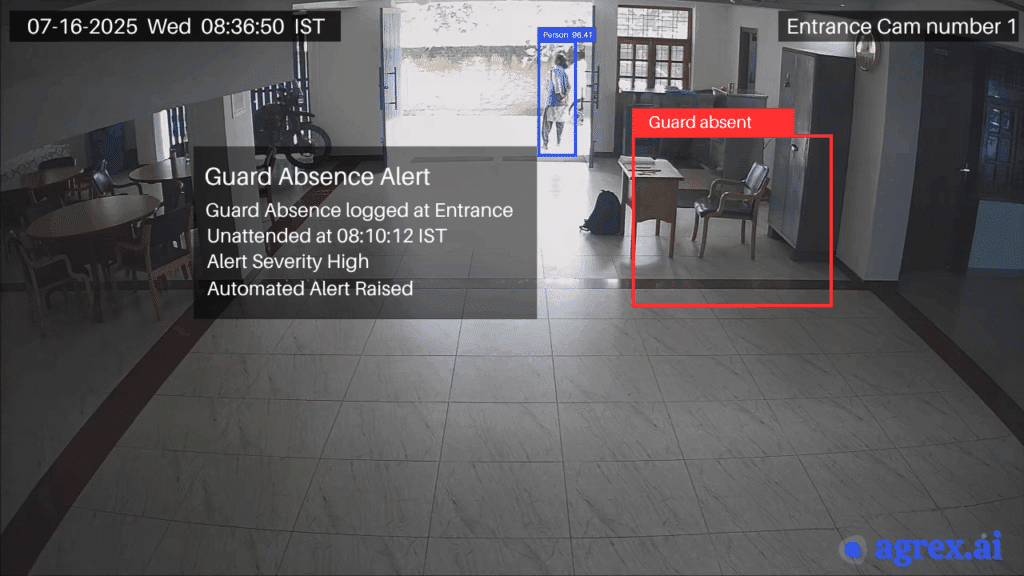
AI video analytics proactive security monitoring on campus
02

Crowd Detection & Occupancy Analytics

This module turns security footage into operational insights. The system tracks pedestrian flow and provides accurate headcounts for any given area. Administrators access a real-time dashboard to see occupancy levels in libraries, monitor dining hall traffic during peak hours, and track study room utilization for dynamic resource management.
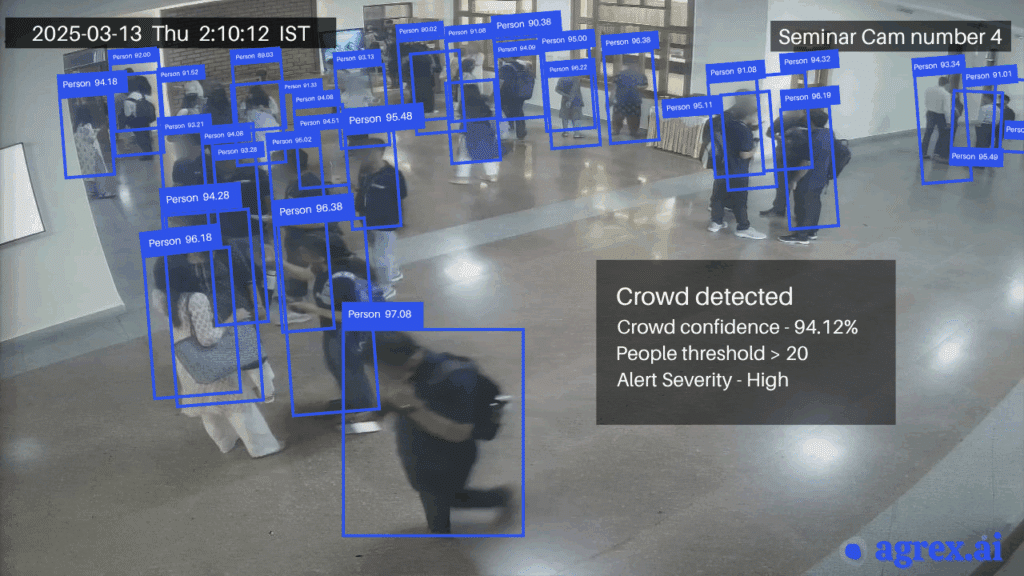
Crowd detection and occupancy analytics for education campus
03

Centralized Data Dashboard

Agrex.AI's platform brings all data into a single, intuitive dashboard. Security, facilities, and administration staff view and analyze campus-wide trends from a unified platform. Customizable reports on space utilization, peak traffic times, and incident heat maps give every department the insights they need to optimize operations.
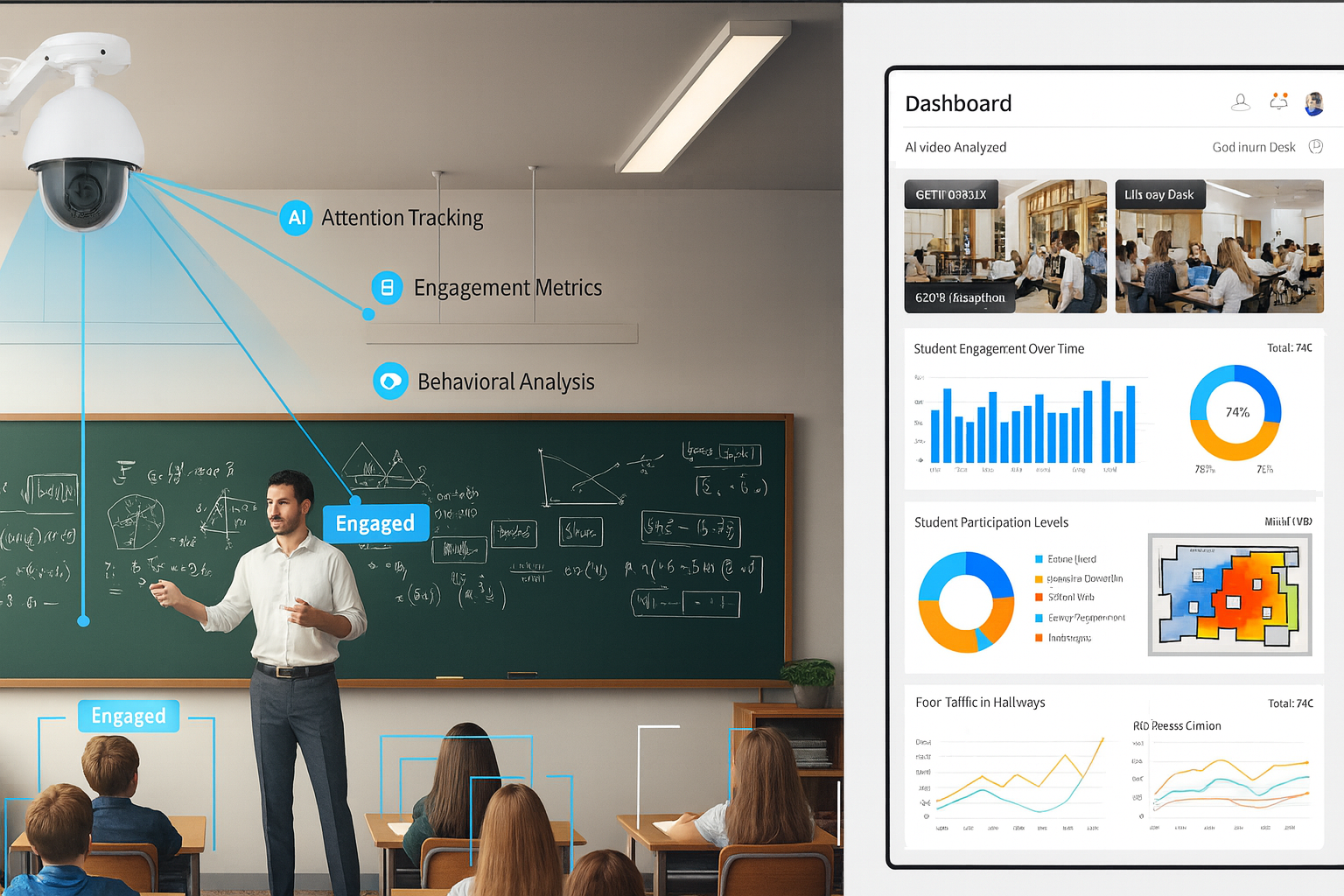
Centralized campus analytics dashboard by Agrex AI
04

Violence & Incident Detection

Advanced AI models detect aggressive behavior, altercations, and potential security threats in real time. The system provides immediate alerts with contextual video evidence, enabling rapid response and intervention before situations escalate. This proactive approach significantly reduces campus safety incidents.
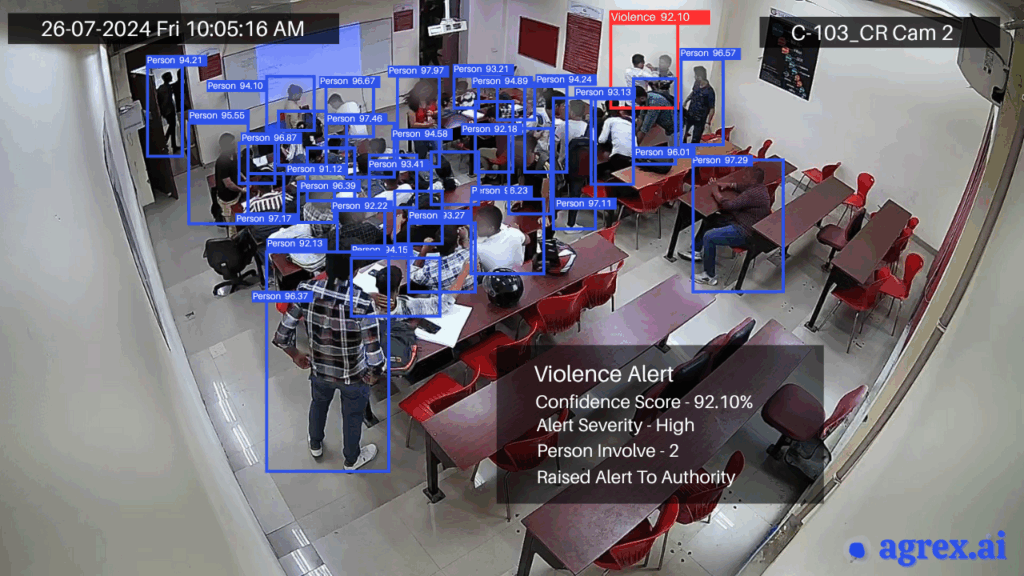
Violence detection through AI video analytics in education
Platform

Core AIVIS Modules for Education

ModuleFunctionality
Proactive Security AlertsReal-time detection of loitering, unauthorized access, unusual movements, and object-left-behind with instant alerts
Violence & Incident DetectionAI-powered detection of fights, aggressive behavior, and medical emergencies with contextual video evidence
Occupancy & Footfall AnalyticsAccurate headcounts and pedestrian flow tracking for libraries, lecture halls, dining areas, and study rooms
Heatmap AnalysisVisual traffic pattern mapping across campus for resource optimization and space planning
Crowd DetectionReal-time crowd density monitoring with threshold alerts for safety management during events
Centralized DashboardUnified platform for security, facilities, and administration with customizable reports and trend analysis
Privacy & AnonymizationObject detection for headcounts without facial recognition, ensuring ethical data collection and regulatory compliance
Results

Measurable Impact

65%
Faster Security Response
Average time to detect and dispatch reduced for all incident types
22%
Space Utilization Improvement
Lecture hall scheduling optimized through occupancy data analysis
$200K
Projected Annual Savings
Reduced energy consumption in underutilized buildings
24/7
Proactive Monitoring
Predictive maintenance replacing reactive schedules campus-wide

Sources: MarketsandMarkets, Campus Safety Magazine

Ready to Transform Your Campus?

Join leading educational institutions using AIVIS to enhance campus safety, optimize facility utilization, and build a smarter, data-driven campus environment.

Book a Free Demo
FAQ

Frequently Asked Questions

Agrex.AI offers an AI-powered video analytics platform that integrates with a university’s existing CCTV camera network. It uses machine learning to analyze video feeds in real time, transforming passive surveillance footage into actionable data. This allows for automated security alerts, real-time occupancy tracking, and operational insights without requiring a full infrastructure replacement.
The university struggled with several key issues, including slow and reactive security responses, inefficient management of campus resources (like classrooms and libraries), and a lack of data for making informed decisions. Manual monitoring was labor-intensive and resulted in significant operational bottlenecks and safety vulnerabilities.
The platform provided a proactive approach to security. It delivered instant, location-specific alerts to security personnel for events like unauthorized access or unusual behavior. This led to a 65% reduction in security response times, enabling the campus security team to address incidents much faster and more efficiently.
The platform’s occupancy and footfall analytics provided valuable data to the university. This allowed them to improve classroom space utilization by 22%, save an estimated $200,000 annually by optimizing energy consumption in underutilized buildings, and use data to justify the repurposing of underused spaces for new student-centric facilities.
Agrex.AI and the university implemented a strict ethical framework. The platform was configured to anonymize data where possible, using object detection for headcounts rather than individual facial recognition for general tracking. Facial recognition was limited to specific, high-security access points under clear policy guidelines, ensuring that the technology prioritized community safety without compromising privacy.
While the case study focuses on a large university, the modular nature of Agrex.AI’s platform allows it to be scalable for a wide range of educational institutions, from small colleges to large, multi-campus universities. The system can be tailored to meet the specific needs and budget of any institution.
The university is exploring further applications, including integrating the video analytics with its building management systems for automated environmental control. Other potential uses include predictive maintenance, real-time crowd-flow analysis for emergency management, and anonymous analysis of student engagement in large lecture halls to inform teaching methods.