
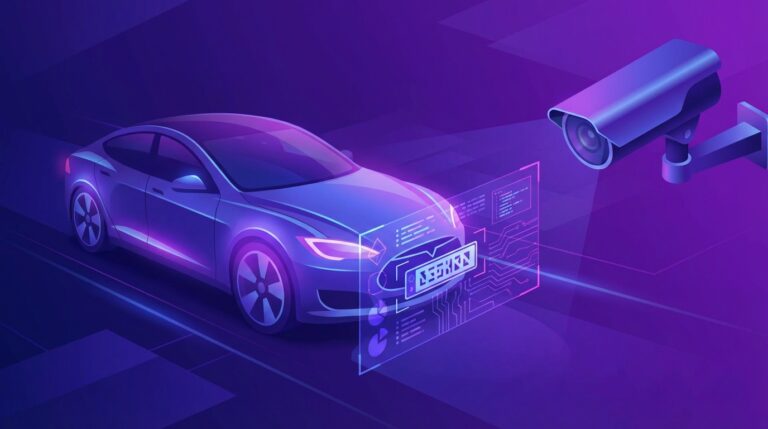
Automatic Number Plate Recognition (ANPR) — also known as License Plate Recognition (LPR) — is one of the most widely deployed AI-powered surveillance technologies in the world. From highway toll booths to retail parking lots, ANPR systems read and process vehicle number plates in real time, enabling automated access control, law enforcement, fleet management, and business intelligence. In India alone, ANPR adoption is surging under the Smart Cities Mission and the Motor Vehicles (Amendment) Act, 2019.
This guide covers everything you need to know about ANPR technology: how automatic number plate recognition works, its key components, industry use cases, benefits, Indian regulations, and how to choose the right ANPR system for your organization.
What is ANPR (Automatic Number Plate Recognition)?
ANPR is an AI-driven technology that uses optical character recognition (OCR) on camera footage to automatically read vehicle registration plates. The system captures an image of the vehicle, isolates the number plate region, extracts the alphanumeric characters, and matches them against a database — all within milliseconds.
Originally developed in the 1970s for law enforcement in the UK, ANPR has evolved from basic template-matching systems into sophisticated deep learning platforms capable of reading plates across varying lighting conditions, angles, speeds, and plate formats. Modern ANPR systems achieve over 99% accuracy even in challenging conditions like rain, fog, night-time, and high-speed traffic.
How Automatic Number Plate Recognition Works
An ANPR system operates through a multi-stage pipeline that processes video frames in real time. Here’s the step-by-step process:
Image Capture
Specialized cameras (often with infrared illumination) capture high-resolution images of approaching vehicles at up to 250 km/h.
Plate Detection
AI algorithms locate the number plate region within the image, handling varying angles, sizes, and positions using deep learning object detection.
Character Recognition
OCR engine segments individual characters and recognizes them using convolutional neural networks trained on thousands of plate formats.
Database Matching
The extracted plate number is matched against databases (RTO records, watchlists, parking permits, fleet registers) to trigger appropriate actions.
The entire pipeline — from camera capture to database lookup — completes in under 100 milliseconds. Modern systems use GPU-accelerated deep learning models that handle multiple lanes simultaneously, processing thousands of vehicles per hour with minimal latency.
Key Components of an ANPR System
1. ANPR Cameras
ANPR cameras are purpose-built for plate capture. They differ from standard CCTV cameras in several ways:
- Infrared (IR) illumination: Ensures plates are readable at night by illuminating the retroreflective plate surface without blinding drivers
- High shutter speed: Eliminates motion blur on vehicles moving at highway speeds
- Wide dynamic range (WDR): Handles headlight glare and bright sunlight simultaneously
- Varifocal lenses: Adjustable focal length to cover single lanes or multi-lane roads
2. OCR & AI Software
The software is the brain of the ANPR system. Modern platforms use deep learning models — specifically convolutional neural networks (CNNs) and transformer architectures — trained on millions of plate images across different countries, fonts, and conditions. Key capabilities include:
- Multi-format support: Indian plates (white, yellow, green EV), international formats, temporary plates
- Dirty/damaged plate handling: AI compensates for mud, scratches, and partial occlusion
- Multi-row plates: Reads plates with stacked layouts (common in commercial vehicles)
- Vehicle classification: Identifies vehicle type (car, truck, motorcycle, bus) alongside plate reading
3. Database & Integration Layer
ANPR data is only valuable when connected to business systems. The integration layer connects to:
- RTO/Vahan database: Vehicle registration verification and owner lookup
- Watchlists: Stolen vehicles, wanted persons, blacklisted plates
- Access control systems: Automated barrier/gate opening for authorized vehicles
- Parking management: Entry/exit logging, fee calculation, permit verification
- ERP/Fleet systems: Vehicle tracking, trip logging, compliance reporting
ANPR Use Cases Across Industries
Parking Management
Automated entry/exit with ticketless parking. ANPR reads plates on arrival, calculates duration, and enables contactless payment — eliminating manual ticketing and reducing wait times by 80%.
Law Enforcement
Real-time stolen vehicle detection, wanted person alerts, and hit-and-run investigation. Police forces use ANPR networks across highways and city entry points for instant watchlist matching.
Toll Collection
Automatic toll deduction via FASTag integration. ANPR serves as backup verification and catches toll evaders, increasing revenue recovery by 15-25% at toll plazas.
Logistics & Fleet
Track vehicle entry/exit at warehouses, automate gate passes, verify delivery trucks, and log trip durations. Integrates with fleet management systems for real-time visibility. Learn more about logistics video analytics.
Retail & QSR
Drive-through customer identification, loyalty program integration, and VIP alerts. ANPR enables personalized service the moment a returning customer arrives at the drive-through lane.
Smart Cities
Traffic flow analysis, congestion monitoring, average speed enforcement, and environmental zone management. Cities use ANPR data to optimize signal timing and identify traffic patterns.
Banking & ATM Security
Monitor vehicles at ATM locations, bank branches, and cash-in-transit routes. ANPR logs every vehicle visiting sensitive financial locations for forensic investigation. Explore banking video analytics.
Benefits of AI-Powered ANPR Systems
AI-powered ANPR systems offer significant advantages over manual and legacy OCR-based approaches:
| Feature | Manual Checking | Legacy OCR | AI-Powered ANPR |
|---|---|---|---|
| Accuracy | 70-80% | 85-92% | 99%+ |
| Speed per plate | 5-10 seconds | 1-2 seconds | <100 milliseconds |
| Night performance | Very poor | Moderate | Excellent (IR cameras) |
| Dirty/damaged plates | Moderate | Poor | Good (AI compensation) |
| Multi-lane support | 1 lane per person | 1-2 lanes | 4-8 lanes simultaneously |
| Cost per vehicle | High (labor) | Medium | Low (automated) |
| 24/7 operation | Requires shifts | Yes | Yes |
Key benefits include:
- Operational efficiency: Eliminate manual gate operations, reduce staffing requirements by 60-70%, and process vehicles 50x faster than human operators
- Revenue recovery: Catch toll evaders, parking violators, and unauthorized vehicles that slip past manual checkpoints — recovering 15-25% in lost revenue
- Enhanced security: Real-time alerts for stolen vehicles, blacklisted plates, or unauthorized access attempts — response time drops from minutes to seconds. Explore security video analytics solutions
- Data-driven insights: Historical plate data reveals traffic patterns, peak hours, dwell times, and repeat visitor frequency — powering smarter business decisions
- Contactless operations: Especially important post-COVID — ANPR enables fully touchless vehicle identification without ticket machines, tokens, or manual verification
ANPR in India: Regulations and Adoption
India is one of the fastest-growing ANPR markets globally, driven by government mandates and smart city investments.
Motor Vehicles (Amendment) Act, 2019 — Key ANPR Provisions
The amended MV Act significantly boosted ANPR adoption in India:
- Section 136A: Empowers government to set up electronic surveillance on highways and urban roads
- Increased penalties: Higher fines for traffic violations make automated enforcement economically viable
- FASTag mandate: Mandatory electronic toll collection creates a complementary ecosystem for ANPR verification
- High-Security Registration Plates (HSRP): Standardized plate format with machine-readable fonts improves OCR accuracy
State-Level ANPR Implementations
Several Indian states have deployed or are deploying large-scale ANPR networks:
- Delhi: Over 7,500 ANPR cameras installed across the city for traffic enforcement, stolen vehicle detection, and pollution monitoring (odd-even scheme enforcement)
- Maharashtra: Mumbai-Pune Expressway and city entry points equipped with ANPR for toll enforcement and security screening
- Karnataka: Bengaluru’s Intelligent Traffic Management System (ITMS) uses ANPR for automated challan generation
- Telangana: Hyderabad Police’s integrated ANPR network covers major intersections and highway corridors
- Gujarat: Ahmedabad’s Smart City project includes ANPR at 200+ intersections
The Smart Cities Mission has allocated significant budgets for intelligent traffic management, with ANPR as a core component. As of 2026, over 40 smart cities have either deployed or tendered for ANPR-based traffic systems.
How to Choose the Right Number Plate Recognition System
Selecting an ANPR solution requires evaluating several technical and operational factors:
- Accuracy rate: Demand 99%+ accuracy in real-world conditions (not just lab tests). Ask for accuracy metrics across day/night, rain, and high-speed scenarios
- Indian plate format support: The system must handle all Indian plate types — white (private), yellow (commercial), green (EV), red (diplomatic), temporary, and HSRP formats
- Integration capabilities: Look for REST APIs, webhook support, and pre-built connectors to your existing systems (parking, ERP, fleet management, access control)
- Edge vs cloud processing: Edge processing (on-camera or local server) ensures low latency and works offline. Cloud processing enables centralized analytics across locations
- Multi-lane and multi-camera support: Ensure the system can handle your throughput — peak hour vehicle count × lanes × locations
- Scalability: Can you add more cameras and locations without re-architecting? Look for camera-agnostic platforms that work with existing CCTV infrastructure
- Compliance: Verify the solution meets IT Act 2000 data protection requirements and any state-specific surveillance regulations
- Analytics dashboard: Beyond plate reading — does the platform offer traffic analytics, pattern detection, repeat visitor insights, and automated reporting?
Agrex AI’s ANPR Solution
Agrex AI offers an enterprise-grade ANPR platform built on proprietary deep learning models trained specifically on Indian number plates. Our solution works with your existing CCTV cameras — no hardware replacement needed — and delivers 99.2%+ accuracy across all Indian plate formats.
Key differentiators:
- Camera-agnostic: Works with existing IP cameras, no proprietary ANPR cameras required
- Edge-first architecture: Processes at the edge for sub-100ms latency, syncs to cloud for analytics
- Indian plate specialization: Trained on 5M+ Indian plate images across all states and formats
- Agentic AI interface: Chat-based AI assistant for querying plate data, generating reports, and setting up alerts — no SQL or dashboard navigation needed
- End-to-end platform: ANPR is one module within Agrex AI’s full video analytics suite, which includes intrusion detection, people counting, queue management, and SOP compliance
Book a free ANPR demo to see how Agrex AI can automate your vehicle management with AI-powered number plate recognition.
Frequently Asked Questions About ANPR
What does ANPR stand for?
ANPR stands for Automatic Number Plate Recognition. It is also known as ALPR (Automatic License Plate Recognition) or LPR (License Plate Recognition) in different regions. The technology uses cameras and AI-powered OCR to automatically read and process vehicle registration plates.
How accurate is ANPR technology?
Modern AI-powered ANPR systems achieve 99%+ accuracy in optimal conditions. In real-world deployments with varying weather, lighting, and vehicle speeds, accuracy typically ranges from 95-99%. Factors affecting accuracy include camera quality, plate condition, mounting angle, and the AI model’s training data.
Can ANPR work at night?
Yes. ANPR cameras use infrared (IR) illumination that is invisible to drivers but illuminates the retroreflective surface of number plates. This makes night-time performance nearly identical to daytime. Most enterprise ANPR cameras include built-in IR LEDs rated for 15-30 meters.
Is ANPR legal in India?
Yes. The Motor Vehicles (Amendment) Act, 2019 explicitly authorizes electronic surveillance for traffic enforcement under Section 136A. Multiple state governments have deployed ANPR systems for traffic management, toll collection, and law enforcement. Data handling must comply with the IT Act 2000 and emerging data protection regulations.
What is the difference between ANPR and ALPR?
ANPR (Automatic Number Plate Recognition) and ALPR (Automatic License Plate Recognition) refer to the same technology. ANPR is the term used in the UK, India, and most of Asia, while ALPR is more common in North America. The technology, functionality, and applications are identical.
Can ANPR work with existing CCTV cameras?
It depends on the camera specifications. AI-powered ANPR solutions like Agrex AI can work with existing IP cameras that have sufficient resolution (minimum 2MP recommended), provided the camera is positioned to capture a clear view of the plate. Dedicated ANPR cameras with IR illumination are recommended for highway speeds and night-time use.
According to the UK Home Office National ANPR Standards, the UK operates one of the world’s largest ANPR networks with over 13,000 cameras reading 60 million plates per day. In India, ANPR adoption is accelerating under the Smart Cities Mission and the Motor Vehicles (Amendment) Act, 2019.