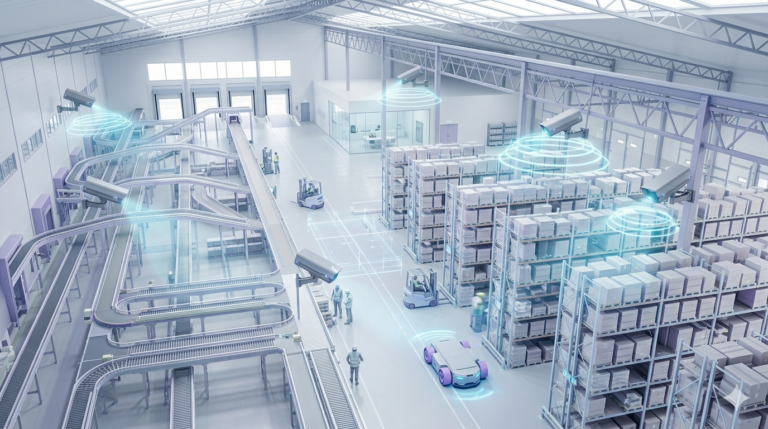
AI video analytics warehouses goes far beyond passive monitoring. Indian logistics facilities are using autonomous video AI to detect PPE violations, flag forklift zone breaches, automate ANPR at gates, and trigger instant alerts to the right supervisor — all without human intervention. This post covers 10 real use cases where AI video analytics is making Indian warehouses measurably safer.
AI video analytics warehouses is no longer about recording footage and reviewing it after something goes wrong. The next generation of warehouse safety in India is not about adding more cameras — it is about making existing cameras capable of detecting, deciding, and acting autonomously.
Indian warehouses and logistics facilities handle thousands of daily operations across loading docks, storage zones, conveyor lines, and vehicle yards. Safety violations, unauthorised access, and compliance gaps happen constantly. The difference between a safe warehouse and a dangerous one is not detection — it is what happens in the seconds after detection.
According to the IFSEC Global 2025 State of Physical Security Report, over 70% of video analytics deployments underperform not because of detection accuracy, but because alerts go unacted upon. The response loop is broken.
This is where autonomous intelligent video analytics changes the equation entirely. Instead of passively logging events to a dashboard, autonomous AI detects the event, classifies its severity, identifies the right person to alert, sends the notification with footage attached, and tracks the resolution — all without a single human reviewing a camera feed.
In this post, we break down 10 specific use cases where AI video analytics is making Indian warehouses safer — with real operational impact.
61%→89%
PPE compliance improvement in 60 days
<60 sec
Average alert-to-supervisor response time
54 sites
Deployed in under 30 days
30%
Reduction in operational costs
Why Are Indian Warehouses Adopting AI Video Analytics for Safety?
India's logistics sector is growing rapidly, but warehouse safety has not kept pace. Workplace injuries in logistics and manufacturing remain alarmingly high — with thousands of incidents annually across warehouses, distribution centres, and factory floors.
The core problem is not a lack of cameras. Most large Indian warehouses already have extensive CCTV infrastructure. The problem is that these cameras record passively. A PPE violation happens, it gets captured on footage, and someone discovers it during an end-of-shift review — hours after the violation occurred and potentially after an injury has already happened.
AI video analytics warehouse solutions change this by closing the loop between detection and action. The camera sees a violation. The AI classifies it. The right supervisor gets alerted — instantly, with footage and zone location attached. The alert stays open in the system until resolution is confirmed. No manual review. No delays. No incidents slipping through the cracks.
Here are the 10 use cases driving this transformation across Indian logistics and warehousing operations.
Each use case below follows the same autonomous loop: detect → classify → alert the right person → track resolution — all without manual footage review.
Use Case 1 — How Does AI Video Analytics Detect PPE Violations in Real Time?
PPE compliance is the single most impactful safety use case for AI video analytics warehouses. The system monitors every camera feed simultaneously and detects when a worker enters a designated zone without the required safety gear — helmet, gloves, goggles, safety shoes, or high-visibility vest.
- Camera detects missing helmet in Zone B → system identifies Zone B supervisor's responsibility
- Supervisor receives WhatsApp alert with footage clip in under 60 seconds
- Supervisor approaches worker, violation resolved → marked closed in system
- If not acknowledged in 5 minutes → follow-up alert escalates to plant manager
- Shift ends → compliance report auto-generated with violations, response times, and open items
Result: Facilities deploying this loop have moved from 61% to 89% compliance within 60 days — because workers know every violation triggers an immediate, real consequence.
Use Case 2 — How Does ANPR Automate Vehicle Tracking at Warehouse Gates?
Automatic Number Plate Recognition (ANPR) eliminates the clipboard and manual logbook at warehouse entry and exit points. Every vehicle is automatically identified, verified against an authorised list, and logged — with zero human input.
- Authorised vehicle approaches gate → plate read → entry timestamped, log updated automatically
- Unauthorised vehicle detected → security team alerted instantly with plate image and footage
- Wrongly parked truck in loading bay → operations team notified with zone and timestamp
- All vehicle logs are searchable, audit-ready, and tamper-proof — no manual entry required
Indian logistics facilities processing 200+ vehicles daily report 70% faster gate processing and complete elimination of manual logbook errors after deploying ANPR.
Use Case 3 — How Does AI Monitor Forklift Zones and Prevent Collisions?
Forklifts operating in shared pedestrian zones are one of the highest-risk scenarios in any warehouse. With autonomous video analytics for logistics, the response is instant — not a dashboard entry reviewed at shift end.
- Forklift detected in pedestrian zone → zone supervisor alerted immediately with location and footage
- Repeated violation in the same zone → pattern tracked, escalation alert sent to operations head
- Every forklift zone breach logged with timestamp, camera ID, and resolution status
If Zone C consistently shows forklift breaches during night shift, the operations team gets a pattern report that triggers a process review — not just individual alerts.
Use Case 4 — How Does AI Detect Sleeping Workers on Loading Bays?
Loaders falling asleep on bays during low-activity hours is a persistent challenge in Indian warehouses — particularly during night shifts. Traditional monitoring relies on periodic supervisor rounds that cannot cover every bay simultaneously.
- Loader detected sleeping on bay → shift manager notified automatically with footage clip
- Alert includes exact bay number, timestamp, and camera reference
- Event logged in the system → resolution tracked until confirmed actioned
A sleeping worker on an active loading bay is a serious injury risk when vehicles and heavy machinery are operating nearby.
Use Case 5 — How Does AI Track Cold Chain Door Compliance?
In temperature-controlled warehouses, every minute a cold chain door stays open costs money and risks product integrity. Manual monitoring at scale is impractical — supervisors cannot watch every door across every zone simultaneously.
- Cold chain door open for more than 5 minutes → operations team alerted with door location and open-duration timer
- Timer logged for compliance audit — every door opening tracked with duration, frequency, and responsible zone
- Repeated violations at the same door → maintenance team notified for a potential equipment check
Use Case 6 — How Does AI Enforce Pathway Adherence in Warehouses?
Warehouses have designated pathways to separate pedestrian traffic from vehicle routes and heavy machinery zones. When workers deviate, the risk of collision and injury increases significantly.
- Worker detected off designated pathway → immediate alert to zone supervisor
- Repeated pathway violations in same zone → pattern flagged, escalation threshold triggered
- Follow-up alert sent to safety officer after repeated violations in the same area
A single deviation is flagged. A repeated pattern in the same zone triggers a process-level review — fixing root causes rather than chasing individual incidents.
Use Case 7 — How Does AI Count and Track Packages on Conveyors?
Manual package counting on conveyor belts is slow, error-prone, and impossible to sustain at high throughput. AI video analytics automates this entirely.
- Every box, carton, or pallet counted in real time with camera-based detection
- Count discrepancy detected → operations team alerted instantly with discrepancy figure and time window
- Open box or damaged package detected → QC supervisor alerted with footage and timestamp
- Shift count report auto-generated — zero manual input, fully auditable
Dual value: operational accuracy (every package counted) and loss prevention (damaged packages flagged before they leave the facility).
Use Case 8 — How Does AI Detect Unauthorised Zone Access?
Warehouses have restricted zones — hazardous material storage, high-value inventory areas, server rooms, and management offices. Unauthorised access must be detected and acted upon immediately, not discovered during a weekly footage review.
- Person detected in restricted zone without authorisation → access event logged, security team alerted with footage
- Alert includes zone ID, timestamp, and person image for verification
- Event stays open in the system until security confirms resolution
When integrated with access control systems, video analytics can correlate camera detections with access card data — making every alert more actionable.
Use Case 9 — How Does AI Monitor Truck Parking Compliance?
Wrongly parked trucks at loading docks create bottlenecks, block other vehicles, and pose safety hazards. In large Indian logistics parks handling dozens of trucks simultaneously, manual parking enforcement is impractical.
- Truck parked in wrong bay or non-designated area → operations team alerted with zone location and plate number
- Alert routed to the dock manager responsible for that zone — not a generic control room
- Parking violation logged with timestamp, duration, and resolution status
Use Case 10 — How Does AI Auto-Generate Shift Safety Reports?
Every alert, every violation, every resolution from the nine use cases above feeds into an automated shift report — generated with zero manual input.
- Shift report includes: total violations, response times per alert, open items, resolved items, zone-wise breakdown
- Reports generated automatically at shift end — delivered to the safety officer, operations head, and facility manager
- Weekly and monthly trend analysis: which zones, shifts, and violation types are increasing or decreasing
- Audit-ready documentation for regulatory compliance reviews
The safety officer's role shifts from manually tracking individual incidents to analysing patterns and driving systemic improvements — because the system handles detection, alerting, and reporting automatically.
What Is the Difference Between Traditional CCTV and AI Video Analytics in Warehouses?
| Capability | Traditional CCTV | AI Video Analytics |
|---|---|---|
| PPE detection | Manual review after incident | Real-time detect → alert → resolve |
| Vehicle logging | Guard with clipboard | Autonomous ANPR — zero manual input |
| Alert response | Dashboard → wait for human review | Instant route to right supervisor |
| Escalation | None — alerts sit in a log | Auto-escalation if unacknowledged |
| Shift reporting | Manual compilation | Auto-generated, audit-ready |
| Hardware required | New cameras per upgrade | Works on existing IP cameras |
How Can Indian Warehouses Deploy AI Video Analytics Without Replacing Cameras?
One of the most common misconceptions is that deploying AI video analytics requires ripping out existing camera infrastructure. Modern platforms like Agrex.ai connect to existing IP cameras, NVRs, and VMS platforms via standard RTSP and ONVIF protocols.
Typical Deployment Timeline
Week 1–2
Camera audit, zone mapping, and rule configuration per area — PPE rules for storage zones, ANPR at gates, pathway rules for aisles.
Week 3
Alert routing setup — mapping each alert type to the right supervisor per zone, configuring escalation chains.
Week 4
Go-live across all cameras. Real-time alerts active. Auto-reporting enabled. Deployment complete.
Enterprise rollouts across 50+ locations have been completed in under 30 days — because the platform sits on top of existing infrastructure rather than replacing it. Read more about how this works in our manufacturing case study.
Key Takeaway
AI video analytics warehouses is not about watching more footage. It is about building autonomous response loops where every detection triggers an action, every alert reaches the right person, and every resolution is tracked and reported — without manual intervention. The 10 use cases above represent real, deployed capabilities making Indian warehouses safer today.
Frequently Asked Questions
What is AI video analytics for warehouses?
AI video analytics for warehouses uses computer vision and artificial intelligence to analyse live camera feeds in real time. It detects safety violations, counts packages, reads number plates, monitors restricted zones, and sends autonomous alerts to supervisors — all without manual footage review. The system works on existing IP cameras and does not require new hardware installation.
How does AI video analytics improve warehouse safety in India?
AI video analytics improves warehouse safety by closing the gap between detection and action. Instead of logging violations to a dashboard for later review, the system instantly alerts the right supervisor with footage, zone location, and event details. Unacknowledged alerts automatically escalate. Facilities using this approach have achieved PPE compliance improvements from 61% to 89% within 60 days.
Can AI video analytics work with existing CCTV cameras in my warehouse?
Yes. Modern AI video analytics platforms connect to existing IP cameras, NVRs, and VMS systems via standard RTSP and ONVIF protocols. There is no need to replace or upgrade camera hardware. The AI layer sits on top of your current infrastructure and starts delivering insights from day one.
What is the ROI of deploying AI video analytics in a warehouse?
Logistics companies deploying AI video analytics typically report 30% reduction in operational costs, 40–60% fewer workplace safety incidents, and 70% faster vehicle processing at gates. Most facilities see measurable ROI within 3–6 months of deployment.
How does ANPR work in a logistics facility?
ANPR (Automatic Number Plate Recognition) uses AI-powered cameras at entry and exit points to read, verify, and log vehicle number plates automatically. Authorised vehicles are processed in under 90 seconds. Unauthorised vehicles trigger instant security alerts with plate image and footage attached. All logs are searchable and audit-ready.
How quickly can AI video analytics be deployed across multiple warehouse locations?
Enterprise deployments across 50+ locations have been completed in under 30 days. The process involves camera auditing, zone mapping, rule configuration, alert routing setup, and go-live — all without replacing existing cameras or disrupting warehouse operations.
Ready to Make Your Warehouse Safer with AI Video Analytics?
See how Agrex.ai deploys autonomous safety monitoring across your existing camera infrastructure — in under 30 days.