The logistics and warehousing industry loses an estimated $50 billion annually to operational inefficiencies, cargo theft, and workplace accidents. Most of it happens in plain sight — on camera, but never acted upon. In this guide, we break down the 6 warehouse operations blind spots that cost logistics companies the most, and show exactly how AI video analytics eliminates each one in real time. ROI benchmarks included.
📄 In This Guide
It is 4 AM at a large distribution centre outside Mumbai. Forty trucks are queued at the loading docks. A loader without a helmet is unloading a refrigerated bay. A forklift is reversing down a pedestrian corridor. Three packages have been thrown from a conveyor belt. And in the security room, a guard is watching a static screen that has recorded all of it — and acted on none of it.
This is not a worst-case scenario. This is a typical night for logistics operations running on passive CCTV.
AI video analytics changes this entirely. Instead of recording problems for someone to discover in a review meeting, it detects, decides, and alerts — in real time, across every camera, simultaneously.
In this guide, we break down exactly what warehouse video analytics is, the 6 operational blind spots it fixes, how to implement it without replacing your existing cameras, and what measurable ROI looks like when logistics companies deploy it at scale.
Why Logistics Operations Have a Warehouse Visibility Problem
Traditional warehouse security was built for a different era. Install cameras, connect them to an NVR, trust that someone reviews footage when something goes wrong. The cameras watched. Nobody acted.
Today’s logistics and warehousing operations are too complex and too fast-moving for passive monitoring. A single mid-sized distribution centre can process 10,000+ packages a day, manage 50+ vehicle movements per shift, and run three overlapping shifts with hundreds of workers — across multiple docks, storage zones, and entry points. The data volume is enormous. The window for intervention is often under two minutes.
The result is a persistent warehouse visibility gap — the space between what your cameras see and what your operations team actually knows. AI-powered video monitoring systems are purpose-built to close this gap, not by hiring more supervisors, but by making every existing camera intelligent.
This gap shows up as six recurring blind spots, each quietly draining revenue, safety performance, and compliance standing from your operations every single shift.
The 6 Warehouse Operations Blind Spots AI Video Analytics Fixes
Operations Blind Spot #1 — PPE Violations Happening at Scale, Every Shift
PPE compliance is the most common — and most costly — safety failure in logistics. Helmets left at lockers. Hi-vis vests forgotten in break rooms. Safety goggles pushed to foreheads during a busy unloading window. Each violation is a liability event waiting to happen, and a compliance audit waiting to fail.
Manual safety walk-throughs catch, at best, 5% of violations. The rest happen between rounds, in areas supervisors aren’t watching, during peak shift hours when everyone is occupied elsewhere. The violations are real. The supervision isn’t.
AI compliance monitoring runs 24/7 across every camera simultaneously. The moment a worker enters a designated zone without required PPE — helmet, gloves, safety footwear, hi-vis vest — the system flags it instantly, sends a real-time alert to the floor supervisor, and logs the violation with timestamp, zone ID, and image evidence for audit trails.
Industry benchmark: Logistics companies deploying AI-based PPE monitoring report a 40–60% reduction in workplace safety incidents within the first quarter, alongside measurable drops in insurance premiums and HSE-related penalties.
The shift from manual rounds to continuous AI monitoring isn’t just about compliance scores. It changes worker behaviour — because workers know the system is always watching, not just when a supervisor walks by.
Operations Blind Spot #2 — Zero Visibility on Vehicle Entry, Exit and Dock Allocation
How many trucks entered your facility yesterday? Which ones were authorised? How long did each spend at the dock? If your answer involves a paper logbook or a guard manually keying plate numbers into a spreadsheet, you are already operating blind.
Vehicle management is one of the highest-friction points in logistics operations. Unauthorised vehicles accessing loading areas, trucks parked in incorrect bays, gate queues backing up during peak windows, no real-time record of movements — this combination creates security vulnerabilities, dock inefficiencies, and compliance gaps simultaneously.
AI-powered ANPR (Automatic Number Plate Recognition) resolves this completely. Every vehicle is automatically identified as it approaches the gate, matched against an authorised vendor or fleet list, and logged with arrival time, bay allocation, and departure — with no manual input required. Unauthorised entries trigger instant alerts. Trucks that overstay their allocated dock window are flagged automatically before they create a bottleneck.
| Metric | Without ANPR | With AI ANPR |
|---|---|---|
| Gate processing time | 4–6 minutes per vehicle | Under 90 seconds |
| Unauthorised entry detection | Manual, reactive | Real-time alert |
| Vehicle log accuracy | 60–75% | 99%+ |
| Dock allocation disputes | Frequent | Eliminated |
| Audit trail completeness | Partial, manual entries | 100% automated digital log |
Read the Complete ANPR for Logistics Guide →
Operations Blind Spot #3 — Loading Dock Chaos: Thrown Packages, Sleeping Loaders, Open Cold Chain Doors
The loading dock is the highest-risk, highest-loss zone in any distribution centre. It is also the zone with the least consistent supervision — because managers can’t be everywhere, and the problems that matter most happen during the busiest, most chaotic windows.
The operational failures here are expensive and entirely preventable: packages thrown from conveyors instead of placed (driving damage claims), cold chain doors left open beyond permitted timeframes (causing spoilage), loaders resting on bays during active shifts (creating bottlenecks), trucks parked incorrectly (blocking other dock movements).
Each event costs money individually. Together, they compound into operational losses that only become visible at month-end reporting — long after the window to intervene has closed.
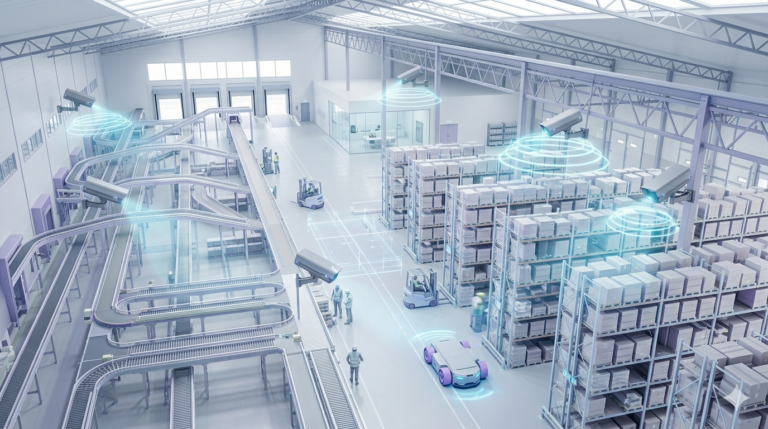
AI-powered CCTV video analytics monitors loading bay operations continuously. It detects thrown packages the moment they leave a conveyor, flags cold chain door violations the instant they exceed threshold, identifies loaders in non-operational positions, and alerts dock supervisors to vehicle positioning errors before they cause delays or damage.
The system does not simply record. It decides that something requires attention and delivers that alert immediately to the right person — before the damage claim is filed, not after.
Operations Blind Spot #4 — Forklift and Pedestrian Pathway Violations Before an Accident
Forklift accidents account for 85 fatalities and 34,900 serious injuries annually in warehouses, according to OSHA data. The vast majority involve forklifts and pedestrians sharing the same space — a problem that floor markings and manual supervision cannot fully prevent at the speed and scale modern warehouses operate.
AI video analytics provides the only scalable solution. The system tracks every forklift movement in real time, detects when a forklift enters a pedestrian corridor, flags workers crossing active forklift lanes, and identifies vehicles operating above permitted speeds. Each event triggers an immediate alert — not a weekly report, but a real-time notification delivered before the near-miss becomes a fatality.
Deployment outcome: AI-powered forklift and pathway compliance monitoring reduces forklift-related incidents by over 40%. Every flagged event is logged with video evidence — critical for insurance claims, HSE inspections, and internal safety audits.
Explore Warehouse and Manufacturing Video Analytics →
Operations Blind Spot #5 — Package Damage and Inventory Shrinkage at the Conveyor
Inventory shrinkage in logistics happens two ways: theft and damage. Both are persistent, both are measurable, and both are dramatically under-reported because the evidence disappears with the shift.
On conveyor belts processing thousands of packages per hour, AI-powered counting and anomaly detection provides real-time inventory accuracy that manual auditing can never match. Open or damaged packages are flagged as they move through the system. Count discrepancies between intake and dispatch are detected immediately. Suspicious handling behaviour — packages being set aside, items being pocketed — triggers an alert.
Intelligent video analytics running on your existing conveyor cameras delivers this continuously, with every anomaly timestamped and evidence-captured for claims processing and insurance documentation. For large-scale logistics operations, even a 1% reduction in monthly shrinkage can represent significant savings that justify the platform investment on its own.
Operations Blind Spot #6 — Security Perimeter Breaches That Look Like Noise
Traditional motion-based intrusion detection generates so many false positives — triggered by animals, weather, passing headlights — that security teams become desensitised. When a real intrusion happens, the alert is treated like noise. The response comes hours later, during footage review, after the threat has moved on.
AI security analytics uses object classification to distinguish between a person, a vehicle, and a tree moving in the wind. False positive rates drop below 5%. Security teams respond only to genuine events — and they respond faster because they trust the system.
The outcome: average response time to real security incidents drops from 45+ minutes (discovered during review) to under 3 minutes (detected and alerted in real time). For a warehouse storing high-value goods, that response window is the difference between stopping a theft and filing a police report after it.
AI Video Analytics vs. Traditional Warehouse Monitoring: A Direct Comparison
If your facility already has CCTV in place, here is what the upgrade to warehouse video analytics powered by AI actually means in practice:
| Capability | Traditional CCTV | AI Video Analytics |
|---|---|---|
| PPE detection | Manual review only | Real-time, every camera, every shift |
| Vehicle management | Manual log books | Automated ANPR + full audit trail |
| Forklift safety | Periodic spot checks | Continuous pathway and zone monitoring |
| Intrusion detection | High false positives (30–50%) | <5% false positive rate |
| Package damage detection | Discovered at claims stage | Flagged on conveyor in real time |
| New hardware required | Proprietary cameras and NVR | Works with any existing IP camera |
| Response time | Hours to days (footage review) | Under 3 minutes (real-time alert) |
| ROI timeline | 12–18 months | 3–6 months |
The Real-World ROI of Warehouse Video Analytics
The business case for deploying ai video analytics in logistics is built from measurable operational outcomes — not projections. Here is what companies consistently report after deployment:
📈 30% Operational Cost Reduction
Automated monitoring reduces the manual supervision headcount required across shifts, cutting overhead costs without compromising visibility.
🛡️ 40–60% Fewer Safety Incidents
Real-time PPE and pathway compliance enforcement prevents incidents before they occur — measurably reducing injury rates and insurance liability.
🚚 70% Faster Vehicle Processing
ANPR automation eliminates manual gate logging, reduces dock queue times, and produces a complete digital audit trail of every vehicle movement.
⏳ ROI Within 3–6 Months
Compared to 12–18 months for traditional security system upgrades. Savings from reduced shrinkage, fewer safety incidents, and dock efficiency typically outpace platform costs within the first quarter.
For a mid-sized logistics operation running 20+ cameras across 3–5 locations, these numbers are not aspirational — they are reported outcomes from real deployments. The compounding effect of simultaneous improvements across safety, operations, and security is what drives the short payback period.
What Agrex.ai Monitors in Your Warehouse and Distribution Centre
Agrex.ai connects to your existing IP cameras and NVRs via RTSP — no new hardware required. AI agents are deployed across your camera network and configured for your specific logistics use cases. Here is what the platform monitors out of the box:
PPE Compliance Monitoring
Detects missing helmets, hi-vis vests, gloves, and safety footwear in real time across all zones. Every violation logged with image evidence for audit trails.
ANPR Vehicle Management
Automatic plate recognition at all entry and exit points. Matches vehicles against authorised lists, logs all movements, and alerts on unauthorised access in real time.
Forklift and Pathway Safety
Tracks forklift movements against designated routes, detects pedestrian zone intrusions, and flags speeding vehicles before a near-miss occurs.
Loading Dock Operations
Monitors loading bays for thrown packages, open cold chain doors beyond threshold, loader absence from active bays, and incorrectly positioned trucks.
Conveyor and Package Analytics
AI-powered counting on conveyor belts, open or damaged package detection, and anomalous handling behaviour — all feeding directly into your WMS for reconciliation.
Perimeter and Intrusion Detection
Object classification distinguishes between people, vehicles, and environmental factors. Under 5% false positive rate. Real-time alerts to security teams within 30 seconds of a genuine intrusion.
What separates Agrex.ai from standard AI surveillance software is the agentic layer. The platform does not just detect events — it autonomously decides what action to take next. PPE violation detected? The system logs it, identifies the zone, sends the alert to the designated supervisor, and updates the compliance dashboard — all without human intervention, all within 30 seconds. Enterprise rollouts across 50+ warehouse locations in under 30 days, no new hardware required.
Your Warehouse Cameras Are Already Watching. It’s Time They Started Thinking.
See how Agrex.ai turns your existing CCTV infrastructure into an autonomous operations layer — live, on your own camera feed.
Stop Operating in the Dark
Your warehouses are not operating without cameras. They are operating without intelligence.
Every shift, every loading bay, every conveyor run, every forklift movement — the data is already there. The question is whether your operation has the capability to act on it in real time, or whether you are still discovering problems in a Monday morning review meeting after the window to intervene has long closed.
Warehouse video analytics built on AI video analytics infrastructure gives your operation the second set of eyes it has always needed — one that never sleeps, never misses a shift, and responds in seconds, not hours. The 6 blind spots above are costing your operation money right now. The only variable is how long you keep paying for them.
Connect with Agrex.ai → Transform Your Warehouse Operations