
The leap from traditional video surveillance to AI-based video analytics represents one of the most significant shifts in how businesses extract value from their physical spaces. While conventional analytics rely on simple rules — “alert when motion is detected in Zone A” — AI-based systems understand context, recognize patterns, and deliver insights that were impossible just a few years ago.
This guide explores how AI-based video analytics works, its real-world applications across major industries, the measurable benefits enterprises are achieving, and how to implement it in your organization.
What is AI-Based Video Analytics?
AI-based video analytics uses deep learning, computer vision, and neural network models to automatically understand and interpret video footage. Unlike rule-based analytics that follow predetermined triggers, AI systems learn from data — they recognize objects, understand behaviors, detect anomalies, and improve over time without manual reprogramming.
AI-Based vs. Traditional Video Analytics
| Capability | Traditional (Rule-Based) | AI-Based (Deep Learning) |
|---|---|---|
| Object Detection | Basic motion/pixel change | Specific object classification (person, vehicle, package) |
| Accuracy | 60-75% | 95-99% |
| False Alarms | High (triggered by shadows, rain) | 90% fewer false alarms |
| Adaptability | Fixed rules, manual updates | Self-learning, improves with data |
| Scene Understanding | None — pixel-level analysis only | Contextual — understands behaviors and patterns |
| Complex Events | Cannot detect | Fight detection, fall detection, crowd anomalies |
| Night Performance | Poor | Strong with IR-trained models |
| Capability | Traditional (Rule-Based) | AI-Based (Deep Learning) |
|---|---|---|
| Object Detection | Pre-defined rules | Deep learning auto-detection |
| Accuracy | 70-80% | 95%+ |
| False Alarms | High (30-40%) | Low (<5%) |
| Adaptability | Manual reconfiguration | Self-learning |
| Scene Understanding | None | Contextual awareness |
| Night Performance | Poor | High with IR/thermal |
Key AI Technologies Powering Video Analytics
Understanding the underlying technology helps evaluate vendors and set performance expectations. Here are the core AI technologies used in modern video analytics platforms:
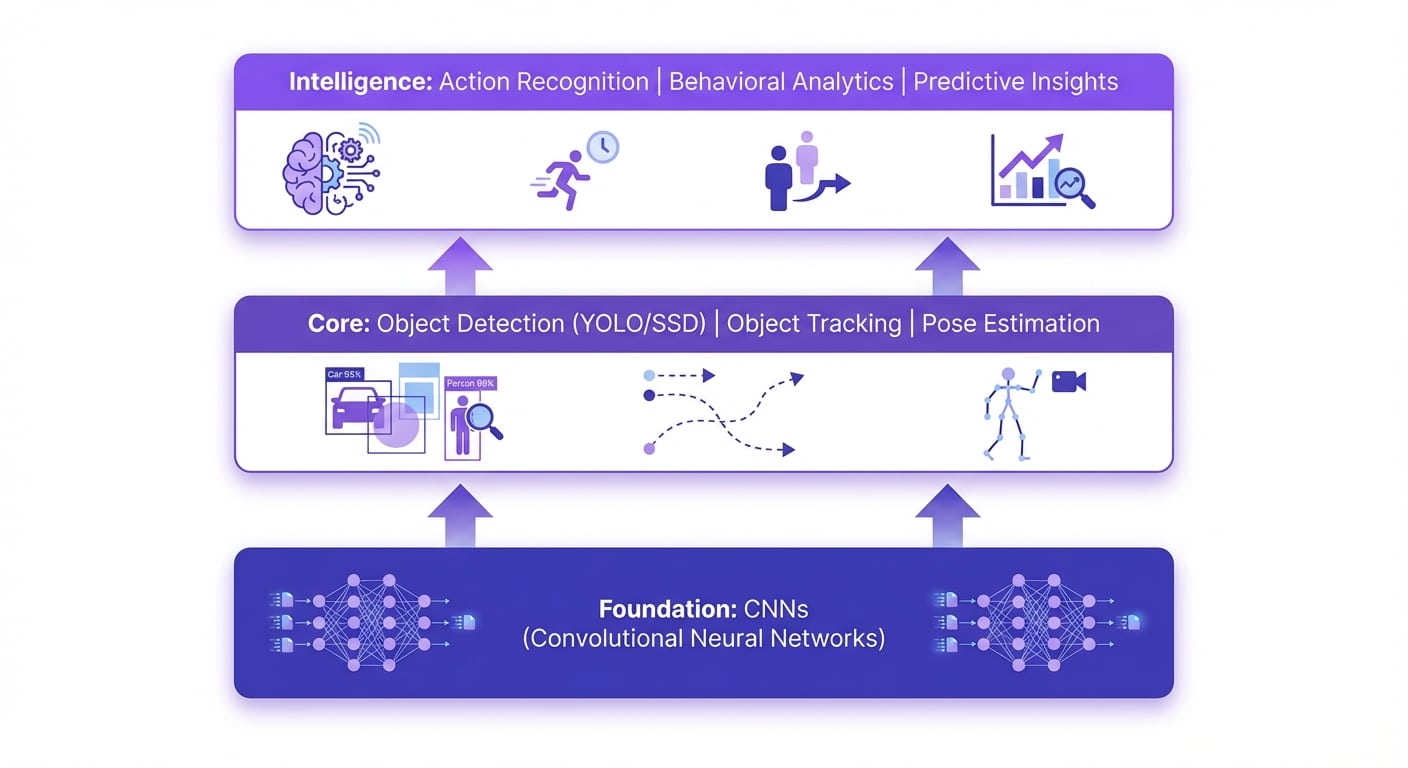
CNNs
Convolutional Neural Networks — Foundation for visual understanding
Object Detection (YOLO/SSD)
Real-time identification and localization
Object Tracking
Following individuals across frames
Pose Estimation
Human body keypoint detection
Action Recognition
Understanding activities and behaviors
Convolutional Neural Networks (CNNs)
CNNs are the backbone of visual recognition in video analytics. These deep learning architectures process image data through multiple layers, automatically learning to identify features — from simple edges and textures to complex objects and faces. Modern architectures like ResNet, EfficientNet, and Vision Transformers (ViT) achieve near-human accuracy in object classification.
Object Detection Models
Real-time object detection is handled by specialized architectures optimized for speed and accuracy:
- YOLO (You Only Look Once): The industry standard for real-time detection, processing frames in under 30 milliseconds. YOLOv8 and its successors offer excellent accuracy-speed tradeoffs.
- SSD (Single Shot Detector): An alternative offering good accuracy at high speeds, particularly effective for mobile and edge deployments.
- Faster R-CNN: Two-stage detector offering highest accuracy for scenarios where precision matters more than speed.
Object Tracking (DeepSORT & Beyond)
Once objects are detected, tracking algorithms follow them across frames and camera views. DeepSORT combines motion prediction with appearance features to maintain identity across occlusions and camera handoffs. This enables path analysis, dwell-time measurement, and cross-camera tracking.
Pose Estimation
AI models like OpenPose and MediaPipe estimate human body joint positions from video, enabling:
- Fall detection for elderly care and workplace safety
- Ergonomic analysis in manufacturing environments
- SOP compliance verification (correct lifting techniques, proper equipment usage)
- Fight and aggression detection based on body movement patterns
Action Recognition
Beyond detecting what objects are present, action recognition models understand what those objects are doing. Using temporal analysis across video frames, these models classify activities — walking, running, fighting, falling, loitering — enabling behavioral analytics that go far beyond simple presence detection.
Real-World Applications by Industry
AI-based video analytics delivers different but equally impactful value across industries. Here are specific applications with measurable outcomes:
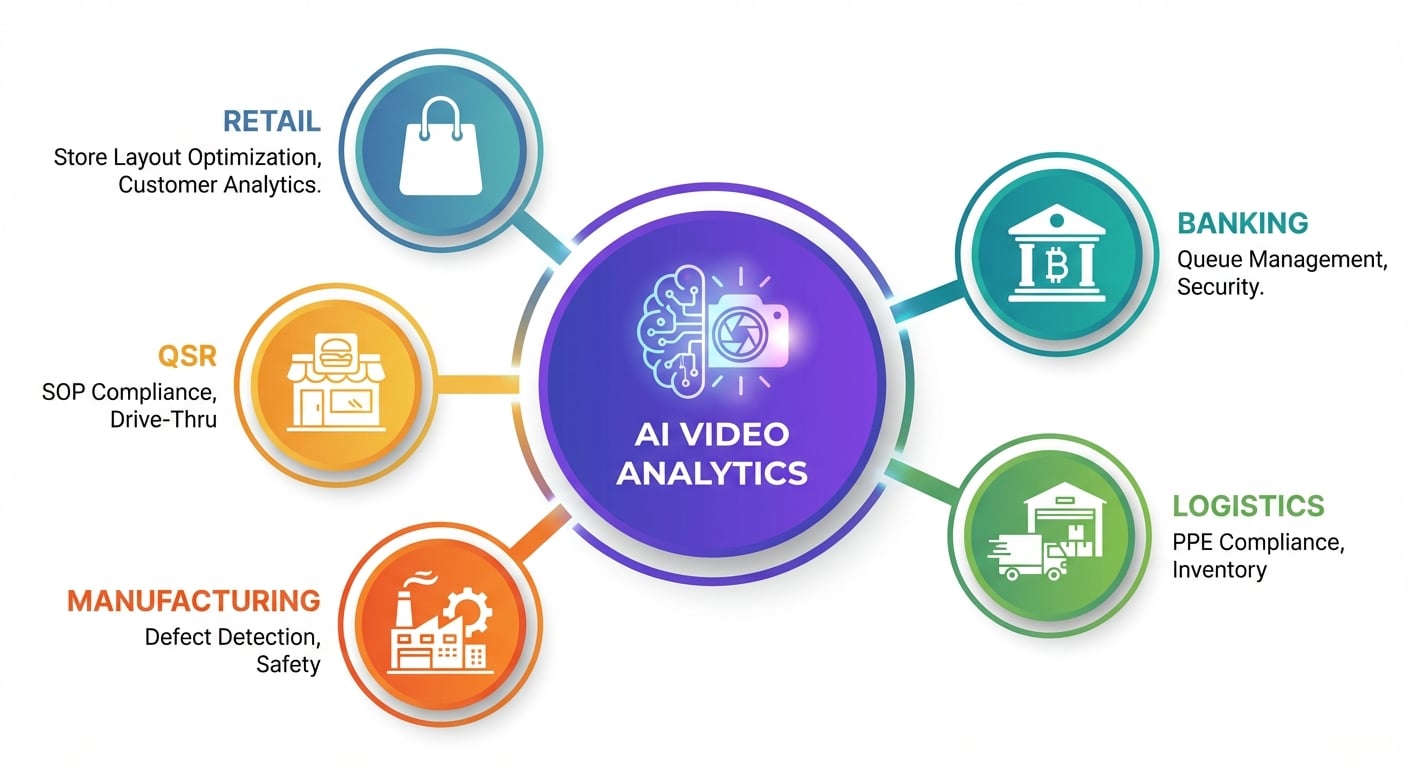
Retail
Customer flow analytics, heatmaps, and conversion optimization
Banking & Finance
Queue management, branch analytics, and security monitoring
Logistics & Warehousing
Safety monitoring, dock management, and inventory tracking
Manufacturing
Quality control, assembly verification, and safety compliance
QSR & Food Service
Drive-thru optimization, food safety, and staff productivity
Retail
Retail video analytics transforms stores from intuition-driven to data-driven operations:
- Customer Journey Mapping: Track how shoppers move through stores, which displays they engage with, and where they spend time. Retailers using this data report 12-18% improvements in store layout effectiveness.
- Queue Management: AI detects queue lengths in real time and triggers staff allocation alerts. One QSR chain reduced average wait times by 35% using queue analytics.
- Planogram Compliance: Verify product placement matches merchandising plans. Analytics detect empty shelves, misplaced products, and display compliance — improving on-shelf availability by 15-20%.
- Shrinkage Reduction: AI identifies suspicious behaviors (concealment, tag removal, sweethearting at POS) and alerts loss prevention teams in real time. Enterprise retailers report 25-40% shrinkage reduction.
- Demographic Analysis: Understand customer demographics (age group, gender) visiting at different times to optimize marketing, staffing, and product mix.
Banking & Finance
Banks use AI video analytics for both security and operational optimization:
- Branch Security: Real-time detection of tailgating through secure doors, unauthorized access to restricted areas, and suspicious loitering near ATMs
- Customer Flow Analysis: Optimize teller allocation and branch layout based on traffic patterns, reducing customer wait times by 20-30%
- Cash Handling Compliance: Monitor cash counting procedures, vault access protocols, and secure cash-in-transit handoffs
- VIP Recognition: Identify high-value customers for personalized service delivery
Logistics & Warehousing
Logistics video analytics addresses the unique challenges of warehouse and supply chain operations:
- Safety Compliance: PPE detection (hard hats, safety vests, goggles) with real-time alerts for violations. Warehouses report 65% improvement in PPE compliance rates.
- Loading Dock Monitoring: Track vehicle arrivals, loading/unloading durations, and dock utilization to optimize throughput
- Forklift Safety: Detect speeding, pedestrian proximity violations, and unsafe operation patterns
- Inventory Verification: Cross-reference visual counts with inventory management systems to catch discrepancies early
Manufacturing
Manufacturing video analytics enhances both quality and safety:
- Assembly Line Quality: Visual inspection of products for defects, with AI catching anomalies human inspectors miss — improving defect detection rates by 30-50%
- Worker Safety: Zone monitoring, machine proximity alerts, and ergonomic risk detection
- Production Counting: Automated counting of items on production lines with 99%+ accuracy, eliminating manual tallying errors
- Process Compliance: Ensure manufacturing steps are followed in correct sequence
QSR & Food Service
Quick-service restaurants use AI analytics for operational excellence:
- Kitchen SOP Compliance: Monitor handwashing frequency, glove usage, food temperature checks, and preparation procedures
- Drive-Through Optimization: Measure service times at each window position and identify bottlenecks
- Cleanliness Monitoring: Detect when dining areas, restrooms, or preparation surfaces need attention
- Customer Wait Time: Track queue lengths and alert managers when thresholds are exceeded
Measurable Benefits of AI-Based Video Analytics
Enterprises deploying AI-based video analytics report significant, quantifiable improvements across key metrics:
- 30% average efficiency gain in operations through automated monitoring and real-time alerts, eliminating manual oversight bottlenecks
- 15% average sales increase in retail environments through optimized store layouts, better product placement, and data-driven staffing
- 65% improvement in compliance rates for safety and SOP adherence, as continuous AI monitoring outperforms periodic human audits
- 40% reduction in security incidents through proactive threat detection and real-time intervention capabilities
- 6-12 month ROI payback for most enterprise deployments, with ongoing cost savings from reduced manual monitoring
- 80% reduction in video review time for forensic investigations through AI-powered search and filtering
These results come from real enterprise deployments. For instance, Agrex AI’s platform delivers these outcomes across 150,000+ cameras for 100+ enterprises in India and globally.
Implementation Guide: Getting Started with AI Video Analytics
Implementing AI-based video analytics follows a structured approach that minimizes risk and maximizes value:
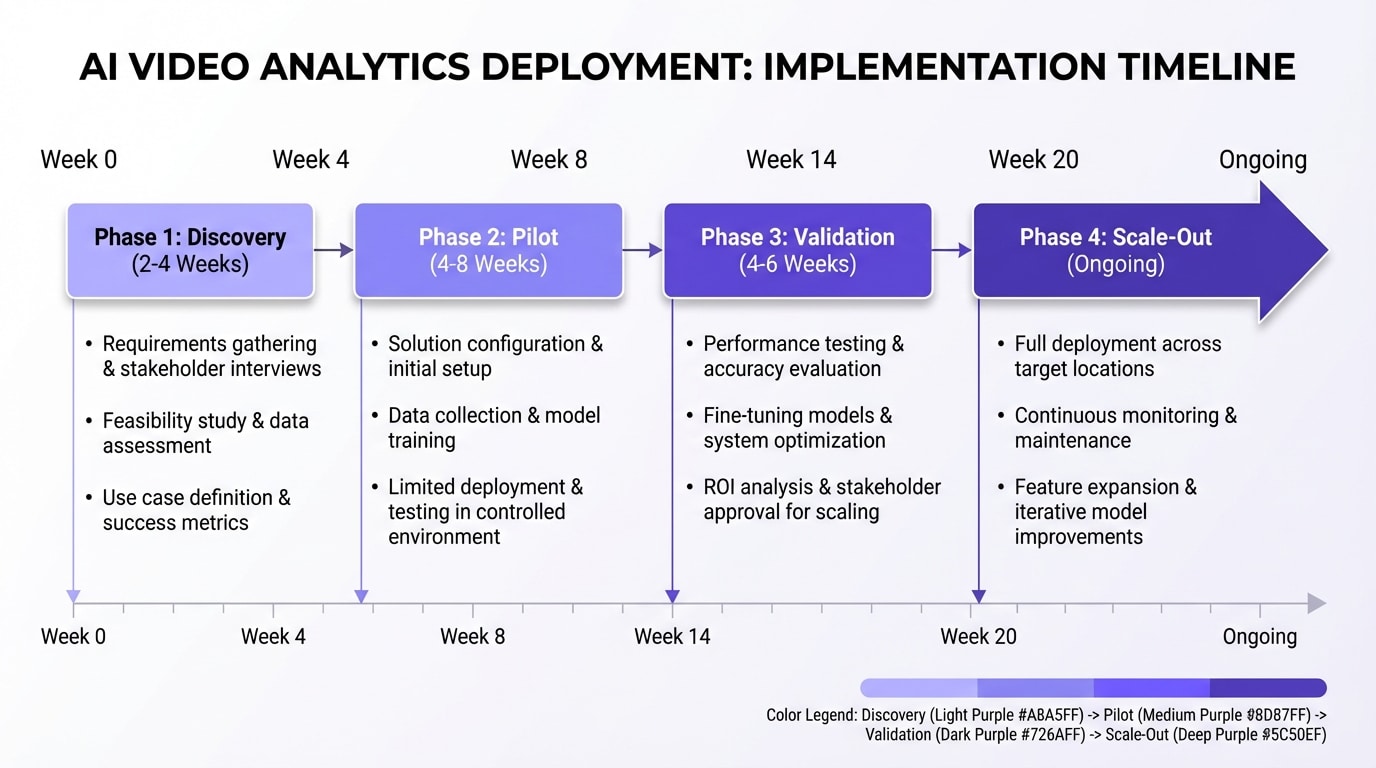
Discovery
2-4 weeksPilot
4-8 weeksValidation
4-6 weeksScale-Out
OngoingPhase 1: Discovery & Assessment (2-4 weeks)
- Infrastructure Audit: Inventory existing cameras, network bandwidth, and compute resources
- Use Case Prioritization: Identify the top 3-5 analytics use cases ranked by business impact and implementation feasibility
- Data Readiness: Assess camera angles, resolution, and lighting for AI model performance
- Integration Requirements: Map connections to existing systems (POS, ERP, access control, BMS)
Phase 2: Pilot Deployment (4-8 weeks)
- Site Selection: Choose 1-2 representative locations for the pilot
- Camera Onboarding: Connect 10-50 cameras to the analytics platform
- Model Configuration: Configure detection zones, alert thresholds, and business rules
- User Training: Train operators on dashboards, alerts, and reporting tools
- Baseline Measurement: Establish performance baselines for ROI calculation
Phase 3: Validation & Optimization (4-6 weeks)
- Accuracy Tuning: Refine models based on real-world performance data
- Alert Optimization: Reduce false positives and calibrate sensitivity thresholds
- ROI Validation: Measure actual improvements against baseline metrics
- User Feedback: Incorporate operational feedback into system configuration
Phase 4: Scale-Out (Ongoing)
- Expand Sites: Roll out to additional locations based on pilot results
- Add Use Cases: Enable additional analytics modules as the organization matures
- Continuous Improvement: Regular model updates and performance optimization
Future Trends in AI Video Analytics
The AI video analytics field is advancing rapidly. Key trends to watch include:
- Agentic AI: Moving beyond detection to autonomous AI agents that understand context, make decisions, and take actions — pioneered by platforms like Agrex AI
- Multimodal Analytics: Combining video with audio, IoT sensors, and transaction data for richer contextual understanding
- Foundation Models: Large vision models pre-trained on massive datasets, enabling faster deployment with less domain-specific training data
- Privacy-Preserving AI: Federated learning and on-device processing that extract insights without exposing raw video data
- Generative AI for Video: Using generative models to simulate scenarios for training, create synthetic data for edge cases, and generate natural language summaries of video events
According to Fortune Business Insights, the global video analytics market is projected to reach $25.6 billion by 2032, growing at a 21.5% CAGR as AI capabilities continue to advance.
According to NIST (National Institute of Standards and Technology), the latest Face Recognition Vendor Test shows top AI models achieving over 99.7% accuracy in controlled conditions, a dramatic improvement from 96% just five years ago — demonstrating the rapid advancement of AI-based visual analysis.
The AI video analytics market is projected to reach $25.6 billion by 2032, growing at a 21.5% CAGR. The shift toward Agentic AI — where video analytics systems can autonomously reason, decide, and act — is accelerating enterprise adoption across industries.
Get Started with AI-Based Video Analytics
Whether you are managing 10 cameras or 10,000, AI-based video analytics transforms your existing infrastructure into an intelligent system that delivers real business value. Agrex AI’s Agentic AI platform is already powering analytics for 150,000+ cameras across retail, banking, logistics, manufacturing, and QSR enterprises.
Book a Free Demo — See AI Video Analytics in Action →
Frequently Asked Questions
What is the difference between AI-based and rule-based video analytics?
Rule-based analytics use predefined triggers like motion detection in zones and rely on simple pixel-level analysis. AI-based analytics use deep learning models that understand objects, behaviors, and context — detecting specific events like fights, falls, or SOP violations with 95%+ accuracy while reducing false alarms by 90%.
How much does AI video analytics cost?
Cloud-based AI video analytics typically costs ₹500-2,000 per camera per month in India, depending on the analytics modules selected. Edge deployments may have higher upfront hardware costs but lower recurring fees. Most enterprises achieve positive ROI within 6-12 months through reduced monitoring costs and operational improvements.
Can AI video analytics work in real time?
Yes. Modern AI models like YOLO process video frames in under 30 milliseconds, enabling real-time detection and alerts. The end-to-end latency from event detection to alert delivery is typically 1-5 seconds, depending on the deployment architecture (edge vs. cloud) and network conditions.
Do I need special cameras for AI video analytics?
No. AI video analytics platforms like Agrex AI work with any standard IP camera of 1MP resolution or higher. You do not need specialized AI cameras — the intelligence comes from the software, not the hardware. Even analog cameras can be connected through IP encoders.
How is data privacy handled with AI video analytics?
Responsible AI video analytics platforms implement multiple privacy safeguards: face blurring and anonymization, role-based access controls, encrypted data transmission and storage, configurable data retention policies, and compliance with regulations like India’s DPDPA 2023. The best platforms allow you to extract business insights without storing identifiable personal data.