An alert fired. Nobody saw it.
This is the most common failure point in enterprise security today — and it has nothing to do with camera quality, sensor sensitivity, or detection accuracy. The camera saw what it was supposed to see. The system sent the alert it was supposed to send. And somewhere between the alert and the response, the loop broke open.
The incident happened anyway.
This is the problem that agentic AI is built to fix — not better detection, but a closed loop from detection all the way to action. In this post, we break down exactly how that loop works, where traditional video monitoring systems leave it open, and what it looks like when agentic AI closes it in real time.
Why Most Alerts Don’t Lead to Action
Before getting into the solution, it’s worth being specific about the failure.
A traditional ai video analytics setup works like this: a rule is triggered, an alert is generated, a notification is sent, and a human is expected to receive it, read it, assess it, and act on it — in that order, manually, within a meaningful time window.
Every one of those handoffs is a place where the loop can break.
- The alert arrives during shift change
- The notification goes to the wrong contact
- The operator is managing three other incidents
- The alert is one of forty that came in the last hour, and alert fatigue has set in
- No one logged what happened, so the next incident is handled from scratch again
This isn’t a people problem. It’s a system design problem. The system was designed to detect and notify — not to act, not to route, not to escalate, not to close.
The result: organisations investing in sophisticated camera infrastructure end up with a glorified recording system. The detection capability is there. The operational outcome isn’t.
What “Closing the Loop” Actually Means
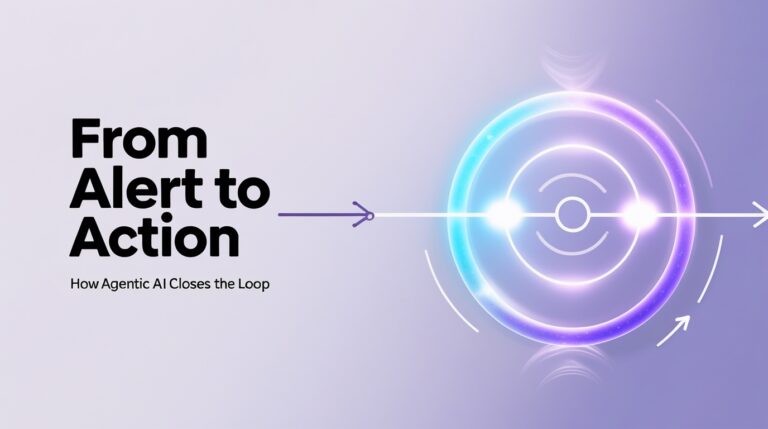
A closed loop in real-time video monitoring means the system doesn’t stop at detection. It handles what comes next.
Specifically, a closed loop covers five stages — from the moment something is detected to the moment it’s handled, logged, and resolved:
Step 1 — Detect
The system identifies an event. A person in a restricted zone. A queue exceeding threshold. A vehicle overdue at a loading dock. This is where most systems stop.
Step 2 — Contextualise
The system cross-references the event against relevant data: time of day, zone access rules, alert history, staffing levels, escalation policies. Detection without context generates noise. Context turns a signal into an actionable incident.
Step 3 — Decide
Based on context, the system determines the appropriate response. Does this need a floor supervisor or a security lead? First occurrence or repeat pattern? Agentic AI makes this decision in milliseconds — not minutes.
Step 4 — Act
The system executes the response — sending the right alert, to the right person, with the right information (clip, timestamp, zone, recommended action) — without waiting for a human to assemble it.
Step 5 — Escalate & Log
If no acknowledgement is received within the defined window, the system escalates automatically. Every action is timestamped, logged, and retrievable — creating an audit trail that manual security incident management processes can’t match.
Detection triggered an outcome — automatically, consistently, without a human bridging every step.
Where Traditional Systems Leave the Loop Open
The gap between steps 1 and 5 is where traditional video monitoring systems consistently fall short.
Most enterprise CCTV setups — even those running basic video analytics — are designed around the assumption that a human will bridge the gap. The system detects. The human decides. The human acts. The human (maybe) logs it.
This model has three structural weaknesses:
Inconsistency — Human response varies based on attention, workload, shift, and experience. The same incident handled by two different operators may produce two completely different outcomes.
Latency — Every manual handoff adds time. In high-risk environments — manufacturing floors, warehouse loading docks, after-hours retail — that latency directly translates into operational exposure.
No institutional memory — Without automated logging, incidents aren’t systematically captured. Patterns aren’t identified. The same failure modes recur because no one connected the dots.
Agentic AI removes human dependency from the steps that don’t require human judgment — detection, routing, escalation, logging — while keeping humans in the loop for decisions that genuinely need them.
The Closed Loop in Practice: Industry Examples
Security Operations
In a multi-site security environment, an agentic ai video analytics system running across facilities doesn’t just flag perimeter breaches — it routes them. The right guard at the right location receives a pre-assembled incident report: the clip, the zone, the timestamp, the recommended action. If no acknowledgement within two minutes, it escalates to the shift supervisor automatically.
→ See how Agrex AI’s security video analytics handles multi-site incident routing.
Manufacturing
On a production floor, PPE non-compliance events are detected by the video monitoring system, cross-referenced against shift schedules and zone assignments, and routed directly to the line supervisor with a timestamped clip. The incident is logged automatically in the compliance record — ready for audit without any manual entry.
→ Explore how SOP compliance monitoring works in manufacturing environments.
Logistics & Warehousing
Vehicle turnaround deviation at a loading dock triggers an alert that goes directly to the operations lead — with the relevant vehicle data, entry time, expected departure, and deviation threshold already assembled. No one needs to pull footage. No one needs to cross-reference the schedule manually. The system did it.
→ See how logistics video analytics handles fleet and dock operations.
Retail
Queue alerts in retail are only useful if someone acts on them before customers leave. An agentic system detects queue buildup, cross-references staffing availability, and notifies the floor manager in real time — not via a dashboard that someone needs to be actively monitoring, but via a direct, contextualised alert that demands a response.
→ Learn more about retail video analytics for multi-store operations.
What Closed-Loop Security Incident Management Looks Like at Scale
For organisations managing 10, 50, or 500 locations, the compounding effect of closed-loop security incident management is significant.
Every open loop — every alert that fired but wasn’t acted on, every incident that wasn’t logged, every escalation that didn’t happen — represents a gap in operational accountability. At scale, those gaps accumulate into measurable risk: shrinkage, compliance failures, safety incidents, and audit exposure.
Closed-loop agentic AI doesn’t just reduce response times. It creates a system where every incident, at every location, is handled consistently — regardless of who’s on shift, how busy the control room is, or how experienced the operator is.
That consistency is the operational value. Not the technology — the outcome the technology produces.
The Bottom Line
Alerts without action aren’t surveillance. They’re liability.
The organisations getting real operational value from their camera infrastructure in 2026 aren’t the ones with the most cameras or the highest resolution feeds. They’re the ones whose systems close the loop — from the moment something is detected to the moment it’s handled, logged, and resolved.
That’s what agentic real-time video monitoring delivers. And it works on your existing camera infrastructure — no hardware replacement required.
If you want to see what a closed-loop system looks like in practice across your facilities, talk to the Agrex AI team.
Frequently Asked Questions
What does “closing the loop” mean in video monitoring?
It means the system handles the full incident workflow — from detection to routing, escalation, and logging — without relying on a human to manually bridge each step. Detection triggers an outcome, not just a notification.
How does agentic AI improve security incident management?
Agentic AI automates the decision and routing steps that traditionally require human involvement. The right person receives the right alert with the right context — and if they don’t respond, the system escalates automatically. Every incident is logged without manual entry.
Can agentic AI work with an existing video monitoring system?
Yes. Agentic AI layers on top of existing camera infrastructure. No hardware replacement is needed — the intelligence is added at the software layer, connecting to your current feeds and routing alerts through your existing communication channels.
What is the difference between a real-time alert and a closed-loop response?
A real-time alert tells someone something happened. A closed-loop response tells the right person what happened, routes it appropriately, escalates if needed, and logs the outcome — automatically.
How quickly does agentic AI close the loop after detection?
Routing and notification happen in seconds after detection. Escalation timers are configurable — most clients set a 2–5 minute window before automatic escalation to the next level.